8 hours ago
Students Block Belgrade
Periskopi(a year ago)
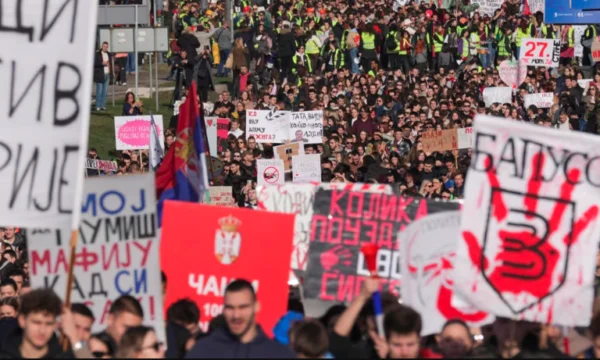
(a year ago)Serbia's university students began a 24-hour blockade of a substantial traffic intersection in Belgrade on Monday, adding pressure on authorities over a deadly collapse of a roof at a train station in November that left behind 15 people dead. Serbian farmers with tractors and thousands of citizens joined the blockade [...]
Serbia's university students began a 24-hour blockade of a substantial traffic intersection in Belgrade on Monday, adding pressure on authorities over a deadly collapse of a roof at a train station in November that left behind 15 people dead.
Serbian tractor farmers and thousands of citizens joined the blockade that followed the long-week protests in which it calls for responsibility for the deadly accident in the northern city of Novi Sad, which critics blame for the government's rampant corruption.
The street demonstrations campaign presents the biggest challenge in years to the population's strong control over power in Serbia.
Serbia's president, Aleksandar Vucic, Prime Minister Milos Vucevic and Parliament Speaker Ana Brnabic, warned that they would later announce key decisions Monday “for the situation, but did not immediately make clear what decisions could be.
President Vucic has faced charges of curbing democratic freedoms despite formally demanding Serbia's membership in the European Union. He has accused students of working for foreign powers to bring down the government, but without giving evidence and without even equivocating what powers it is about.
Several incidents have covered street protests in recent weeks, including two incidents in which drivers crashed cars with the crowd, wounding two young girls.
Road police secured the student blockade Monday to avoid any similar incidents. Protesters set up tents at the site of the protest, which is an important intersection.
Some students played volleyball, others sat on blankets on the sidewalk, or walked on a warm day. Students also held a 15-minute memorial silence at 11:52, just as the roof at a train station in Novi Sad collapsed on 1 November.
Many in Serbia believe the large concrete roof collapsed due to irregular reconstruction work, the consequence of corruption.
Prosecutors in Serbia have pressed charges against 13 people, including a government minister and several state officials. But former construction minister Goran Vesic has been released from custody, prompting doubts about independence and the investigation.
The main railway station in Novi Sad was renovated twice in recent years as part of a broader infrastructure agreement with Chinese state companies. / VOA