9 hours ago
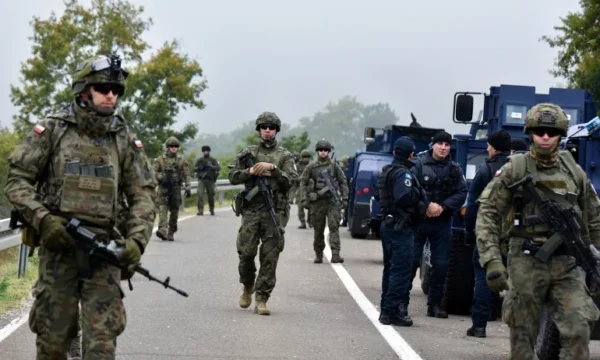
NATO Assembly: Presence of forces in Kosovo can still be reinforced in light of events' development
Periskopi(a year ago)
(a year ago)Numerous risks are warned in Kosovo and Bosnia and Herzegovina if there is no added commitment by the European Union and NATO, a NATO Parliamentary Assembly report said. The lack of normalisation of relations between Kosovo and Serbia is cited as the most challenging issue for the Western Balkan region. For this, NATO has been called and [...]
Numerous risks are warned in Kosovo and Bosnia and Herzegovina if there is no added commitment by the European Union and NATO, a NATO Parliamentary Assembly report said. The lack of normalisation of relations between Kosovo and Serbia is cited as the most challenging issue for the Western Balkan region.
For this, NATO and the EU have been called on to exert pressure on Kosovo, Serbia for implementation of the Ohrid Basic and Annex Agreement
Incidents in northern Kosovo are alarm bells for the international community in terms of the seriousness of continued challenges in the Western Balkans, the NATO Parliamentary Assembly end-of-year report found.
The author of this document, the lord from Great Britain, Mark Lancaster, highlights the current causes and drivers of key security challenges.
Kosovo along with Bosnia and Herzegovina is seen as countries with high potential violence due to interethnic issues and reports with Serbia.
“Viti 2023 testified to a considerable return of violent confrontations in northern Kosovo. The incidents sounded as an alarm call to the international community for the seriousness of continuing challenges in the Western Balkans. In the region where almost all states and territories are looking for a Euro-Atlantic future, unresolved issues in both Kosovo and Bosnia and Herzegovina must re-launch the important attention of allies: Allies must agree with the potential for broader destabilisation that presents these challenges”, writes in the report titled “Western Balkans: General security challenges on the NATO threshold”, KOHA reports.
The lack of steps towards normalising relations between Belgrade and Pristina is considered the region's most challenging and unstable issue.
“It has many immediate significant impacts: it prevents both countries from advancing their EU membership processes, is an important factor in regional instability, an obstacle to closer and more effective regional economic co-operation, and a contributor to power vacuums that enable criminal networks to exploit the region as roads, the arena, and the area for arms trafficking, drugs and people”, the report says.
According to the document, at the heart of the Kosovo- Serbia is two key issues: Kosovo's non-recognition by Serbia, as well as the approach of the Kosovo government to Serb-populated northern municipalities.
Referring to the risks, it is also recommended that NATO consider adding troops to Kosovo and Bosnia and Herzegovina.
The presence of NATO forces in Kosovo can still be reinforced given the development of field and region events: Allies and the EU can work together to ensure more suitable forces for their goals in Kosovo and Bosnia and Herzegovina. Allies' attention to Kosovo cannot be ignored. The priority has potentially more forces, positioned properly. KFOR's operation has an important role, which extends beyond curbing violence, as it also serves as a channel for positive contact and confidence building with all communities in Kosovo and Serbia”, writes in the report.