8 hours ago
The former director of the Trepca mine recalls the protest of justly89: I thought we were all dying.
Periskopi(a year ago)
(a year ago)Burhan Kavaja had taken office as director of the thermo-communation mine “Trepca” in Stantrg in 1988. Just a year later, the engineer and his colleagues organised one of the biggest miners' strikes in modern European history strike on Trepca miners' hunger. This strike, from many mentioned [...]
Burhan Kavaja had taken office as director of the thermo-communation mine “Trepca” in Stantrg in 1988. Just a year later, the engineer and his colleagues organised one of the biggest miners' strikes in modern European history strike on Trepca miners' hunger. This strike, since many are named as the beginning of the end of Kosovo under Serbia's regime, is documented in Reporting House, which Kavaja visited Wednesday, returning to personal memories.
All visitors indiscriminately leave Reporting House with their impressions. But there are some impressed visitors. These are not only visitors, but protagonists and contributors to the 1989-1999 resistance, which is recorded at the “Exporting House/house of Journalists”.
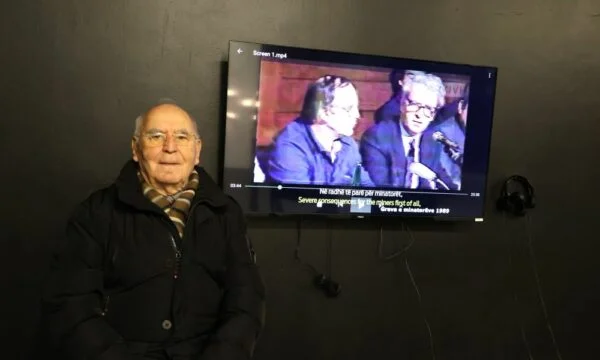
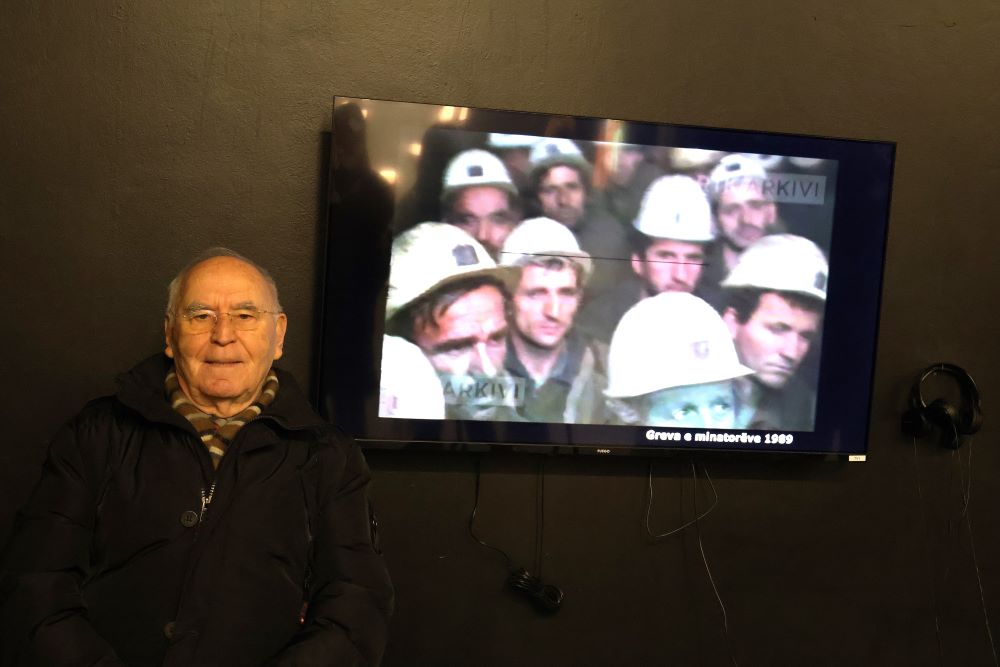
Such is Burhan Kavaja, the man in his eightties who entered the first floor of the former target “Grmia” in Skenderbeu Square in Pristina, where there is Reporting House, stopped in front of the first screen on which the shots are shown by the 1989 Trepca miners' strikes in Mitrovica.
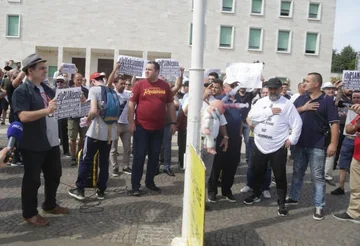
Cavaya started naming his colleagues, and explaining to each of them what he was doing back then, until at one point he says: “This is me”, as he waved towards a man dressed in Trepca uniform and seated at the conference table talking to the media about the rights requirements of Albanians in the former Yugoslavia of the striking miners.
This protest, Kavaja had spoken, was held a month before the assessment of Kosovo's autonomy as the Autonomous Wing under Yugoslavia, the status Kosovo enjoyed until 23 March 1989.
In 1988 Burhan Kavaja, a graduate engineer at the Faculty of Engineering and Xehetaria at the University of Belgrade, was appointed director of the mine with the flotilla “Trepca” in Stantrg. Just a year after taking office, he faced one of the biggest challenges remembering the hunger strike of Trepca miners, as co-organising and responsible for the thousands of miners who went on strike.
This strike, initiated by Trepca Mines employees on February 20th 1989, was a protest requiring worthy representation of Albanians in the Yugoslav Parliament, Albanians who were not elected by Milosevic, but those who would choose the people of Kosovo. The protest called for the resignation of Albanian deputies who were seen as Milosevic's party puppets at the time.
The protest differed from others because it was hunger strike and prevented Trepca's production from affecting the economy of all Yugoslavia, not just Kosovo. The miners knew that the Croatian and Slovenian press would more independently cover the event and therefore hoped that in other republics of the former Yugoslavia, Albanians' rights in this state would be talked about.
The most difficult moment, or biggest challenge, has been how to keep the miners alive, intact and without sacrifice”, Kava recalls.
While Serbia's National Assembly was preparing constitutional changes that would have formalised the removal of Kosovo's autonomy, over 1,300 Trepca miners began their hunger strike for eight days, with the request to preserve autonomous status and the resignation of three Albanian politicians appointed by Slobodan Milosevic in Kosovo. After about a week, the miners ' first exit was accomplished, and nearly 180 miners had been admitted to the hospital. While on the evening of February 27, 1989, Nundman Morina, Ali Shukriu and Husamedin Azemi, the leaders of the pro-Milosqi faction in Kosovo, resigned. In late hours of the evening, Yugoslavia's presidency met and placed “particular measures for Kosovo, which in fact set an unlimited state that implied the removal of additional police that came from Belgrade, the expulsion of Albanian civil servants from work, and the exclusion of students and students from schools and faculties. Fifty hornets were barricaded inside the “mine Stanterrg”, about 1,000 meters deep in the earth.
And then the ventilation well was totally on ice. They had to confront the ice crews and beat their way out of 1,000 meters underground where the miners were, so to speak. It was a major event for me and I can tell that there was mental and physical trauma, because it's been very difficult with the realist”, Cavaya confessed, while staying at Reporting House/age of Journalists on January 15th of this year, pointing away that he never believed they would leave the mine alive.
Knowing that we've had 400 pounds of explosives there, I thought we were all dead. However, after 36 years of living today, he says with a light smile, until he gave a message to the younger generations.
I don't think they have much knowledge of the sacrifices that we've made, that they're now educated and well-educated and educated and then family. I think very little is being read about history and few are informed of our difficult past”, he said.
It hasn't been easy, in the years of '45, we've had about 7-8 intellectuals, and in '77 and '78, that number has increased to 70 thousand. So then the leader did his best to teach the people, the educated, that then today's” professionals, Kava recalled by assessing the record of generation resistance, of Kosovo freedom, in Reporting House.
Modestly, accept the sacrifice, and have a message for “bayratarism”.
We had less success than we had. The miners' strike is the biggest strike in the world. Eight days and eight nights [at strike] on political issues. The miners' strikes are usually social, but these were political cigar strikes, and for freedom”, Burhan Kavaja said.
Burhan Kavaja was born in Mitrovica on May 9, 1943. A graduate of Xehetari Engineering at the University of Belgrade. Meanwhile, in 1970 he worked as deputy secretary of the District Secretariat for Economics. From 1990 to 1994, he was chairman of the Executive Council of the Independent Union of Trade Unions of Kosovo. Kavaja has also been deputy in the Kosovo Parliament and chairman of the Parliamentary Commission for Energy, Natural Resources and Industry.
He and his friends visited Reporting House on January 15, 2025.