5 minutes ago
Is the registration of the Bosnian community at risk with the wrong termiology?
Periskopi(2 years ago)
(2 years ago)The Bosnian community in Kosovo shows fears that its number could be reduced due to irregularities recorded during the population registration process, which started April 5th and will continue until May 17th, writes Radio Free Europe. These irregularities refer to the question in the Serbian language questionnaire: “Which group [...]
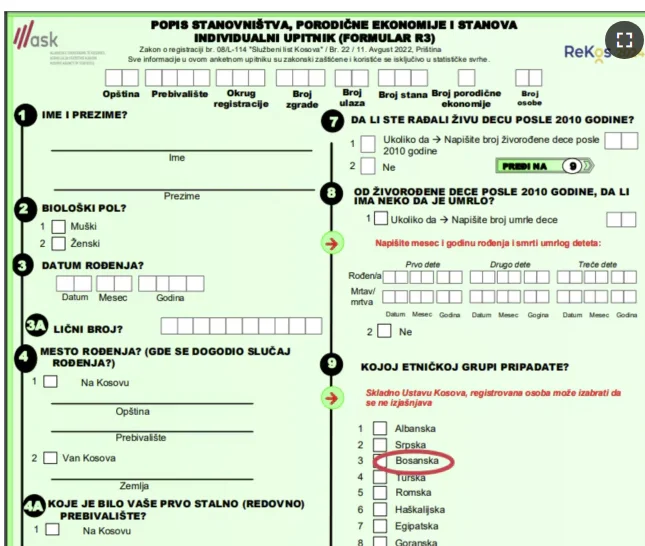
These irregularities refer to the question in the Serbian language questionnaire: “which ethnic groups belong to”, in which one of the answers is “bosanac” instead of the Bosnian “”.
Bosniaks are one of the minority communities familiar with the Constitution in Kosovo, while the term “bosanac” refers to someone living on the territory of Bosnia and Herzegovina.
Questionaries are available in two official languages: Albanian and Serbian.
Fahret Sijaric, a member of the Bosniak community from Peja, tells Radio Free Europe that the recorders went to him three days ago to conduct the census, and that they had interrogators in Albanian.
Having failed to understand some questions, he asked a Serbian-language questionnaire.
However, on the Serbian-language form, it found ébosanac% as an option of ethnic affiliation and I did not want to continue”, Sijaric says.
He shows that some family members and his neighbour refused to register, precisely because of this error in Serbian-language questionnaires.
This recording looks like a football tournament. Come on, let's play, sign, and say hi-ho-x1...
Journalist Mustafa Bale, who comes from the Bosniak community and follows the census in Kosovo, tells Radio Free Europe that some Bosniaks -- “from revolt” -- have told the recorders to mark the other “option”.
In these cases, according to him, Bosnians register as other minority communities in Kosovo, which are not familiar with the Constitutions.
The minority communities, familiar with the Kosovo Constitution, are Serbs, Bosniaks, Roma, Ashkali, Egyptians, Gorani and Turks. They have certain rights, such as guaranteed countries in the Kosovo Assembly or the right to education, language use, culture cultivation, religion and tradition.
Kosovo Deputy Prime Minister for Minority and Human Rights Issues Emillija Rexhepi, in a statement for The REL has said it has reacted urgently to these irregularities, and that the error has been corrected in Prizren and in the part of Dragas, where the Bosniak community lives.
According to her, the term “bosanac” in these municipalities has been replaced with the term “Bosniak “” only in electronic questionnaires, which recorders use in their Serbian language tablets.
“I have made a warning to Peja and Istog, it has been corrected in several places, but not everywhere where Bosniaks are majority”, Rexhepi said.
The REL provided photographs of this irregularities in the registration tablets, which were subsequently corrected on April 17th in areas where Bosniaks live.
However, Mustafa Bale says the error on the tablets using the recorders has only been corrected in Prizren, while in other municipalities where members of the Bosniak community live like Dragashi and Peja CHA recorders still have the option “bosanac” as the option for ethnic affiliation.
On April 24th, the nongovernmental Council of the Congress of Bosnian Intellectuals of Kosovo announced the Kosovo Statistics Agency (ASK) that the error has not been corrected in Dragash or Pec.
Some citizens are turning back to the recorders, because they do not have national affiliation”, says the letter of this organisation to the AKS, which was signed by Meedin Saliji from Prizren.
The organisation asked the AK to correct the error immediately, so that “registration would make sense and all citizens would express themselves the way they feel”.
REL asked the AKS about these irregularities, but until the publication of this article, there was no response.
“Brolling and catastrophic consequences”
Maydin Salij says members of the nongovernmental organisation Council of the Kosovo Bosnian Intellectual Congress are constantly on the ground and that they monitor population registration.
According to him, they have information that the error regarding Bosniaks' ethnic affiliation has not been corrected everywhere.
He adds that, in this case, public debates have been held in Prizren and Pec and that they have received information that some recorders from the Bosnian community have refused to make the census until the error in the questionnaire is corrected.
It's probably a problem about language [v.j. Translation] but that means a lot for us Bosniaks, because it could happen when the data is updated, that the two communities will figure out -- Bosniaks and Bosniaks”, Salij says.
He also says there are a number of Bosniaks who refuse to sign up and that this has “catastrophic consequences” for the community.
According to the latest 2011 population census, some 27,000 Bosniaks live in Kosovo.
But, journalist Mustafa Bale says the census in northern Kosovo was not done then and that, according to some estimates, there are about 30,000 members of the Bosniak community.
He believes the census in areas where Bosniaks live should be repeated or extended because, he says, the process has been delayed because of mistakes in the questionnaire.
On the contrary, Bale says, the collective rights of this community are at stake.
This will affect guaranteed rights, in the right to use language, in the right to hold teaching in Bosnian”, he says.
Bale and Salij also say that a large number of members of the Bosniak community live in the diaspora and that neither have they been enabled to declare their ethnic affiliation.
Kosovo's Statistics Agency has enabled the registration of family living outside Kosovo, but there is no possibility that anyone will declare which ethnic group belongs.
What do Bosnian political representatives say?
Deputy Prime Minister Emillija Rexhepi, from the ranks of the New Democratic Party (NDS), part of the Government and the Assembly of Kosovo, says the Bosniak community has been urged not to respond to the census until mistakes are corrected, while announcing that there is information that a large number of members of this community have registered in the last two or three days.
According to its assessment, delays in the Bosniak community's census will not affect the final outcome, because, as she says, the process lasts until May 17th and has time for all to register.
We're a small community, registration can be completed in a week... I am personally satisfied with our people's response, we have all been activated, all political subjects, nongovernmental sector, media”, Rexhepi says.
Creim Bajrami from the Vacat coalition a Bosniak political subject that is represented in some local but central Kosovo institutions has said that the subject of terminology has caused revolt among the Bosniak community, and that many of its members are now refusing to register.
The important thing is that here [in Prizren] the mayor has reacted, which is a good thing. He has asked the registration commission to correct mistakes, but those corrections have lasted a week. The census has not begun until corrections have been made, but only in Prizren municipality. In Dragash, the mistake regarding the Bosnian-bosanac term has only partially been corrected. The same is true in the Pec municipality and in other municipalities in Kosovo”, Bajrami says.
He adds that they have talked to Kosovo Statistics Agency Director Avni Kastrati, and that all those registered as “bosanac” will eventually be registered as “Bosniak”).
However, Bajrami stresses that this issue has triggered revolt among members of the Bosniak community and that many now refuse to register.
Other Language Errors
In Serbian - language questionnaires, apart from actual ones, there are numerous linguistic errors that make questions incomprehensible.
For example, one of the questions about the marital situation is said to be <x0 years old/marqued by” and “burr/married uncrown”.
Deputy Prime Minister Rexhepi believes a series of institutions have failed to prepare the Serbian-language census questionnaire, including the main body responsible for organising the entire process, the Kosovo Statistics Agency.
In Kosovo, Albanian and Serbian are official, which means institutions are obliged to ensure the equal use of these languages.
Languages of other minority communities are also used at the local level in certain municipalities, where they live.
However, the Office of the Language Commissioner, which operates under the Cabinet of Kosovo Prime Minister, often shows that minority communities' rights are violated when it comes to using languages.