8 hours ago
Munter: US to No More Traditional Access to Kosovo, Serbia
Periskopi(a year ago)
(a year ago)Former American diplomat Cameron Munter says negotiations between Kosovo and Serbia on normalising relations cannot continue without changing anything, “if we don't want to spend another 15 years waiting for”. He believes Donald Trump's return to the White House will definitely impose a change of strategy, as, as he says, [...]
He believes Donald Trump's return to the White House will necessarily impose a change of strategy, as, he says, Trump wants agreement.
His position is not to bring Serbs and Kosovars into the European Union. His aim is to do his best for the United States, to make America once again magnificent”, Munter says in an interview given Radio Free Europe.
According to him, Kosovo Prime Minister Albin Kurti has advantages and disadvantages in relation to the elected president, while Serbia's president, Aleksandar Vuciq, has worked on establishing personal ties with people of his administration.
Radio Free Europe: Mr. Munter, Kosovo and Serbia are engaged in negotiations for normalising relations for nearly 14 years, but the ultimate goal remains far apart. If a person was to be held accountable for this situation, who do you believe would be?
Cameron Munter: I'm not a big fan of finding the guilty. I'm a fan of finding a solution. So I want to do some assessments about what went wrong and what might have gone well.
I think the focus was on small things, in detail whether those car plates or documents... These, of course, are important in everyday life. But I have the feeling that the range should be expanded and that it should not only be addressed as the issue of Kosovo and Serbia. Because, throughout the Western Balkans, there are very big issues and the more we get into detail, the less progress we make.
However, I will break my rule a little bit and blame the European Union, where there is a tendency to deal with details rather than broad-scale strategies.
I think that large-scale strategy would be like we were looking at all the issues in the region, not just institutional issues.
What does the EU care about? He cares about immigration. She worries about energy. It worries about the infrastructure. These are issues that the Balkans can help resolve.
If we were to deal with them more than with small details, I think we would make more progress, because they are in the interest of all, not only Kosovo and Serbia, but also the European Union, and even the US.
So my answer to you is: If there is to be progress between Kosovo and Serbia, it must be drawn from resolving major issues.
Radio Free Europe: So, do you think international mediators could do more in this process?
Cameron Munter: Yeah. Take, for example, the Berlin Process, gather every six months, make the list of problems... I don't want to be skeptical, but this [negotiation] process has shown itself not in the last 3-4 years, but in the last ten years, because there has been no progress.
I left Serbia in 2009, so 15 years ago, and many of the problems there remain the same.
I think the actual process should change and I think there will be a push to change it as the new administration comes to Washington.
The new administration in Washington is not a friend of the European Union. Donald Trump is not someone who thinks too much of the European Union. Donald Trump doesn't care, he wants a deal. He wants agreements with Serbia, with Hungary, with Romania... It doesn't matter. He wants agreements and is not strategic.
This means that the traditional strategic way the European Union and the six countries of the Western Balkans have talked to is no longer the goal of Donald Trump. He doesn't care if anyone ever joins the European Union. He's interested in reaching a deal.
I think that people living in the region, people who work in the region, should remember that the updating approach will no longer function, there will be a Gabriel Escobar [former US envoy for the Western Balkans] who supports Miroslav Lajcak [EU special representative in Kosovo-Serbia dialogue].
Americans will no longer be a part of this. They're going to say: we have a problem with natural gas, immigration, investments... You gonna help us work this out or not? And so, Kosovo, Serbia, Montenegro... all six Western Balkan countries can be part of the answer, rather than being the problem that the EU must solve.
Radio Free Europe: Considering there are some international urgent issues at this time, how much do you think the new US administration will be involved in relations between Kosovo and Serbia?
Cameron Munter: I think the focus of the United States will not be on external affairs, but on internal issues. I've been to Washington lately and I've heard how Americans talk about three priorities. First priority is China, second priority is China, and the third priority is China. That's all they're talking about. Therefore, I think that engagement in the Balkans will come on the continuation of domestic issues.
If Americans are really tough on China, this will not be easy for [Serbia's president] Aleksandar Vuciq, because he has worked hard to develop good relations with the Chinese and good relations with Americans.
But there is also the personal element. Richard Green, who has now been appointed adviser to special projects by President Trump, and his son-in-law, Jared Kouchner, have shown great interest in investments in Albania, Serbia and such countries.
So there will be people who will follow the deal, but not in the traditional American style. The traditional way has been when [US State Secretary] Antony Blinken has gone to Brussels when Gabriel Escobar has gone to the Balkans...
And now, untraditional way will be to pursue agreements not with strategic intent, but opurtunist.
Radio Free Europe: Do you expect Kosovo and Serbia to be forced into difficult compromises?
Cameron Munter: They can be forced. The old goal was: If you do this, you will enter the European Union as the form of reward; if you do not, you will never enter.
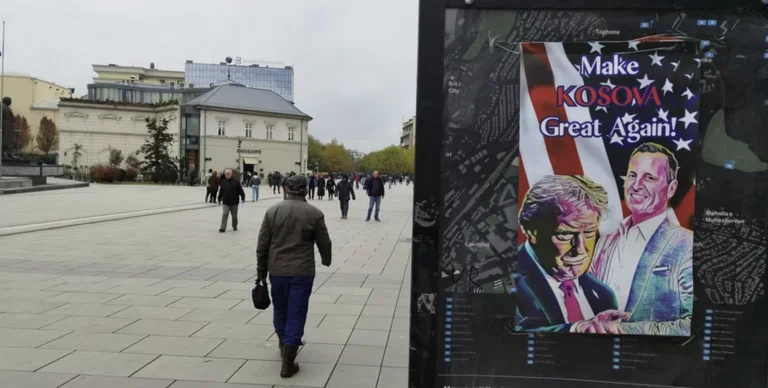
Donald Trump's goal is not to bring Serbs and Kosovars into the European Union. His aim is to do his best for the United States, to make America once again magnificent. He does not say to become Kosovo again magnificent, make Serbia grand again.
If the people who run these countries, [Kosovo Prime Minister Albin] Kurti, and [the president of Serbia, Aleksandar] Vuciq, pay attention... they will try to adjust their interests to Trump's interests.
For me, Trump's interests are not always clear, so they will have to figure out what to do. Does this mean that they must make painful compromises? Maybe. But let us remember that they will not be in the context of what we had in the past.
I don't expect to have as much commitment as in the past. I may be mistaken, but what if Trump says, "I don't want you to continue working with China?" What will Aleksandar Vucinq do? Painful compromises, right? Hence, there may be painful compromises but not such expected in the past.
Radio Free Europe: What about Kosovo in that case? Kosovo is not very close to China.
Cameron Munter: You're absolutely right. If the Kosovo leaders are smart, they'll say: "We are with you, we are hard on China." They should play with this card. However, Kurt is different from Vucinqi, they are not similar in the way they approach problems.
Kurti will have to work hard to create a personal relationship with people in Trump administration. In this regard, Vuchic has done better work in the past.
Radio Free Europe: Are you saying Kurt's at a disadvantage on this?
Cameron Munter: Yeah, I think he's at a disadvantage, because there's a history of personal relationships here. Vuchy was at Trump's in the White House. There's a story of business deals. There are promises there will be investments on the main road in Belgrade, in building a luxury hotel.
This kind of relationship I know doesn't exist between Kurt and the people in the new US administration.
The United States and Europe have been closely linked in the past. In the past four years, they have said their policy is the same, but it doesn't seem to exist anymore. Now it will take a new kind of policy in which the leaders of the two countries [Kosovo and Serbia] will have to decide: go in the European direction or in the American direction? Normally, if they're different.
Radio Free Europe: And what would be the best choice, you think?
Cameron Munter: What I think you should do is get information. None of us still know... To decide in December 2024 what politics will be, I think it's not a smart thing. What leaders of all Western Balkan countries, not just Kosovo and Serbia, must do is wait for who will handle their issues most.
If we talk in six months, the situation could be quite different. Trump doesn't want to be predictable. For traditional diplomats like me, that's terrible. But if that's what he wants, we have to agree.
I, as an American diplomat, have always believed that all Western Balkan countries will belong to the European Union and the family of democratic countries in the West. Trump is the first president I've seen who doesn't care about the community of democracies in the West. So it's a new world. You should see what your advantages are and what you can do. But you won't know that until several months of his administration pass.
Radio Free Europe: We'll see 14 more years of negotiation?
Cameron Munter: No, I don't think so. I think we'll see other options. It may be that the six Western Balkan countries never become EU members. It may be that the European Union itself is changing and reformed, and there are no more extenuating ideas, which have been the basis of the European Union in the last 30 years. There may be reforms within the EU and they come not as a result of events in the Balkans, but as a result of the way the war ends in Ukraine, or how trade with China and the US works.
So the Western Balkans must wait to see how things change in the world before making decisions for its future.
But you don't just need Germany and America to make decisions for you. You can make decisions with other countries.
For example, to have coherent energy supplies in all countries in the region, pipelines and infrastructure must be built. You don't need America to do that. It would help if America helped, but you can do it yourself, working together. And if you do that, you get progress even if Berlin thinks of something else, or America thinks of something else.
It would be wise to think of a bigger Balkans, instead of saying that we are the six Western Balkan countries waiting to enter the European Union, and that's all we do.
I'd look outside and say, "How do we deal with such issues as natural gas? What common approach can we pursue to promote tourism? How can we reach out to our people for a better future and not depend on Americans?
Radio Free Europe: But is that possible if Serbia does not yet recognise Kosovo?
Cameron Munter: Kosovars can work with Greeks, Kosovars can work with Macedonians... You have other people in the region you can work with. You shouldn't think like you thought in the last 15 years. You could start a different route, take different initiatives.
If we continue to think only about recognition between Kosovo and Serbia, we will spend another 15 years waiting. I believe this is not just a matter of discrete between the two countries. This requires a broader solution, within which Kosovo and Serbia learn to have a prosperous, just and democratic future.