8 hours ago
Jeremiah Alban: Who are fighters from the Western Balkans in Syria?
Periskopi(2 years ago)
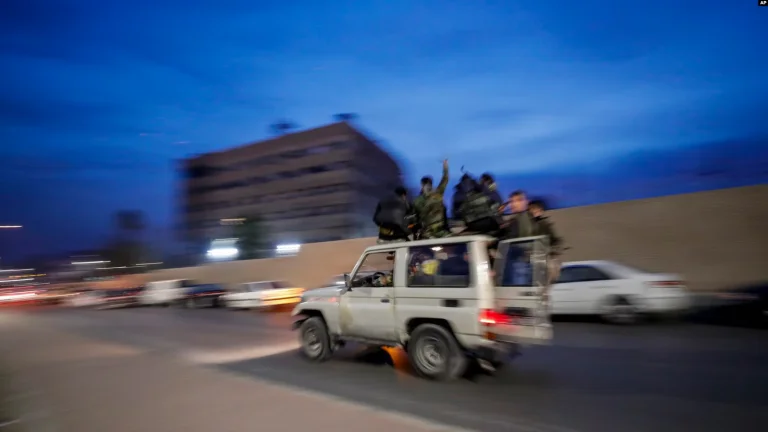
(2 years ago)Albanians from several Western Balkan states have been seen active in the recent fighting in Syria, which led to the collapse of existing powers there. Fighters are believed to have been grouped into an Albanian-speaking unit within the Hayat Tahrir al-Sham (HTS) coalition, declared terrorist by the US and its allies, who in early December, [...]
Fighters are believed to have been grouped into an Albanian-speaking unit within the Hayat Tahrir al-Sham (HTS) coalition, declared terrorist by the US and its allies, who in early December led to the collapse of President Bashar al-Assad's powers.
“James Alban” is the name by which the group of Albanian fighters has identified themselves in public, especially in social networks.
Albanians, however, make up only a small part among hundreds of foreign fighters in the ranks of the rebel group that took power. The HTS itself and Allied groups are believed to have about 10,000 fighters in total.
It has been declared a terrorist organisation by the US and the EU, and has previously been linked to Al-Qaeda. With the newly taken power, this alliance has pledged tolerance and inclusion, though there are concerns about their ties to terrorist groups.
Who's HTS?
Hayat Tahrir al-Sham (HTS) is the Islamist militant group, whose members are mainly Salaphs, an ultra-radical sect of the Sunni Islam. This group requires the establishment of a state in Syria that ruled according to Islamic law.
The group appeared on stage in 2012, a year after the start of the Syrian civil war. Initially, the group appeared under the name Jabhat al-Nusra, or Fronti Nusra, Syrian branches of Al-Qaeda.
Led by Muhammad al-Julan, the group received orders from Abu Bakr al-Baghdadi, the leader of Al-Qaeda in Iraq. Baghdad later severed ties with Al-Qaeda and founded the extremist group, the Islamic State (IS), the group in which Yulan refused to participate.
Front Nusra became one of the deadliest groups to fight Assad and use tactics, such as suicide bombings and explosive devices.
The militant group then changed its name several times and distanced itself from Al Qaeda. In 2017, she joined other opposition groups in northwest Syria to form HTS.
This group is declared a terrorist organisation by the United States and Allied groups.
Who is Cemati Alban, and what is his importance in Syria?
Adrian Stetun, a foreign policy and security expert operating in Washington and a associate of the International Centre for Counterterrorism at The Hague, says that this group has been active in Syria since 2012, although not officially named after Xhemati Alban, but its components, the people that later formed this group, have used it as the name Xhemati Alban.
According to him, Cemati Alban is made up of dozens of people, has ethnic Albanian command structures, and is referring to “a Islamist group jihadist and well structured”.
The “Persons that are members of this group mostly come from Kosovo, from Northern Macedonia, but also from other Albanian trains in the Balkans, and from the geox1> diaspora, He says.
The Albanian group's “leader there is a 48-year-old from Skopje, which is known as Abu Qatade al-Albani. His real name is Abdul Yashar, and he had high advisory positions with HTS Commander”, State says.
Abdul Jashar has been sanctioned by the United States since 2016.
According to the Treasury decision, this military adviser has been sanctioned as one of Al-Nusra's leaders, the branch of Al-Qaeda in Syria, and has helped raise funds for Nusra's families of warriors.
The group has been very active on social networks, especially in the telegram, publishing battle progress and even video and photos of soldiers, mainly in disguise.
A video verified by the REL, November 30th, shows a soldier speaking Albanian standing in a fortress in the old town of Aleppos, the second largest in Syria.
The video was captured on the day HTS took over from the northwest city.
The unidentified person in Albanian speaks of the liberation of Aleppos, praying for additional deliverances from “the great impression” as he refers to the Assad regime.
The same soldier carries a distinguishing mark of “-Albanian Tactical”, which is believed to be a subgroup of Cemati Alban, focused on training.
Jex0> James Alban is divided into several groups that are specialised: one for mines, the other is a sniper group and then we have this training group called Albanian Tactical”, says Steun.
He adds that the group of Albanians and its leadership have special importance within the HTS.
REL has identified several sets of telegrams ranging from hundreds to thousands of followers and publishing the activities of militants in Syria.
Most of the contents of the posts are in Albanian, and there are also several videos in which soldiers speak Albanian and show images from different Syria cities, particularly after the latest shares of the collapse of power there.
However, earlier data shows that over 350 people have been in Syria since 2011, mainly to join the extremist group, the Islamic State.
Kosovo has adopted the Law to ban participation in armed conflicts outside Kosovo's territory in 2015, until several repatriation operations were organised since 2019, with which hundreds returned.
In the Kosovo Correcting Service, some 42 prisoners for participation in foreign wars are going through its correctional institutions. Currently, there are 7 of them in the correctional institutions.
Earlier it has been said that about 100 Kosovars continue to remain on the territory of Syria and Iraq.
By the end of 2017, the majority of Kosovars in Syria lived in territories controlled by this group.
Lavrim Muharnier, a member of the Islamic State who was declared killed, was known as the leader of Albanians in terrorist formations of Islamic State.
Even from other countries in the region, ethnic Albanians flocked to Syria to join the extremist Islamic State group (IS) and the Nusra Front, the Syrian branch of Al-Qaeda.
Among them was an ethnic Albanian from Northern Macedonia who fought in Syria for four years until 2020 and later returned to Europe.
The new “I was deceived by internet video”, he said under anonymity for security reasons.
And then we got in touch with some of Turkey, and we left (for Syria). It was suicide. We were barely able to escape from there”, the man added, who did not discover the group he joined.
According to the Northern Macedonia Ministry of Internal Affairs, 4 Macedonian citizens are currently participating in the battlefields in Syria and Iraq.
This ministry, as well, confirmed that separate ethnic groups exist, including in this case Cematin Alban, with Albanian members of several Balkan states.
Samet Shaban, from the organisation Horizon Citivias, which deals with full implementation of human freedoms and rights, says the phenomenon of Albanian recruiting in the Middle East wars “is in considerable decline in the last eight years”.
Northern Macedonia has also classified participation in foreign armed conflicts as a criminal offence, Radio Free Europe reports.
So, I appreciate that if there's going to be further attachment to the Middle East, it's going to be for the reasons of eternal migration in the so-called promised areas of land, rather than for war motives”, says Shaban.