7 hours ago
How can it be fought to introduce weapons to the north?
Periskopi(2 years ago)
(2 years ago)It is a public secret that northern Kosovo has had many weapons. It was a weapons depot”. This is how Kosovo Police Director Gazmend Hoxha, described this part of the territory, as he spoke at Kosovo Radio Television about the weapons that are constantly found during police raids. In less than a week, [...]
It is a public secret that northern Kosovo has had many weapons. It was a weapons depot”.
This is how Kosovo Police Director Gazmend Hoxha, described this part of the territory, as he spoke at Kosovo Radio Television about the weapons that are constantly found during police raids.
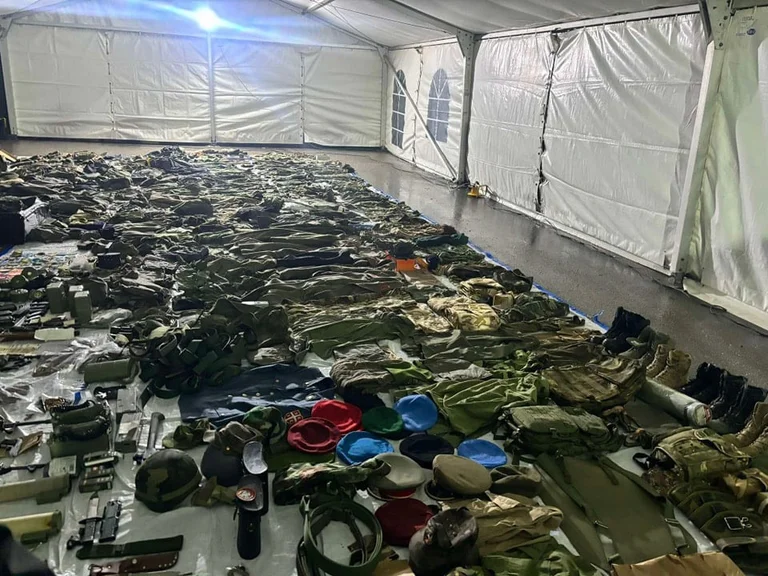
In less than a week, police have found twice as many military weapons and uniforms in northern Kosovo, in actions committed following the November 29th attack on the Iber-Lepenci channel in Zubin Potok.
Police have said that the attack on the Canal has been supplied with water from Weyman Lake several cities in the country, as well as the Kosovo Energy Corporation for cooling its thermoelectrics has been carried out with an explosive amount of around 20-kilograms.
Meanwhile, Kosovo Minister of Internal Affairs Jedal Svecla has said the subject used in the attack on the channel “is impossible to find unless supplied directly from army warehouses”.
Kosovo authorities blame Serbia for the introduction of weapons in Kosovo, as well as for organising and carrying out attacks that they consider terrorist, on the Iber-Lepenci channel and in Zvecan Banjsk, a year ago.
Belgrade denies everything, even for the latest attack, has offered assistance in conducting investigations.
Challenge on Kosovo border- Serbia
Kosovo Customs has earlier told Radio Free Europe that the weapons have entered via “mountain roads”.
According to its officials, prior to the attack on Banjska, some types of weapons have been able to enter Kosovo within the day through illegal routes.
Meanwhile, the police chief has said dozens of illegal routes with Serbia have already been blocked, but the challenge poses the inability of police officials to be very close to the border.
The two countries share a long border line about 400 km.
Over 60 percent of it includes Serb-run municipalities in northern Kosovo. A significant part is a difficult, uninhabitable area. This fact also makes it almost impossible to control every border part.
For the security of Kosovo's borders with Serbia is the mission of the North Atlantic Treaty Organisation (NATO) in Kosovo, KFOR, while for the rest of the borderline, cares Kosovo Police.
However, under a 2014 decision by the commander of the world's KFOR, police can patrol the Kosovo border- Serbia, up to a mile near the line of division.
Former Kosovo Police Director Rashit Qalaj believes illegal routes are being controlled, or little, and although praising the work police officials are doing, he says they are missing the main element: information.
“Security institutions, especially the Kosovo Agency for Intelligence (AKI), be much more alert, and also the intelligence that is under the Kosovo Police to be more on the ground, and to be done proactively”.
Other Limits
Qalaj says about REL has information that, except for Serbia, weapons in Kosovo are being smuggled into Albania as well, so authorities must increase control in each border area.
And we have to focus on other parts of the country, because criminals cooperate. They know neither nationality nor what language people speak”.
Even Fatmir Colak, the connoisseur of security issues, believes weapons from Serbia have entered Kosovo even after the attack on Banjska, but not by Albania.
“An increase in alertness and frequent border police patrols, along with members of [European Union for Rule of Law in Kosovo] EULEX and KFOR would influence the reduction, if not in 100% prevention, at least in sufficient reduction and reduced access to weapons and military equipment on Kosovo territory”.
Weapons confiscated
Police have said several times that confiscated weapons are old and vary, from ammunition and grenade launchers to high-caliber weapons, machine guns, snipers, anti-ceernel mines, detonators.
The Digital Radio Radio Unit Free Europe has verified that several weapons were produced in the 1990/91 period at Serbian factories “Privi Partizan” and “Millan Blaguyevicq”.
Kosovo police have offered no information despite the REL's request to understand how many people have been arrested over the years for the introduction of weapons in Kosovo.
The Danger of Security
In local and international reports, the security situation in the north is considered calm, but fragile, with the potential of rapid escalation.
Police Director Hoxha has repeated several times that the institution he is leading has, in principle, the potential to conduct massive raids in the north, but cannot do so, as all must be carried out in accordance with the law and there must be a basic suspicion.
Security acquaintances in Kosovo have often suggested using fears for border monitoring, setting up cameras in more critical border areas, or increasing international pressure on Serbia. / REL