8 hours ago
Only 39% of citizens consider the Western Balkans a safe place to live
Periskopi(a year ago)
(a year ago)Today, the Regional Co-operation Council (RCC) presented the results of the Securit Meter poll at a event held in Tirana, attended by government representatives, diplomats, international organisations, security professionals and media. Securi Meter 2024 offers a public perception of security, governance and trust in the Western Balkans, offering important information about [...]
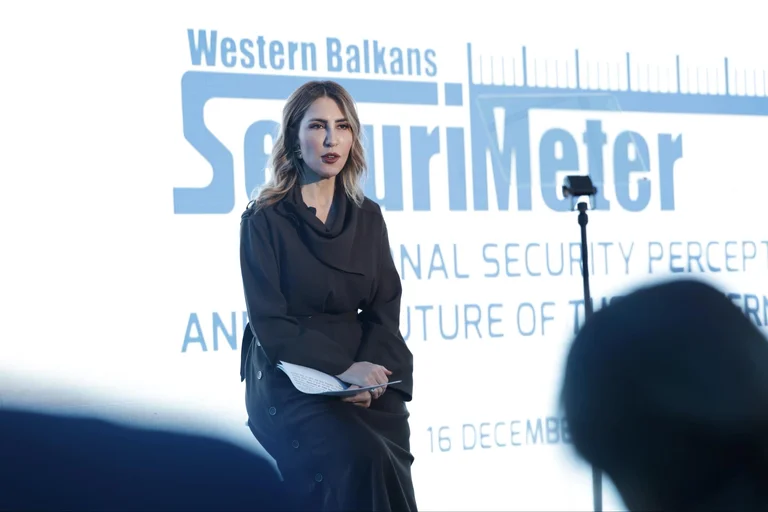
Today, the Regional Co-operation Council (RCC) presented the results of the Securit Meter poll at a event held in Tirana, attended by government representatives, diplomats, international organisations, security professionals and media.
Securi Meter 2024 provides a mirror of public perception of security, governance and trust in the Western Balkans, providing important information to formulate strategies for the future of the region.
We are not simply presenting a report today; we are amplifying the voices of thousands of citizens from the Western Balkans. Their stories remind us that security is not just a political priority. It is a common responsibility. These findings lead us to action, not with hesitation, but with urgency and determination,” said RCC Secretary General Majlinda Bregu, at the opening of the event.
The poll, conducted with 6,000 respondents across the region, shows a complex mirror:
Only 39% of citizens think that the Western Balkans is a safe place to live, stressing continued security concerns;
48% fear there could be a war between Western Balkan economies, reflecting continuing tensions;
59% of citizens feel secure personally, but the wider regional uncertainty remains;
36% view depopulation as a major problem, while 23% are planning or are in the process of migration;
83% believe corruption is widespread, stressing the need for reform in government.
The results also highlight significant security concerns with gender dimensions, with 66% of women identifying domestic violence as a significant threat and 54% viewing sexual harassment as a real concern. According to statistics available in the region, an average woman is killed every week. These are not just statistics; they are calls for action. Women's security is a foundation of any safe and just society,” stressed Majlinda Bregu.
Securi Meter's 2024 data provide a map to address these challenges through strengthening regional co-operation, targeted policies and confidence-building initiatives.
RCC Secretary General stressed the need for:
Visible progress to restore public confidence, with only 31% of citizens believing the region will be safer in the next 12 months;
Effective interventions to address corruption, organised crime and institutional weaknesses;
Full policies to address depopulation, gender security issues and economic challenges;
Deeper integration in the EU and NATO, as 31% of citizens recognise NATO's role in regional stability.
Majlinda Bregu also reflected on the RCC's achievements during its mandate, stressing progress in cyber security, gun control and regional co-operation. “Working together, we are not only strengthening security for the Western Balkans, but contributing to a more stable and united Europe. ”
The presentation included a dynamic discussion on the panel, moderated by renowned journalist Lutfi Dervishi.
In attendance on the panel: Juidas Daskalovski, director of the School of Political Studies “Mother Teresa”; Alida Vraciq, executive director and populist; and Agon Maliqi, political analyst and cofounder of Sbonker.net.
The panel considered practical steps to turn the report's findings into applicable policies, focusing on governance, confidence and regional security.
Since its establishment in 2021, Securi Meter has offered invaluable knowledge of public perceptions, serving as a tool for politicians to create fact-based answers to challenges that arise. This year's poll highlights the related nature of security issues in the Western Balkans and the critical need for common solutions. Funded by Italy's Ministry of Foreign Affairs and International Co-operation, Securi Meter is one of the RCC's main efforts to link perceptions with politics.
For more information on findings and full report, visit www.rcc.int/secutimeer