7 hours ago
What awaits Syria after Assad's fall?
Periskopi(2 years ago)
(2 years ago)After more than a year of relentless conflict in the Middle East, the shocking chaptering of the regime of Syrian President Bashar al-Assad will be marked in the region's history as one of the greatest shocks. In just 12 days, the rebels marched north and then south toward the center of Damascus, [...]
In just 12 days, the rebels marched north and then south toward the centre of Damascus, occupying the capital and ending the over 50-year reign of the Assad dynasty over the nation. In less than two weeks, they achieved what tens of thousands of armed opposition fighters had failed to do in the 13 terrible years of civil war.
Also involved in its conflicts, Russia in Ukraine and Iran, with its representatives in the 14-month conflict with Israel, Moscow and Tehran, Assad's top supporters, were unable or unwilling to prevent this development.
In many ways, the spectacular fall of the regime seems to be one of the unintentional consequences of Israel's harsh responses to its opponents since Hamas' attack on October 7, 2023. The following year, it has overturned all previous rates in the region, creating an explosive and unpredictable environment.
For months, Israeli forces carried out air strikes in Syria, killing Iranian commanders and their representatives, as well as shelling objects related to Iran and Hizbolah dealt with the Lebanese militant movement that also supported the Assad regime during the civil war.
But more than anything else, the rebels ' quick offensive highlighted the plight of Assad's corrupt and destroyed regime.
Assad, who in 2000 succeeded his father, Hafez al-Assad, was a brutal despot. He used the most brutal means to suppress opponents during the civil war: chemical weapons, barrels, sieges and hunger tactics, mass arrests, torture and murder.
More than 12 million people have been forced to flee their homes during the war decade. There are more than 100 thousand so-called missing “ ” people from security forces who are not yet known where they are.
While the parasitic regime was draining the country of resources, even those in his Alav community who had sent their sons to die in Assad's war against the people followed the demoralization and despair of hope after years of economic and social deterioration.
Assad's fall would be welcomed by the millions who suffered under his rule, as he refused to compromise and negotiate a political solution with his opponents to stabilise the country and put it in another direction.
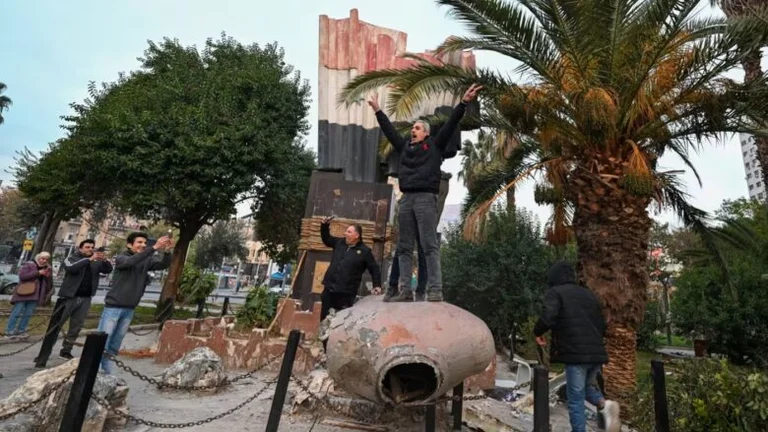
But the massive explosion of joy will mix with fear of what will follow.
The offensive was led by the most powerful rebel force, Hayat Tarhir al-Sham (HTS), a former Islamist group of al-Qaeda declared a terrorist organisation by the UN, the US and other states. The leader of the group, Abu Mohammad al-Jolan, who has publicly declared his desire to invade Damascus and now appears to be the main decisionmaker, once fought with the ISIS, the jihadist group, while with a $10 million reward from the United States for his head.
During the six years HTS has ruled the northwestern province of Idlib through a civil-led government, he has tried to re-sign the group as a more moderate Islamist movement. But he has maintained control with an iron hand, while UN agencies have documented abuses.
If 42-year-old Jolan achieves his ambition to rule, it will create dilemmas for Western powers and international agencies on how to engage with him and HTS.
But HTS is just one of many opposition groups that are remains of the initial rebellion and who participated in the attack. In the past, different factions have been in conflict with each other.
During the latest offensive, there was co-ordination between the HTS and Turkey-backed factions operating under the Syrian National Army umbrella, as well as other groups surrounding Damascus from the south.
However, the real test will come when factions will seek to share the benefits of victory and power.
Syrian analyst Malik al-Abdeh has said he finds comfort in the fact that the rebellion clearly co-ordinated between the HSS and other groups, describing the attack on the regime as a “controlled collapse plan”.
This feeling of euphoria and pride has also been softened by the feeling that there might be violence that is almost too good to be true”, Abdeh said. However, it is clear that there is a plan; very carefully communicated by HTS and Jolan that there is a road map. This has appeased a lot of people”.
Besides the rebel Sunite groups, there are forces led by Kurds whom the US supported in the fight against I The SIS control part of northeastern Syria.
Turkey, however, considers them an extension of Kurdish separatists who have fought against the Turkish state for decades.
Turkish troops have been deployed for several years in northern Syria to deter Kurdish militants and their ties to rebel Sunite groups. That means Ankara is now probably the most powerful actor in the neighbouring country and will play a crucial role in what will happen next.
However, Turkey has a complex and occasional difficult relationship with the HSS, which it has also declared a terrorist organisation.
Meanwhile, the US has around 900 troops in the country to support the fight against ISIS.
Besides risk of clashes within rebel groups, he will fear that I The SIS once controlled large parts of northern and northeast Syria will try to exploit chaos and make a comeback.
Minority groups throughout Syria, one of the region's most secular countries, a factor that served Assad, as he himself was a member of a minority minority, will worry about what will come next. The country has a diverse population of tribes, religions, and sects.
During the offensive, Yolan, as a refined pragmatist, addressed tribal groups, former opponents and brokered handover agreements, ordering minority protection.
Neighboring countries, including Israel, Jordan and Lebanon, will also be cautious, as will the Gulf states, which relaunch commitments with Assad and view Islamic movements as destabilizing forces.
It was good for Syria's neighboring countries to see Assad weakened, while Israel has always wanted an end to Iran and Hizbo God's presence on its northern border. But there will also be concern about the possibility of a fragile state, crushed by chaos, with Islamic groups at the helm.
When popular promotions against authoritarian regimes included the Middle East in 2011, a wave of optimism spread to the region. But it was too short.
Syria fell into its disastrous civil war. In Egypt, the military took power in a coup two years after President Hosni Mubarak, who led one of the region's most autocratic regimes, was overthrown.
In Libya there was a moment flirt with democracy, before rival armed factions turned against each other and the North African country remained fragmented and in chaos.
The challenge Syria expects now that Assad is finally gone is whether it can overcome obstacles and avoid disasters that have hit other countries following the fall of dictators, and launch the difficult process of reconstruction and reconciliation. /Telegraphy/