5 minutes ago
Serbia fertile land for Russian propaganda in the Balkans, Russia warns of opening new media on Serbian market
Periskopi(2 years ago)
(2 years ago)A Russian television station will soon open in Serbia. That despite numerous EU requirements Serbia must impose sanctions and secede from co-operation with Russia. So has Margarita Simonyan, editor-in-chief of Russian state media known for extending propaganda to Putin's Kremlin. That a few days ago [...]
A Russian television station will soon open in Serbia. That despite numerous EU requirements Serbia must impose sanctions and secede from co-operation with Russia.
So has Margarita Simonyan, editor-in-chief of Russian state media known for extending propaganda to Putin's Kremlin.
That few days ago, it has announced that Russia will open a new television station in Serbia soon.
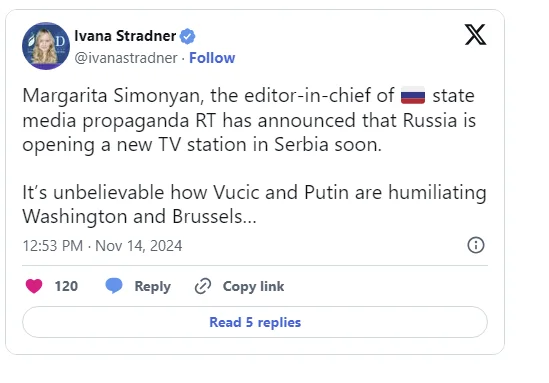
American analyst Ivana Stradner has said that what Serbian President Aleksandar Vuciq is doing in Serbia is totally unacceptable.
It's incredible how Vuciq and Putin are humiliating Washington and Brussels...”< wrote it on X.
How long will Serbia be fertile land for Russian propaganda in the Balkans?
“Manipulation and media intervention are risks to democratic processes and social sustainability in Serbia and the Western Balkans. The State Department Global Accession Centre previously warned that the Kremlin media, RT and Sputnik are the most significant elements in the Russian deinformation and propaganda system”, said in a response to the State Department's investigation into the Serbian-language programme of Voice of America concerning the unhindered functioning of Russian state media in Serbia, despite sanctions and bans imposed on these media, to encourage and support aggression against Ukraine.
The issue was currentised in a recent report by Reporters Without Borders, a nongovernmental organisation focused on the protection of journalists and media freedom.
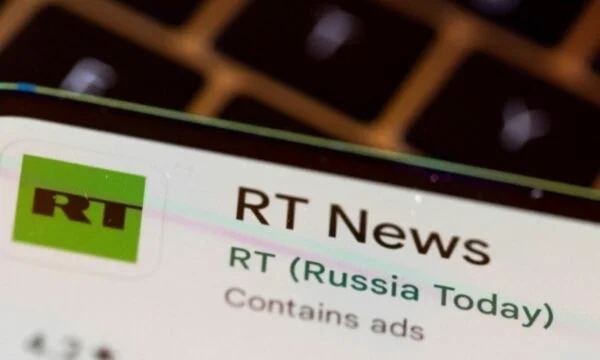
In the report, it was stressed that RT, former “Russia Today”, uses correspondents in Belgrade to adapt the Kremlin confession before disseminating it into the Southeast European area.
It was also said that this has become possible because of the influence of Serbian authorities on the media, as well as favourable political environment.
In his response, the State Department stressed that, it will continue co-operating with Serbian partners for recognition and response to the threats and secret activities of RT.
Last month, US Secretary of State (Antony) Blinken announced that RT, as part of the Russian Sednjeão network, which also includes RT Balkans, has gone beyond the role of the Kremlin's dezinformator and propagandator and has begun dealing with the effects and secret destabilising operations in the field of information worldwide. The United States has imposed additional sanctions to respond to Russia's efforts to intervene in the upcoming elections in Moldova and influence malicious activities carried out worldwide by those controlling RT”, said the response to the Voice of America.
In response, it alludes to the September decision by US authorities to sanction Russian state media. RT was labeled an associate of the Russian Army, who is collecting money to buy snipers and other equipment for soldiers fighting in Ukraine.
US, sanctions on Russian state media
The stance on the functioning of Russian media in Serbia has also expressed a European Union representative, a community with which the country is negotiating membership for more than a decade.
EU diplomatic service spokesman Peter Stano said Serbia should take urgent measures in the fight against Russian media manipulation and intervention.
The European Union has imposed sanctions on Russian state media, including RT, whose broadcasts are suspended inside and outside the EU. These media, including RT in all its forms, have become a Kremlin instrument in the fight against Ukraine and a channel for spreading and manipulation of information”, said spokesperson Stano for the AFP news agency.
Although a European Union membership candidate, Serbia has not stopped broadcasting RT and Sputnik. Unlike her, Montenegro did so in 2022.
Calls from Brussels to Belgrade answered Arno Gujon, chief of the Office for Public and Cultural Diplomacy in Serbia's government. He said the state will continue to promote media diversity and freedom of thought.
The European Union's request is very disturbing. It reminds you of the period of communism during which censorship was applied in Yugoslavia on behalf of the war against harmful or undesirable ideas. It conflicts with the values of pluralism, tolerance and freedom of speech in which Serbs believe, and for which many Serbian intellectuals fought, who were imprisoned and killed because of it”, Gujon wrote on the social X network.
RT Balkan exists in Serbia since 2022. It publishes content on the internet portal and social networking. Television, even though it's been talked about, has not yet been launched. Sputnik Serbia, on the other hand, arrived a little earlier, in 2017. It is part of Moscow-based Russian news agency Sputnik, which was founded by the state media group “Russia Sevodnja” and is a descendant of the agency “RIA Novosti” and Russia's radio “Zer”.
Ruslan Trad, an expert at the Forenzic Digital Research Laboratory at the Atlantic Council, explains about Russia's Voice of America in Belgrade is being provided a platform for building a serious infrastructure, which includes a media presence.
“The government's strong influence on public life in Serbia enables information operations to develop, according to them, in an appropriate environment. Thus, Russian pro-government stories provide continuity in local media. Russian propaganda media use Serbia to create a presence in the wider region. They use various methods, such as Google advertising platforms, in which users have confidence, to be redirected to the content of the Russia Todayʹ or other Russian or pro-Russian media in the Serbian language”, says the mechanism expert on the expansion of digital deninforms and news, for documenting human rights violations and building digital sustainability.
Mr. Trad believes that Serbian authorities will do nothing about objections voiced by the European Union or non-governmental observers.
Belgrade's “position is clear. The European Union, which has economic interests in Serbia related to lithium, will hardly do more than comment and make statements. (Serbian President Aleksandar) Vucic does not see it as a problem, so things will continue to function the same way”, the co-director of the Voice of America, under which changing such a situation depends on political decisions and the will to implement the law.
It is clear that Belgrade makes this possible because of interest and not because it is shouldered to the wall. Unlike other countries in the region, Serbia views the Russian Federation as an ally, but not as a partner at all costs. It is no coincidence that Belgrade has ties to China, the US and European countries like France. However, if it wants to become part of the European family, Belgrade will have to implement rule of law and improve the situation in the media environment”, expert Trad concludes.
In May 2020, the NATO Centre for Strategic Communication (STRATCOMCOE) published the Russian subx1> study in the information environment of the Western Balkans” under emphasis that Russia's presence in the Western Balkans is inevitable, so the commitment and assistance of the European Union, NATO and the United States are important for the process of democratic reforms of countries in the region.
The publications of that organisation also analysed media contributing to the spread of Russian influence by disseminating the content of Sputnik Serbia. The list included local media such as Srbin.info, Novosti.rs, B92.net, Informer, Kurir, Alo, Blic and Telegraph.