5 minutes ago
Schmitt: With Ottomanism and Islam against Albanian national identity
Periskopi(3 years ago)
(3 years ago)1912 is the crucial year in terms of Albanian national identity in the Balkans. With borders separating in some new state spaces speakers of the same language and culture, national identity was described differently. Among the Western Albanian “”, the educational and administrative system managed to create a national identity beyond the region. As for the “The Albanians [...]
1912 is the crucial year in terms of Albanian national identity in the Balkans. With borders separating in some new state spaces speakers of the same language and culture, national identity was described differently. Among the Western Albanian “”, the educational and administrative system managed to create a national identity beyond the region. As for the “Eastern Albanian”, those who were left under Serbian occupation, the identity was created as capacity for power and state. The lecture of the academic and professor from Vienna, Oliver Jens Schmitt, titled “Kosovo and Albania: two ways of Albanian history 1912-2023” on Friday morning under this year's edition of the Albanian International Ministry for Language, Literature and Culture. Until the Albanian state succeeded in etabling the project of a secular nationalism, Yugoslavia, under Serbian control, promoted Islam and Ottoman structures. “This was done in order to prevent the birth of secular nationalism as it was happening among Western Albanians”, Schmittt said in the lecture that has been followed by a large number of interested people.
Two Albanian national states in the Balkans are the epilogue of a 111-year-old story. What shaped as an idea during the major anti-Hisoman uprisings in Kosovo and Macedonia ʹ the establishment of an Albanian state in the central Balkans has been followed by the declaration of independence in Vlora. It's just some of the dichotomys of a story that's the same and different at the same time. With the lines outlined along the Drin since 1913, at least technically the terms “Western Albanian” and the “East Albanian”). Although the border has drawn closer and closer for 24 years than it divides, this new experience also brought about the need to reconsider the past and the militia that marked the main moments of identity.
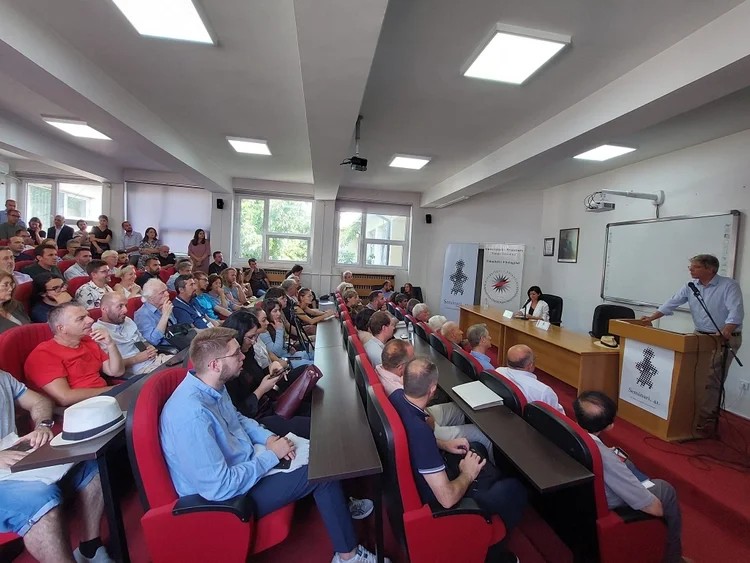
With such claims was the speech of the academic and professor from Austria, Oliver Jens Schmittt, held Friday morning in Pristina Faculty of Philology' hall “
On the fourth consecutive day of the 41st edition of the International Theatre for Albanian Language, Literature and Culture, increased public interest has been witnessed in the packed hall with seminarists, professors and scholars.
“Schmit: Kosovo has rendered service to all Albanians”
Following the opening address by morning session director Blerta Ismajli, the academic from Vienna has been addressed in Albanian with a word of opportunity to acknowledge the merits of Seminari with a tradition of over 40 years. According to Albanologist Schmitt, this important albanology event has served students from Vienna for years to become more familiar with Albanian language, literature, and culture.
This seminar plays an important role not only for Kosovo, but for all Albanian trains. In that sense, Kosovo has rendered a special service to all Albanians”, Schmitt said, commemorating that such an albanological event is missing in Albania.
Since the Albanology seminar is older even than Kosovo's own citizenship, according to the university professor from Vienna, it should be assessed by all those who have political responsibilities in the country.
This seminar was kind of a window for the world, because all those who lived in the '70s and '80s know how unknown Kosova” was then, Schmittt said.
“
At the introduction of his speech, which he has held in English, Schmitt has estimated that there are two Albanian states in the Balkans today. Although officially the Republic of Albania views itself as a national state of Albanians, Kosovo itself can be adopted.
“created in 2008 and forced to declare itself as a multiethnic state, Kosovo is ethnically homogenous, inhabited by Albanian majority, and as such could be considered the second Albanian state in the Balkans”, Schmitt said in his lecture “Kosovo and Albania: two ways of Albanian history, 1912-2023x3>.
These new realities, single out among Kosovo's independence opponents, have produced rumours about the creation of a joint Albanian state, which continue to echo in Serbia, Russia, as well as a part of Western media. On the other hand, Kosovo's independence has also served as a substitute for a long-term inter-Albanian debate on the true size of national unity. According to Schmitt, these debates “develop emotionally” as they assemble on central issues of state identity and sovereignty.
“1912 ) crucial year”
But, a member of the Academy of Sciences in Vienna has said that his speech has been conceived beyond these clashes, revealing his intention to paint Albanian divisive moments since they no longer lived in the same space. According to him, the experience of living in various state-run, economic and cultural spaces is not exclusively Albanian. So is German and Korean experience.
Citing his explanation, Schmitt has singled out a thousand nine hundred and twelve as the crucial “division”.
Three different developments are collected in this year. First, failed effort to establish an Albanian state within the Ottoman Empire. Second, the attack by Orthodox national states on the Ottoman Empire, which was simultaneously a response to the possibility of an Albanian statehood in the Central Balkans. And third, the proclamation of the Albanian state at the southern end of Albanian space, in Vlora, which was far from the centres, such as Skopje and Prizren, where the Albanian state was nearly created”, has highlighted historian from Vienna.
He has estimated that the new Albanian state survived thanks to Austria and Hungary's insistence that otherwise it would have been torn apart between Greece, Serbia and Montenegro. Thus, the new borders, he continued, did not reflect ethnic realities, but the balance of power between two major European alliances and their candidate states.
“The social and economic spaces were divided under the new” boundaries, has added Schmittt byvoting the examples of Prizren, Gjakova and Debar, which were torn out of the back.
For the given historical period, it is difficult to appreciate what the feeling of unity was for people living in Laber and others living on the northeast corners of Gegnya, as it were, in Podujevo.
“There was strong regionalism”, has added Schmitt, while acknowledging that there was, however, awareness of language co-ordination.
Western Albanian “” and Eastern Albanian “”
The border set in 1913 continues to this day, although it no longer represents a dividing line. For the historian from Vienna, it should only be taken as a trigger for the invention of the Western Albanian “ ” and the Eastern Albanian “”.
“Today the border unites more than separates, yet some changes are also evident as a result of various developments based on this demarcation line”, he noted.
According to Schmittt, the new realities among Western Albanians -- that is, those who had a share in living in the Albanian state -- provided the situation for them to undergo an educational and administrative system aimed at creating national identity that exceeded district loyalty.
This does not mean that belonging to a cultural and linguistic community did not exist until 1912. A national identity was created through institutions from prestate identity that existed until then”.
In parallel, on the other side of the border, among the eastern Albanians who remained under Serbia, national identity was not developed by power, but as opposition to power. According to Schmitti, “this is the fundamental difference between the state and nation”.
“Islamism against Albanian secular nationalism”
Thus, the crucial moments of Albanian national identity have the period between the two world wars, the communist era, as well as that of transition.
“With all the fragile institutions, the Albanian state created a new sense of national identity that was so heterogenous in cultural and religious terms”, has continued. Rather, according to him, this community identity was absorbed by new urban levels in Albania.
The Serb-dominated Yugoslavia tried to keep education at a lower level, promoting Islamic religious cults with the aim of preventing the birth of secular nationalism as it was happening among Western Albanians”, has praised Schmitt.
Yugoslavia consistently treated the eastern Albanians as Muslims in order to expel them to Turkey”.
Facing a backdrop where Kosovo and Macedonia were treated as internal colonies, while Albanians as unwanted populations within the state were being described in Albania as other realities. Despite repeated resistance to the State, such as the Mirdit uprisings, the door opened to important religious and cultural developments.
The state took control of religious communities and promoted for most of the population the formation of religious institutions under state control and the modernisation of Islam through actions as a ban on religion. Yugoslavia, on the other hand, did the opposite by promoting all Ottoman structures and the most conservative Islam”, Schmitt added.
Born in 1973 in Basel, Switzerland, Oliver Jens Schmidt, is professor of Southeast European history at the University of Vienna. At well - known German - speaking centers such as Basil, Vienna, Berlin, and Munich, he studied Byzantines, Greek philology, modern Greek, and Eastern European history. He has legalized universities in Munich and Bern, and for a time he was also a professor at Colège de France. Since 2017, he has been chairman of the Department of Humanity and Social Science near the Academy of Sciences in Austria, while at the same time heads the research department for Balkan studies at the Institute for Modern History and Contemporary of the highest scientific authority in Austria. His interest in history is vast, with focus especially on the Middle Ages and the Balkan Adriatic trends, as well as Romania. Schmit contributions also bring together the medieval Albanian world, with titles such as monographs “Das vazianische Albanian” (2001), “Cosovo: kurze Geschichte ynralbalkanischen Landschaft (2008), “Scanderbeg ʹ der neue Alexander auf bull Balkan” (2009), “A Concise History of Albania” (2022), etc. By 2015, Schmitt is also an external member of the Kosovo Academy of Sciences and Arts.