20 minutes ago
Pendarovski in Albania: Lack of Three Countries in the Open Balkans, Major Failure
Periskopi(3 years ago)
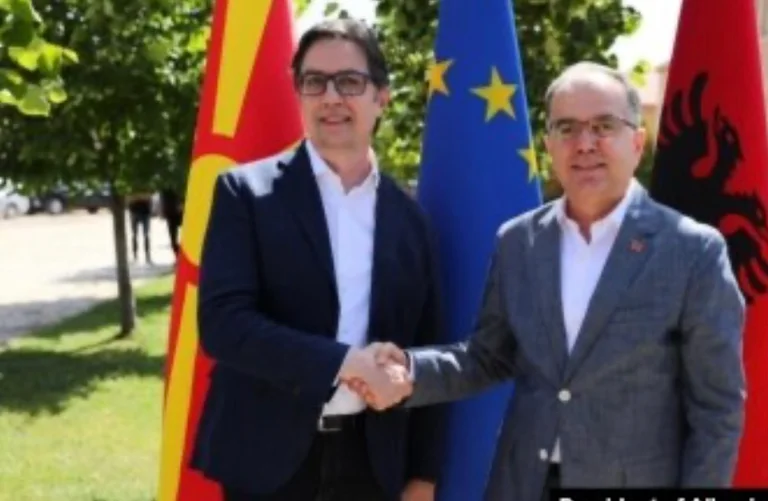
(3 years ago)Northern Macedonia President Stevo Pendarovski has once again demonstrated his reservations for the regional initiative, the Open Balkans, during a visit to Albania on Sunday. The Macedonian leader met with his Albanian counterpart, Bajram Begaj, in Pustec, where the Macedonian minority lives in Albania. The two presidents spoke on July 23rd about [...]
Northern Macedonia President Stevo Pendarovski has once again demonstrated his reservations for the regional initiative, the Open Balkans, during a visit to Albania on Sunday.
The Macedonian leader met with his Albanian counterpart, Bajram Begaj, in Pustec, where the Macedonian minority lives in Albania.
The two presidents spoke on July 23rd of good relations between the two countries and of the common journey towards the European Union, but journalists' interest prompted their media statement to focus on the Open Balkans.
The Macedonian president said the absence of three of the Western Balkan countries in the regional initiative is a major shortcomings for the Open Balkans, where, apart from Albania and Northern Macedonia, Serbia is part of.
The “is incompatible, for countries that are part of the Open Balkans, that umbrella for all initiatives is the Berlin” Process, Pendarovski has been expressed.
The Berlin Process has much more precise structural relations than the Open Balkans. Six states participate in the Berlin Process, while only three countries in the open Balkans -- and this is a major fault for the Open Balkans” -- has declared the president of Northern Macedonia.
Meanwhile, Albania's president, Begaj, stressed that the decision to continue the regional initiative belongs to politics.
Of course, any regional initiative is good. Political executive decision-makers think of continuing an initiative or not”, Begaj has indicated.
“Fat” of this regional initiative is still unclear.
Albania's Prime Minister, Edi Rama, stated shortly ago that the Open Balkans mission has been completed, while Serbia's Prime Minister Anna Brnabiq, during an informal meeting of the region's leaders in Tirana, stressed that the initiative continues to exist, and continues with joint projects.
About a year ago, Pendarovski had declared that the Open Balkans could be a good idea for co-operation among Western Balkan states, but not an alternative to the European Union, which, according to him, should be a priority for the region.
He has expressed his reservations since the beginning of this initiative.
I, since 2019, have had reservations about this initiative, and I have told them what they are: not to be an alternative to the European Union and so on...”, Pendarovski said.
I have no problem with this initiative, and I have told its initials, as I see that there are no political components, or is essentially no alternative to European integration”, Pendarovski said.
The regional initiative, originally called Mini-Sengen, was launched on October 10th 2019 in Novi Sad of Serbia, and was signed by Serbia's President Aleksandar Vuciq, Albania's prime minister, Edi Rama, and then Northern Macedonia Prime Minister Zoran Zaev.
On July 29, 2021, she was baptized under the name Open Balkans. The initiative was rejected by the opposition in Albania, and rejected by Kosovo, Montenegro and Bosnia and Herzegovina.
Kosovo Prime Minister Albin Kurti had said earlier that the Open Balkans initiative more resembles a “Balkan open to influences from the East”, rather than a initiative for common regional market.