13 minutes ago
Vucinqi, with Kosovo card, received 300m euros from EU
Periskopi(3 years ago)
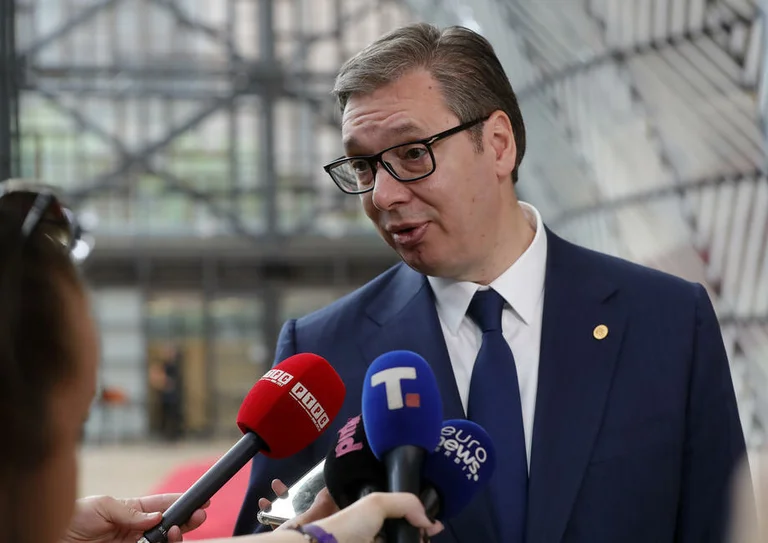
(3 years ago)“New York Times”: President, football hooligans and “the home of horrors” of the crime world (the third party of writing) at the same time, Vuciqi became more open to friendship with the authoritarian leaders of Russia, Hungary and China. Despite all these signs of slide, European leaders continued to greet him warmly, making investments [...]
“New York Times”: President, football hooligans and “The home of horrors” of the crime world (third party writing)
Like Aleksandar Vuciqi, Bellivuk was shaped by war in Bosnia and Herzegovina, although he was too young to have any role in it. One morning after the end of 1995, when the war was at its height, an explosion occurred at the Belivuk family home in Belgrade, killing three people. Authorities' inspector at the scene that day was a man named Caslav Ristic, now veteran in his work. When I met him in Belgrade he was a 63-year-old pensioner, with his face up and down, his hair weakened and harsh. He had brought pieces of yellow newspapers about the explosion, along with his polaroid photos from the crime scene.
Belivuk passed through the bodies of his mother and grandmother
Bellivuk's father, Ristic told me, was a veteran who brought guns home from the war; he wore two grenades in a kitchen drawer. He had been depressed and after arguing with his wife, he left and activated the two grenades. Evidently, he intended only to kill himself. My wife and mother-in-law were collateral damage. Later, 9-year-old Belivuk “was supposed to fit through the corridor, crossing lifeless bodies to the neighbour's house”, Ristic said. (The only obvious injuries he had were several cuts). Ristic told me it was an unusual case, but only because Father had killed himself with two grenades.
Belivuk grew up and became a major dilemma at Belgrade's nightclubs, full of minor crimes. In the early 2000s, Serbia was fighting Milosevic's toxic heritage, which had empowered a criminal class as a means to avoid wartime sanctions imposed on Serbia's economy. At the top, mobsters clashed with the country's intelligence chiefs to protect their flow of money. They were so powerful that in 2003 they killed the country's reformist prime minister, Zoran Djindjic, who had threatened blows. Finally, there were bandits such as Belivuk, heedare in the growing cocaine trade.
“Jenicers”, “state project”
Bellivuk could have remained a small bandit if his life did not take the fall with Vuciqi's establishment. About 2012, while Vuciqi was gaining control over the country's security agencies, a new group of hooligans appeared at Belgrade's “Partizan stadium” and Belivuk was asked to join the crowd. Most football fans are eternal in Serbia, but leaders of the new group consisted mainly of people without prior connections to “Partizan”. The group's name, “Janiciers”, was a clever admission to this fact: The Yenches were the Ottoman elite military force consisting mainly of boys taken from their Christian and prepared families as ruthless assassins for the Ottoman state. Where former hooligans had informal and random police support, mainly for the sale of drugs, the ties of this new group to the state were direct and political. The name of his first leader would later appear in the handwritten notes of a law enforcement official along with the label “State Project”, in evidence uncovered by Serbian investigative journalists.
Bellivuk and his new boss ? Another hooligan named Aleksandar Stankoviq, known as the silent “ ” soon began co-operating closely with their clients at the Interior Ministry. The relationship was displayed in a series of photographs and text exchanges that appeared in a judicial process years later. In one of the exchanges, Belivuk stressed his loyalty, and an interior ministry official responded to a message: “He knows. The boss knows. The big boss knows”. Texts do not explain who he was talking about, but the minister's first superior was a woman. He was then prime minister and security chief.
Bellivuk would later claim in court that “Jenicers” helped realise a shameless collapse in downtown Belgrade that paved the way for a water project that one of Vuciqi's allies mediated with the leader of the United Arab Emirates. That case, in which dozens of masked persons used bulldozers to destroy a street full of buildings that were a barrier to the project, remains intact.
Homophobic hooligans who provided parades
Amazingly, “Geniciers” seem to have helped secure the Vuciki gay parade. It was a little out of character for hooligans, an extremely homophobic mob that had turned the case into a bloody clash in the past years. But Vuciqi apparently thought that violence was becoming an obstacle to Serbia's application for EU membership. According to B., who himself was not present, Vuciqi organised a meeting behind closed doors with a group of hooligan leaders, holding in their hands a thick package of files and promising them that any previous criminal charges against them would be suspended if they maintained peace during the events of the “Parade of pride”. Thereafter, parades were organized without problems.
I was unable to confirm that Vucinqi had ever held such a meeting. (Vucciq rarely gives interviews in foreign media and his spokespersons did not respond to my demands for one.) But Stankovic has apparently been suspended from criminal cases. When the gang wheel was entrusted, it had only been sentenced to five years in prison for illegal drug trafficking and possession. In the years that followed, the sentence was postponed several times for false medical claims, using the form of doctors who later resulted in counterfeiting, according to documents uncovered by “Vreme”, Belgrade's weekly.
Criminal amnesty and media criminal empire
Shortly thereafter, Vuciqi was asked during an interview if she planned to do something about increasing hooligan violence. He replied he lacked the power to do so because there was no “general social consensus” on the matter. It was the crucial Vuciqi -- both assailants and guards -- and this job was soon forgotten amid the constant whirlwind of real crises and produced in Serbia.
While consolidating power, Vucinqi repeatedly reformed Serbia towards autocratia. In 2019, the non-profit organisation “Freedom House” brought Serbia down to the annual assessment of democracies from free to partially free, citing the politicisation of the judiciary and other institutions and a mountain election with attacks and bribery. Despite this, Serbia's EU membership application was quietly passed, as if the bureaucratics in Brussels have not noticed that Vuciqi was moving in the wrong direction.
An important power leverage for Vucinqi is the media. He has used the state-owned telecommunications company to buy local television stations, and his allies run a three-count of media organisations that shamelessly follow the Progressive Party line and give abundant time to the broadcast itself Vucinqi. These include television network Pink, which specializes in wonderful talk shows and reality show. But the most shameless is “Informer”, a picture of scandals dealing with dirty work and publishing images of false women.
In early 2017, Vucinqi announced the candidacy for president. The subsequent campaign was filled with accusations of voter intimidation, while some public employees said they were pressured to support the ruling party, according to a report by the Organisation for Security and Co-operation in Europe. Media coverage was dominated by party organs, which polluted Vuciqi's rivals. He received 120 times more coverage than the two main opposition candidates combined, the independent research group announced.
Small Balkan Putin
Vuciqi won the presidency by a considerable margin. With his party dominating Parliament, he now controlled every branch of the government and was able to choose the successor as prime minister -- a movement similar to those of Putin, who in 2008 placed Dmitry Medvedev on the president's chair to offer a balance of democratic order in Russia. During Vuciqi's inauguration ceremony, hooligans, including a member of “Jenichers”, helped collect and evacuate protesters. Vuciqi's governing style was openly becoming authoritarian, with counterfeit public displays of loyalty by his allies.
At the same time, Vucinqi became more open in friendship with the authoritarian leaders of Russia, Hungary and China. Despite all these signs of slide, European leaders continued to greet her warmly, making investments and giving no indication that Serbian EU application was at stake. (In 2020, the EU donated about 300m euros to Serbia and constituted 62 percent of Serbia's trade. The reason was not secret: Kosovo's status is still unresolved. Europeans tied their hopes to Vuchqi to oversee a solution. He's very powerful, someone who can do things if you want”, a German diplomat told me. “Vuciqi can be the man who can mark essential progress regarding Kosovo”.
Vulin, “masha”
Vuciqi sent soothing signals to Europeans, but he had other messages for his conservative base and for Serbian nationalists who support Bosnia, Kosovo and Montenegro. (He shares this challenging language with Putin, who has repeatedly stated his opposition to Kosovo's independence). These messages are often delivered by Aleksandar Vulini, the interior minister, who regularly complains that Serbs in other Balkan countries are being mistreated. Volinin and other nationalists suggest that their real goal is a major Serbia that helped lead the Balkans to war in 1991.
Gangs have a role to play in these political masquerades. Northern Kosovo, with its mainly Serb population, is nominally under the control of the National Government in Pristina. In reality, it is dominated by organised crime groups widely seen as Vuciki's party allies and accused by the US Treasury Department of plotting with Serbian security officials, but also smuggling. This gives Vuciqi an important lever to reduce or raise regional tensions. But as tools of the State, mobsters can be unreliable.
Black Night of October 13, 2016!
The first sign of real trouble in the Vuciki administration's relations with hooligans was given on the night of October 13, 2016. Bellivuk had just left his gym in Belgrade along with his boss, Stankoviq, when a team of killers passed quickly with a black “Audi” and opened fire with Kalashnikov. As Bellivuk leaned over a car, the armed men quickly fled, leaving Stankovijk dead. The crime scene was quickly surrounded by police, according to a well documented story published last autumn at “Vreme”. One of the officers, on the phone with his boss, shouted: “Who is Belivuk?”, “When Belivuk answered, the officer said, apparently referring to his superior: “She told you to return to the shelter”. The gang had a new leader.
The murder may have been linked to Stankovic's role as a “state project”. According to the “Vremes” report, Stankoviqi, who drove a “Audi” equipped with a police radio, was receiving cocaine shipments at lower prices than other gangsters and they were angry. But the main lesson from Stankoviki's murder was that the Bellivuk gang was involved in an increasingly violent fight among drug clans in the region. The cocaine trade was more profitable than ever, with Latin American cartels turning their attention to the emerging European market. Although most of Europe's cocaine arrives through container ports in northern Europe, the Balkan route was becoming more important and most of it was focused on Montenegro, Serbia's southern neighbour. Montenegro is a small population of just over 600,000 people, but there are several features that make it suitable for trade, including the long Adriatic coastline. Like Sicily, he is poor and dominated by clans with the reputation for lawlessness. And there's a story of smuggling, a practice promoted by the Government during the civil wars of the 1990s.
The Deadly War of Gangs
The gang war began after the fall of Darko Sariqi, whose arrest Vuciqi announced in 2014. Sariqi had built a narcotics base in Kotor, a magnificent medieval portual city on the Malaysian coast, which is a site of U's protected world heritage NESTO. A group of Kotor traffickers inherited his leadership and later split into rival clans for a 200-kilogram of cocaine. The war quickly turned deadly, with batik assassinations occurring in Serbia and Montenegro. The warring clans, Kavac and Skaljar, had established connections with police and intelligence agencies throughout the Balkans, which were being withdrawn to violence.
Stankovic's murder was seen in Belgrade as a sign that the clan war was coming out of control. On the morning after Stankoviki's death, then Serbian Interior Minister Nebojsa Stefanovic held a press conference to announce that there has been enough: It was time to hit the Mafia. As it did, things would get worse.
One of Bellivuk's first actions as a boss was the change of his band's name to “Prince”. In an interview with a Belgrade weekly, he said it was because he acted “with principles”. He did not say what those principles were. The name held another silent connection: Gavrilo Princip, Bosnian Serb nationalist who started World War I, killing Archduke Franz Ferdinand in Sarajevo in 1914 and still widely considered hero among Serbs for his courageous stand against the Austro-Hungarian empire.
His son “in position”, but Vucinki's almighty
Bellivuk was warned several months later, when he and his older boss, Marko Milikykovic, known as Kasap, were charged with killing a man in downtown Belgrade. The victim was a martial arts expert who worked as a keeper at a nightclub in Belgrade at one of the turquoise by the river. On his favorite television, Pink TV, President Vuciq explained that this man was targeted “because it prevented some of the people of Bellivuk and Milikykovic from taking the gomone. When it comes to the stadium's bunker, it takes a gram of 50 euro drugs, then spreads throughout Serbia, and sells it to the burmons for 70 euros. That price just goes up. And that's why this man was killed”. Hearing of this, Belivuk could easily have imagined that his state support had been suspended. DNA evidence that was applying Belivuk mysteriously disappeared and he and his deputy were acquitted (though they spent little time in prison before the verdict).
Another sign of Bellivuk's invulnerability was the appearance of a guest in football Tributes: Danilo Vucciqi, the president's eldest son. Danilo's photos with his arms about the members of the Bellivuk gang appeared in Belgrade's independent media, prompting the president to attack furiously and accuse reporters of unjust targeting his family. Vucinqi has repeatedly said that his son, who works at a wine shop, is a private citizen without an official position. But Danilo seems to play a vague political role. Two years ago, he publicly welcomed a Serb war criminal after suffering his time in Croatia and, according to Serbian media reports, handed him $30,000 cash in cash, along with the keys to an apartment in Belgrade and a car. The origin of this greatness has never been explained. (Vucin's spokespersons did not respond to the requests for comment). Danilo has also been photographed alongside the leader of the People's Patrol, a nationalist right-wing group that organises protests against immigration and recently threatened to cross the border in defense of ethnic Serbs living in Kosovo. # Time.