17 minutes ago
Stoltenberg: It would be a tragedy for Ukrainians if Putin wins, but also a risk for NATO allies.
Periskopi(3 years ago)
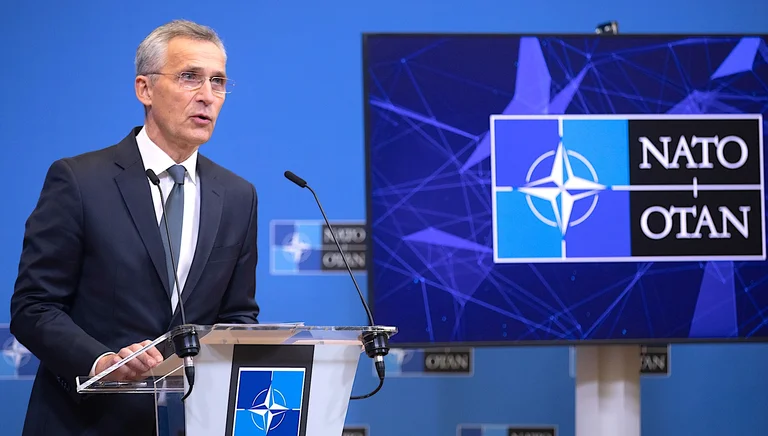
(3 years ago)Secretary - General NATO, Jens Stoltenberg, said it is up to Kiev to decide when the time is right to launch a new offensive against the invading Russian army. He said that, given what Ukrainian forces have achieved to date, he is convinced that “Ukraine will be [...]
He said that, given what Ukrainian forces have achieved to date, he is convinced that “Ukraine will be successful”.
Stoltenberg made his comments in an interview with the Ukrainian Radio Free Europe Service and Time Canal.
On Friday, April 21st, he attended a meeting of the Ukrainian Defence Contact Group, which was held at the air base, Ramstein, in Germany.
Stoltenberg reiterated the statement he made the previous day in Kiev that NATO has decided Ukraine will become a member of the alliance, but must first prevail against Russia.
Our responsibility as NATO allies and partners is to offer as many equipment and support to Ukraine as possible. All this support has made a big difference on the battlefield”, Stoltenberg said.
We need to remember that Ukraine has been able to remove Russian forces from Kiev to the north... and then to the eastern [front] Harkiv é and then south and around Herson”, he added.
The Ukrainian armed forces, their bravery, their courage combined with supplies from NATO allies and partners, have shown they have the ability to free territories”, the chief stressed NATO's interview REL.
Radio Free Europe: Can Ukraine win on the battlefield, taking into account the fact that supply of long-range aircraft and weapons is being blocked by Ukrainian partners? As you know, Russia currently has air advantage...
Jens Stoltenberg: First of all, air protection is important and can be done with land and aircraft systems. The focus now is on earth-based systems. Ukraine has accepted several planes from Poland and Slovakia. But, I think we should make further assessments and discussions on new systems, including aircraft.
The most important thing is to make sure that all systems already there work properly. This means that we need a large quantity of ammunition, spare parts, maintenance, repair equipment, to ensure that thousands of systems function properly. So, I think keeping this attitude on our part is important, perhaps even more important than discussing new systems.
Radio Free Europe: According to your assessment, how much longer will Russia be able to continue the fight against Ukraine?
Jens Stoltenberg: I will not speculate about it, because war, or war, are unpredictable by nature. And we should never underestimate the Russians. They have witnessed their willingness to take aggressive action against Ukraine.
War hasn't started last year. It started in 2014. That is exactly why the message to all NATO allies and partners, as well as to the Ukrainian Defence Contact Group, that we should be ready to stand by Ukraine for a long time, however necessary.
My message to the President [of Ukraine, Voldymor] Zelensky yesterday [April 20th] in Kiev has been that NATO has supported Ukraine for many years and that we continue to stay with Ukraine today, until it continues to fight the aggression of President [rus, Vladimir] Putin against your country. And, we'll be with Ukraine in the future, as long as necessary.
It would be a tragedy for Ukrainians if President Putin wins, but also a danger to NATO allies. It would send a message to all authoritarian leaders that when they use military force to get what they want, they would make the world more dangerous and NATO allies more vulnerable. So my message to NATO allies is that it is in our interest to ensure that Ukraine wins and survives as a sovereign country.
Radio Free Europe: The media, especially Bloomberg, are currently spreading information based on sources, of course, that French President Emmanuel Macron aims to include China at the negotiating table with the Russians and Ukrainians. Are you informed of this initiative and how do you evaluate it?
Jens Stoltenberg: First of all, I think Ukraine should decide when the time is and when conditions allow negotiations for its future. Second, there is no indication President Putin is ready for peace. He's preparing for war. And thirdly, what we know is that although it is very difficult to predict the outcome of this war is that the war will end.
We know that if you end up at the negotiating table, what happens at that negotiating table, is inseparably linked to the situation on the battlefield.
So the only way to ensure that President Putin is willing to accept Ukraine as a sovereign, independent country, and that we have an acceptable solution, is to offer military support to Ukraine, to strengthen its role in any possible future negotiations.
It is up to Ukraine to decide what acceptable conditions are, it is up to us to make sure that Ukraine has strength on the battlefield, which allows us to ensure an acceptable solution to this war.
Radio Free Europe: You have said that all NATO allies, finally, agree that Ukraine should become part of this alliance. Will it be possible for Ukraine... or what are the chances of gaining membership during the upcoming NATO summit in Vilnius [to be held in July]?
Jens Stoltenberg: First of all, I think it is important that NATO has decided that Ukraine become a member of the alliance. I have declared that Ukraine has every right to a country in the Euro-Atlantic family, as a member of the alliance, and for the support we give it.
I also expect the Allies to agree on a multi-year programme through which we will help Ukraine pass from Soviet-era standards, equipment and doctrines to NATO standards. Doctrines will help Ukraine move towards NATO membership.
However, the main focus now, of course, is to make sure Ukraine wins and not President Putin, because we need Ukraine as a sovereign and independent country in Europe.
Radio Free Europe: On the way to NATO, Ukraine has sought a kind of security guarantee to prevent future attacks on its sovereignty and territorial integrity. At what level is this discussion now, what are the allies ready for? What guarantees can be given, and what countries are involved?
Jens Stoltenberg: It's still early to say something. I repeat, we do not know how or when this war will end. What we know, is that when it's over, we have to make sure that history doesn't repeat, that President Putin cannot continue to destroy Europe's security by launching new wars, waging another war against Ukraine.
So we have to sit down and talk about a strong framework, a security agreement, which ensures President Putin cannot continue to attack a sovereign and independent nation.
I can't tell you exactly what it's going to look like, but I'm just saying that the responsibility is for all of us to make sure President Putin's aggressive behavior model stops. Therefore, we also need to discuss how to prevent this in the future.