9 minutes ago
Effects warned for Kosovo, Serbia if they fail to implement Ohrid Agreement
Periskopi(3 years ago)
(3 years ago)France's Ambassador to Kosovo, Olivier Guerot, has declared that he expects the Kosovo government to start talks on forming the Association of Serb majority municipalities. He added that “these days are expected meetings on this issue”. Ambassador Guert stressed that from Serbia's leader, he expects him to respect the obligations he has made [...]
France's Ambassador to Kosovo, Olivier Guerot, has declared that he expects the Kosovo government to start talks on forming the Association of Serb majority municipalities.
He added that “these days are expected meetings on this issue”.
Ambassador Guert stressed that from Serbia's leader, he expects him to respect the obligations he has made and that, on the contrary, there will be consequences for both sides.
“It is very early to say what the consequences will be and now we need to focus on the benefits”, Guert said in the debate on implementing the agreement between Kosovo and Serbia on normalising relations, held Friday at the Media Centre in Caglavica, near Pristina.
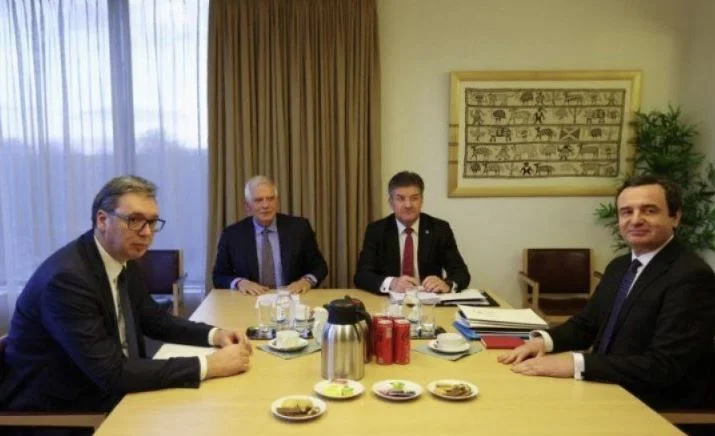
On February 27th, Kosovo Prime Minister Albin Kurti and Serbia's president, Aleksandar Vuciq, agreed to the Agreement on normalising relations on the basis of the European proposal, while on March 18th in Ohrid, they agreed to the Annex for its implementation.
The French ambassador stressed that the main negotiators within the dialogue, Besnik Bislimi and Petar Petkov, will meet on April 4th in Brussels, and praised that this is the first step towards implementing the Agreement.
French Ambassador Guerot said that “a certain level of self-awareness of the Serb community in Kosovo”, mentioned in the Agreement, is unequivocally referring to the formation of the Association of Serb-run municipalities.
Formation of association is envisioned in 2013, between Kosovo and Serbia, but the official Pristina refused to comply with the argument that it is harmful and not in line with the Kosovo Constitution.
The principles for forming association were adopted in 2015, and it accurately confirms that association has full competence in the field of health, education, spatial planning and others.
However, the Constitutional Court of Kosovo found that these principles are not fully in harmony with the Kosovo Constitution, but that they can be harmonised.
Guerot encouraged the Government of Kosovo to start discussing the formation of the Serb majority municipalities.
In the same debate, German Ambassador to Kosovo Jorn Rohde has expressed optimism about implementing this agreement and has stressed that the most important thing at this point is that the agreement has been reached.
“Now we have the political will of actors”, Rode said.
He has expressed the opinion that the agreement on normalisation of relations is a “long-term”, and added that Kosovo should respect the part that concerns the self-awareness of the Serb community in Kosovo, meanwhile Serbia should not block Kosovo's membership in international organisations.
He said he is more optimistic this time around and that he sees the will of Kosovo and Serbia leaders to implement what has been agreed upon.
The German ambassador believes this agreement will facilitate the lives of ordinary citizens, especially members of the Serb community living in northern Kosovo.
Asked by journalists how he comments Serbian President Alexander Vuciq's statements that he will never allow Kosovo to join the United Nations, German Ambassador Rohde said such messages “are not healthy”, but that the international community should focus on implementing the agreement.
The agreement towards normalisation, among other things, envisions mutual respect for independence, autonomy and territorial integrity, but does not specifically mention recognition of Kosovo's independence by Serbia.
Also, Serbia takes over not to block Kosovo's membership in international organisations, while the deal also envisions mutual recognition of license plates, symbols, documents, diplomas and customs stamps.
Also, a particular <x0 ...aragement for the Serb community in Kosovo” is also envisioned in the agreement, or, a certain level of self-advancing.
This proposal is supported by Western countries, including the United States of America.
The European Union has announced earlier that this agreement, although not signed, is legally binding and will become an integral part of Serbia and Kosovo's integration process in the European Union.