21 minutes ago
EU, US want finally to resolve conflict between Kosovo, Serbia
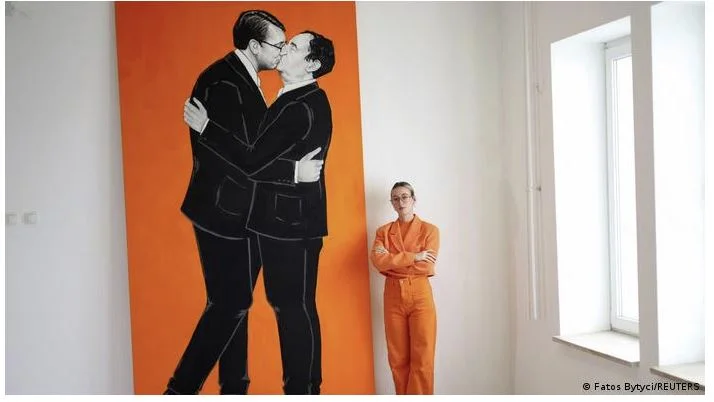
Periskopi(3 years ago)
(3 years ago)On March 18, 2023 Vuciqi and Kurti will meet again under EU mediation. Will the Western proposal for compromise between Kosovo and Serbia be successful, or will the next failure be successful? Russian President Vladimir Putin has always used the ongoing dispute between Serbia and Kosovo as justification for his attacks on Ukraine. [...]
Russian President Vladimir Putin has always used the ongoing dispute between Serbia and Kosovo as justification for his attacks on Ukraine. The West allowed Kosovo, which is almost exclusively inhabited by Albanians, to be separated from Serbia 15 years ago. That is why the West should now allow Russia to retake areas that historically belonged to it, such as Crimea or Eastern Ukraine, Putin says. Launched by this, the West is now rushing to finally settle Kosovo's conflict after decades, in order to lift a pretext from the Kremlin ruler's hand.
The result of Western efforts was the German-French proposal of November 2022, which was published as the EU's stance in late February 2023. The core of the mediation document, containing eleven points, is for both sides to recognise each other's national documents and symbols. Serbia abandons blocking Kosovo's membership in international organisations, including the United Nations. For its part, Kosovo enables the establishment of association of Serb majority municipalities, which has been controversial for ten years, and guarantees special protection for the numerous Serbian Orthodox churches and monasteries of the medieval period in the country.
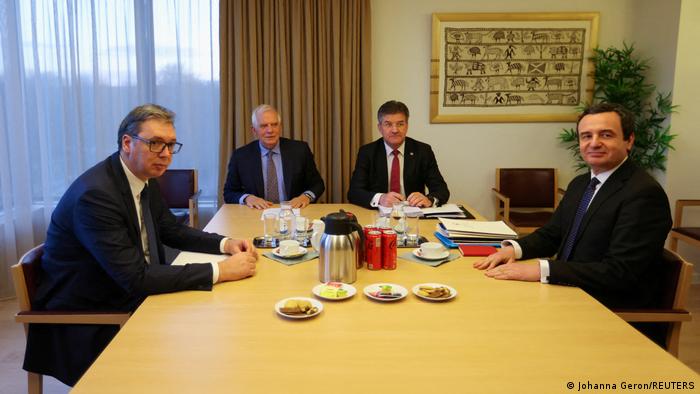 After the Vuciq- Kurti meeting on February 27th 2023 Brussels foreign policy chief Josep Borrell announced that both sides had accepted the EU mediation document.
The United States supports the proposal. And for weeks, senior diplomats from Brussels and Washington are making pilgrimages to the capitals of the countries -- Belgrade and Pristina -- to convince Serbia and Kosovo to accept the proposals. If we trust news in the media of both Western Balkan countries, Western envoys have threatened political and economic isolation if their latest initiative is again rejected as often in the past
Meeting with Borrell
After the meeting between Serbian President Aleksandar Vuciq and Kosovo Prime Minister Albin Kurti (February 27th 2023), Brussels foreign policy chief Josep Borrell announced that both sides had accepted the EU mediation document, which according to him opens the door for the final resolution of this permanent European conflict.
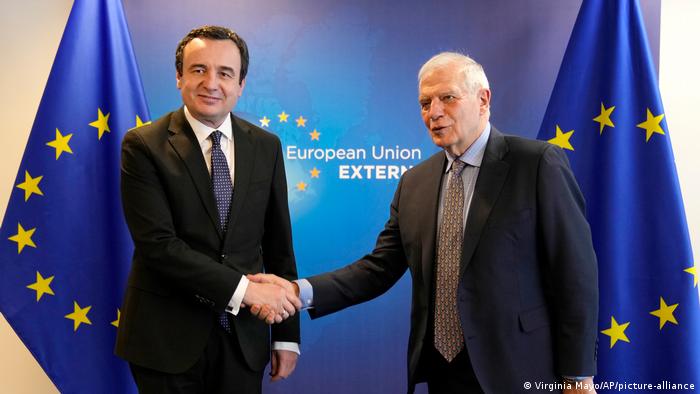 View of Kurti Borrell meeting on February 27, 2023
But after returning from Brussels, neither in Belgrade nor in Pristina was anything heard about whether commitments made at EU headquarters. President Vuciq assured that Serbia will never allow Kosovo to become a member of the UN. Prime Minister Kurti was sworn in at the Pristina Assembly that both an association of Serb municipalities with autonomy and self-government, as well as a special protection for Serbian cultural treasures is not set for discussion.
Albanian, Serbian stances exclude each other
Kurti and Vuciqi's behaviour is not surprising, nor surprising, because Kosovo and Serbia have attitudes on the Kosovo issue that do not comply to minimum. Like Palestinians and Israelis in the Middle East, two peoples claim the same territory. Kosovo is Serbia's heart “argues Belgrade, referring to historical buildings and medieval battlefields. Albanians, on the other hand, see themselves as an autonomous people in Kosovo, where they have long made up the absolute majority of the population.
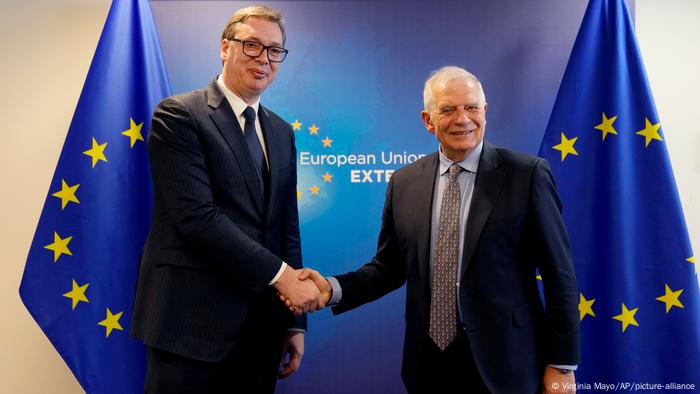 View of the Vuciq Borrell meeting on February 27, 2023
And more importantly, especially in Serbia, the Kosovo issue has been the most important issue of all political forces for decades. For example, former Serbian President Slobodan Milosevic used the Kosovo conflict to ascend to power. Later, Democrat politician Vojislav Kostunica amended Serbia's claim for Kosovo in the Serbian Constitution. Serbia's last democratic president, Boris Tadic, also put the Kosovo issue at the centre of his political agenda. No wonder it is also the basis of President Vuciq's rule.
No Western Critics Against Vucinqi
Since the West says it needs Serbia's head of state to reach a compromise with Kosovo Albanians, Brussels shows restraint against any minor criticism against the increasingly authoritarian system of Vuciqi's rule. The main points of Vuciki's policy are the elimination of all independent state institutions, the instrumentisation of the judiciary, media censorship and the dominance of the economic system by faithful followers.
The “My past and, above all, myths that Kosovo is Serbian holy ground, only serve to prevent us from thinking about today”, criticises Serbian journalist Milojko Pantic. Opposition columnist Dejan Ilic knows that “Vucciqi has been avoiding any obligation for years, lives out of the crisis, and creates different spectacles that will not solve any of Serbia's problems”. It turns out that “if you solve the Kosovo crisis, it will no longer be necessary”.
Meeting in Ohrid
On March 18th 2023, Vucinqi and Kurti will meet again under EU mediation. This time in Ohrid, North Macedonia. At this meeting both sides will have to accept, if they really want to give up their demarcation lines as Brussels claims. How this is supposed to work remains a mystery at the moment. Because for example, Vuciqi will have to give the green light to Kosovo's membership in all international organisations and, however, prevent Pristina from joining the UN.
Kurti, on the other hand, should enable the association of Serbian municipalities even though he opposes any institutional and territorial forms of this association and wants to limit minority protection only to individual persons. And as for the particular protection of Serbian monasteries and churches Belgrade is trying for, the opposition in Kosovo is already saying that in the future you will have to show the passport to visit these cultural assets.
In view of this mixed situation, undoubtedly high level of diplomatic art is required to agree to the incompatible. But after past decade's experiences with politics towards the Western Balkans, we should fear there will be again a compromise with which everyone can identify himself but who will not change real problems. /dw