16 minutes ago
Drift extension: Presidency against change of tariffs, Government Seeks to Touch Business
Periskopi(3 years ago)
(3 years ago)The presidency and the government have submitted their comments regarding the Energy Regulatory Office's proposal that tariffs be expensive for about 14 per cent. The country's first has recommended that tariffs not be changed and that additional costs of operators be covered through the EU's 75 million package, as far as executives have suggested [...]
New electricity tariffs will take effect from 1 April. More likely, they'll be more expensive. The initial proposal by the Energy Regulatory Office is for the tariff to rise for about 14 per cent, but for the final decision to be made after analyzing comments by the interest parties.
On this proposal, the government presidency has different opinions.
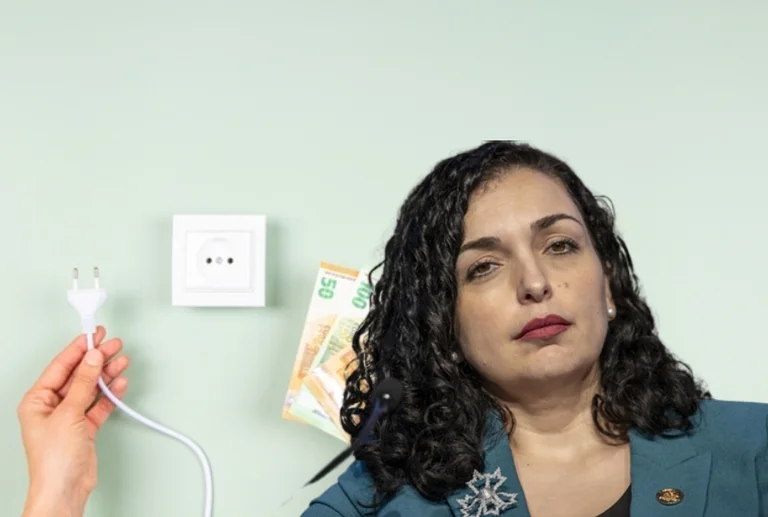
In comments he handed in to Z RRE, President Vjosa Osmani's office has recommended that there be no tariff increases. The reason for this has given the high inflation rate.
To cover the additional costs that have contributed to increased difficulties for regulated operators, the presidency has cited the possibility of covering them through subsidy.
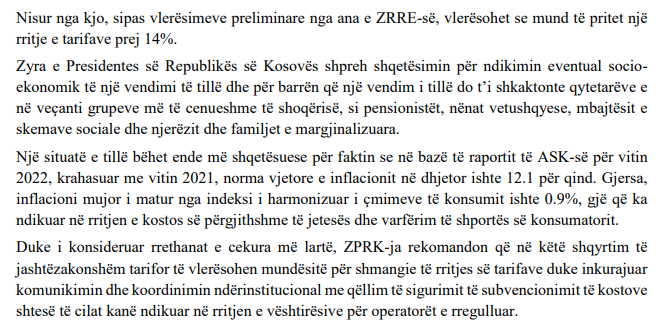
“... Z The PRK recommends that in this extraordinary tax review, the opportunities to avoid raising tariffs by encouraging communication and inter-institute co-ordination with the aim of ensuring the subsidisation of additional costs that have contributed to increased difficulties for regulated operators”, the ZPRK's comments said.
For this, the presidency has said it could also contribute the 75 million EU package.
The EU's energy support package for Kosovo through which 75m euros have been provided to help deal with the energy crisis. Under the agreement between Kosovo and the EU, 25m euros will go towards subsidising energy bills and alternative heating methods, such as wood and diapers.
So, the ZPRK, recommends that prior to making a final decision, the possibility of subsidisation be seriously considered, avoiding the need for a new ZERE decision, which would result in renewed increase of tariffs in our country”, says the Presidency's comments.
Comments have also delivered the Office of the Prime Minister. In comments sent out, ZKMA suggests that household fees remain unchanged and that coverage of the gap be made by adjusting tariffs for businesses, especially large ones.
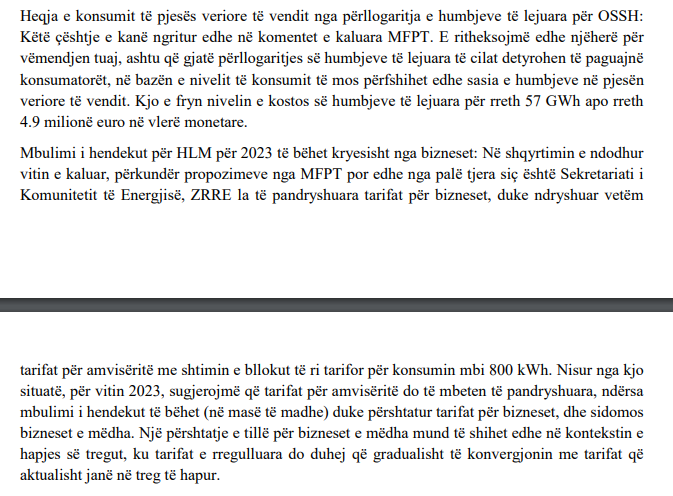
“Covering the HLM gap for 2017 to be done mainly by businesses: In last year's review, against MPPT proposals, but also other parties such as Energy Community Secretariat, Z. The RHR left tariffs for businesses unchanged, only changing household tariffs to the addition of the new tariff bloc for consumption over 800 kWh. In view of this situation, for 2023, we suggest that household fees will remain unchanged, while coverage of the gap will be made (in large measure) by adjusting fees for businesses, especially big businesses. Such adaptation to large businesses can also be seen in the context of opening the market, where regulated tariffs should gradually be converted to tariffs currently on the open market”, said the comments sent by the ZKM.
The Energy Regulatory Office has confirmed the Gazeta Express's acceptance of these comments, adding that after their review they will publish the final report in response to the parties.
“The Energy Regulatory Office has accepted comments from : COST, KEDS, KESCO, KEK, President's Office and the Office of the Prime Minister. Z The RRE is in the process of assessing the comments received by the interested parties, and after their analysis it will publish the final report in response to the parties. This phase of consultation included the process of determining maximum access, and after their approval, regulated operators apply for tariffs”, Petit Pepaj of the ZRRE said.
Otherwise, the tariffs currently in effect were approved on February 8th of last year.
With these fees, expensive bills have been spent over 800 kilowatts per hour per month.
Tax consumers over 800 kilowatts per hour have the high fee of 12.5 cents per kilowatt and 5.9 cents per low fee.
For consumers who spend up to 800 kilowatts per hour monthly, the high rate is 7 cents, while the low one, 3 cents.