21 minutes ago
No trilateral meeting, Lajcak's meetings conclude with Bisimi of Petkov
Periskopi(3 years ago)
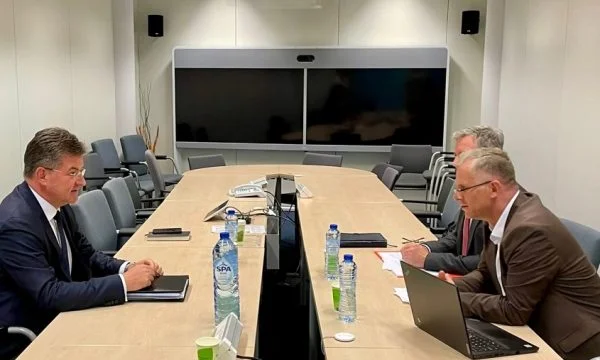
(3 years ago)Kosovo and Serbia's chief negotiators have held meetings in Brussels on Thursday to discuss implementing preliminary agreements reached between the two countries. The European Union's envoy for dialogue between the two countries, Miroslav Lajcak, has first met with Serbia's chief negotiator, Petar Petkov, at the same time chief of the Office for Kosovo in the government [...]
Kosovo and Serbia's chief negotiators have held meetings in Brussels on Thursday to discuss implementing preliminary agreements reached between the two countries.
The European Union's envoy for dialogue between the two countries, Miroslav Lajcak, has first met with Serbia's chief negotiator, Petar Petkovovic, simultaneously head of the Office for Kosovo in Serbia's Government, and later with Kosovo's chief negotiator, Besnik Bislim, the country's deputy prime minister.
There has been no trilateral meeting, reports Radio Free Europe.
The EU has announced that expert meetings for the unemployed and energy issues have been held in parallel.
Bislimi has said Wednesday that the 16 November meeting is the continuation of the meeting held on 26 October with leaders of Germany, France, Italy and the European bloc.
Petkov has said days earlier that in Brussels it will be launched with a “ekip experts”.
According to European sources, on the agenda of meetings it has been a discussion of the draft Association of Serb-run municipalities in Kosovo, but also of the next steps in implementing obligations stemming from the Agreement to normalise relations between the two countries.
The parties have reached compliance with this agreement in February in Brussels, while for the implementation annex in March in Ohrid.
However, at Thursday's meeting, according to EU sources, the top priority will be association.
The bill for this association has been handed over to the parties in October by a joint delegation of the United States, the EU, Germany, Italy and France.
The EU views this draft as the modern European “plan” and insists that the parties accept it.
Although the contents of this draft continue to be incontinent to the public, the EU and the main member states view it as the best proposal and as compromise which parties should use to move forward.