2 minutes ago
The lack of dinars in Kosovo's Serb areas: Hard without money, it's all blocked
Periskopi(3 years ago)
(3 years ago)Zoran from Gracanica, the Serb-run municipality in central Kosovo, could not receive his pension on October 12th because, as they said in the post, there was no money. “You don't have to buy food now, no one gives you money”, he tells Free Europe Radio. Nor on October 13 [...]
Zoran from Gracanica, the Serb-run municipality in central Kosovo, could not receive his pension on October 12th because, as they said in the post, there was no money.
“You don't have to buy food now, no one gives you money”, he tells Free Europe Radio.
Not even on October 13th morning did he get the money.
His pension is about 40,000 dinars, which is about 350 euros. As he says, three members of his family live with that money.
We've been waiting, there's no money, it's all blocked. All pensioners are unhappy, depressed, without money it's hard”, Zoran adds.
Serbs in Kosovo receive pensions from the Serbian system, so they are paid in dinars, Serbia's official currency.
Meanwhile, a pensioner from Northern Mitrovica tells Radio Free Europe that the payments in this city in northern Kosovo have started on 13 October.
Besides pensions, salaries for workers working in Serbian institutions in Kosovo, additions to children and lehonia, as well as social assistance are paid in dinars as well.
These revenues may be withdrawn to the post office or to Post Bank ATMs (Poštanska ãodionica), which operates within the Serbian system.
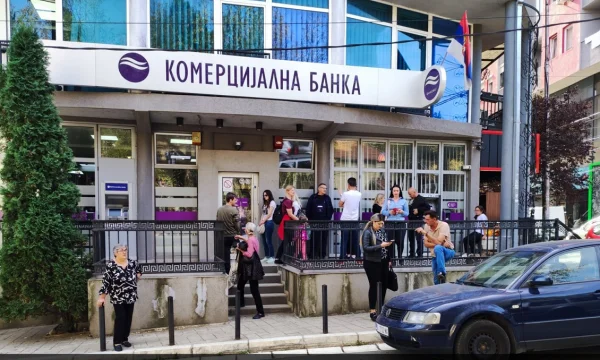
Also, the commercial bank, NLB, has branches in Serb-run majority areas in Kosovo, where there may be accounts in dinars.
Why doesn't he have dinars?
In Serb-run areas in Kosovo, besides Euro currency, the dinar is also in use. In four municipalities in northern Kosovo, northern Mitrovica, Leposaviq, Zvecan and Zubin Potok, prices at stores are marked with dinars.
In recent years it has been practiced to import money (dinarians) from Serbia through the Jarinje border crossing point, because this crossing is the closest to Leposavicin, where is the representative headquarters, or the National Bank of Serbia's treasury.
However, Jarinje has been closed since 24 September, when a group of registered and armed Serbs attacked the Kosovo Police in the Zvecan municipality's Banjska. In this attack, Sergeant Africa Bunnjak was killed, while three of the attackers were killed in the ongoing clashes between police and armed groups.
Brnjak, the second border checkpoint in northern Kosovo, was then closed, but opened on 4 October. However, Jarinje is still closed due to <x0 field investigation” following the attack on Banjska.
Kosovo police have not answered Radio Europe's free question about when investigations on the ground are expected to end and the border crossing point opened for entry at Jarinje. Currently, through this crossing, it is possible to leave Kosovo, but it is not possible to enter.
Limited ATM attractions
On October 13, REL saw ahead of the branch in Gracanica of the NLB commercial bank that the money transport company “Henderson” has brought dinars. Some of the people he talked to. REL, confirmed they have managed to withdraw money from the ATM, but they fear it will be empty again in a few days.
REL could not confirm whether the dinars, with which the ATM was filled, were imported from Serbia through another crossing point or whether they were delivered by the National Bank of Serbia's vault in Leposaviq.
On the other hand, October 12th at Post Bank ATMs in North Mitrovica could attract 10,000 dinars, which is about 80 euros.
We recall that earlier the daily border at the Post Bank ATMs was 50,000 dinars, while there was no limit to attracting money to the sports.
A North Mitrovica resident who has wanted to remain anonymous told Radio Europe Free on October 12th that she has tried to pull money into one of the two Post Bank ATMs in North Mitrovica, but that she wrote the highly wrong “ ” on screen.
In another ATM, the people who pulled the tools told me the amount was limited to 10,000 dinars. I decided to withdraw the money into the sports, but they told me that even there could only be 10 thousand dinars”, she says.
She then attempted to withdraw money to Zvecan, where she also has the Post Bank branch, but there was no money in ATMs, even though there was limited withdrawal.
The “Ende was possible to withdraw as many as 50,000 dinars in the sports room”, she added.
Radio Free Europe asked the NLB commercial bank, the Post Bank and the Post of Serbia, why there has been no dinars for payment in Serb-run areas in Kosovo over the past few days, and whether it is known how long it will last “magea” of the dinar, but until the publication of this text, no response has been made.
Nobody: Problem is solved, co-operation with Kosovo institutions is necessary
Former director of Serbia's Kosovo Post, Randel Nojik, in his statement to Radio Free Europe underlines that this is not the first time that it has <x0 dinar community”, but that this problem is “
We organized ourselves in a completely different way and exceeded it. For that (passing the problem), correct co-operation is needed with institutions in Pristina. We've had very good (co-operation) and there's always been an alternative solution to overcoming that problem”, Nojjic explains.
Currently, the director of Serbia's Post in Kosovo is Ivan Milojevic.
He has earlier participated in the work of the Kosovo Government through the Serbian List, the largest party of Kosovo Serbs to have Belgrade's support. He was director of the Kosovo Prime Minister's Cabinet Office and minister of Regional Development.
Radio Free Europe has attempted to contact him to get more details about “
On the other hand, Nojik stresses that money from Serbia should not be introduced only through the crossing in Jarinje, despite the national bank of Serbia's safe is located in Leposaviq.
“It is only necessary to reach an agreement (with Kosovo authorities) to contact the Post Bank. It takes only an application to agree with those in Belgrade, I mean the problem is solved, but that employees should be engaged, proposed a solution”, he adds further, and reiterates that these are “technical issue”.
He emphasises that the co-operation of Serbia's institutions with Kosovo authorities is necessary and that this has previously been a regular “”.
“We have regularly communicated, whenever there has been any problems we have gone and we have agreed with them (the authorities of Kosovo) on how to overcome it. In doing so, we have not violated Kosovo's laws, but we have co-operated. Co-operation with Kosovo institutions is necessary for the lives of Serbs in Kosovo”, Nojrik concludes.
Prior to the problem with “the lack of dinars”, even health institutions in Serb communities in Kosovo had warned of “the lack of medicines and medical materials”. Health care in Serb communities in Kosovo functions, as well as under the Serbian system.
However, the Ministry of Health of the Government of Kosovo has denied these claims on the grounds that no “requirement for donation” of medical products from Serbia, destined for health institutions in Kosovo's predominantly Serb municipalities. / REL/