20 minutes ago
What does the European Parliament resolution mean condemning the terrorist attack on Banjska?
Periskopi(3 years ago)
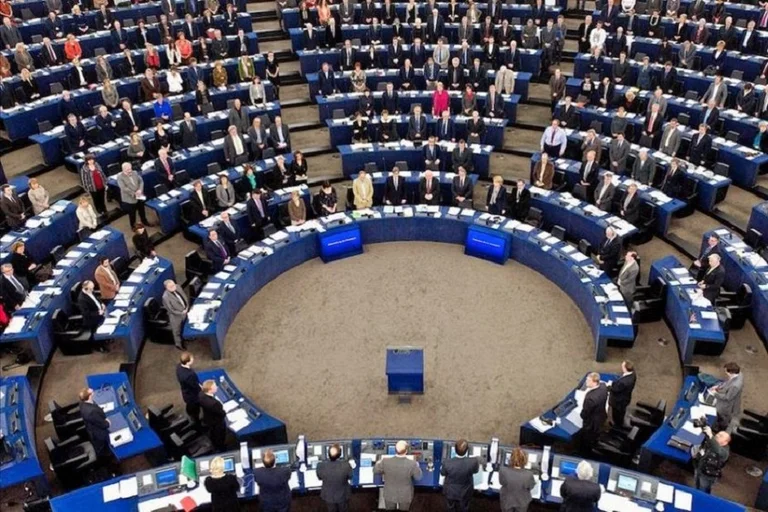
(3 years ago)The European Parliament today has voted the resolution regarding Serbian aggression in Zvecan Banjska on 24 September. The resolution contains 28 points in which it speaks of recent political developments and the dialogue process. The EP strongly condemns this aggression. “Calls on all EU member states that do not [...]
The European Parliament today has voted the resolution regarding Serbian aggression in Zvecan Banjska on 24 September.
The resolution contains 28 points in which it speaks of recent political developments and the dialogue process. The EP strongly condemns this aggression.
The “call on all EU member states that have not done so so so far to also condemn the attack. It expresses deep sorrow for the victims and expresses condolences to Africa's family, colleagues, and girlfriends. Kosovo Police Co-operation With International Partners Commended EULEX and KFOR in its response to the” attack.
Furthermore, it is required that all sides work on the escalation of the situation in the north. EU states are urged to impose measures on Serbia if proven to be behind Serbia's aggression.
The “is invited to the European Commission and the Council to take measures towards the Government of Serbia if investigations testify to direct connection of Serbia's state with the attack on Banjska or even the violent attacks that took place in northern Kosovo in May 2023, or if Serbia's authorities will not show a will for full co-operation in the investigation process. It is called on the Commission, in this context, to freeze the funds provided to Serbia under the Instrument for Pre-Adherence Assistance III, if the investigation findings show that the Serbian state was directly involved in these attacks. The Council is invited to adopt targeted rhetorical measures, including not even limited, the freezing of property and the prevention of travel for destabilising actors in northern Kosovo and leaders of key organised crime networks. In this context, we invite the Council to follow the example of the United States for the deployment of measures targeted against Milan Radovici”.
Similarly, the increase in the number of Serbian Army soldiers on the border with Kosovo is strongly condemned: “is required by Serbia to refrain from supporting any terrorist group in northern Kosovo in the future. It is called on Serbia to refrain from this repeated model of escalation in the future and to be brought in full accordance with the Kumanovo Agreement. It is called on Serbia to step up its efforts to descale tensions caused by the deployment of its military”.
Full resolution with 27 points:
- We condemn in the most powerful way possible the cowardly terrorist attack on Kosovo police members by well-organised Serb paramilitaries in Banjsk in northern Kosovo, which took place on 24 September 2023 and resulted in the murder of Kosovo police officer Africa Bulnjak and the wound of two other Kosovo policemen. All EU member states that have not done so so so far also condemn the attack are urged. It expresses deep sorrow for the victims and expresses condolences to Africa's family, colleagues, and girlfriends. Kosovo Police Co-operation With International Partners Commended EULEX and KFOR in its response to the attack.
- It is required by all sides to work to de-tradition the situation in northern Kosovo and to avoid any rhetoric or action that would further increase tensions. All facts about the attack are being confirmed and continuing investigations by Kosovo authorities are being closely followed. We extend an invitation for the EU to support investigations on the part of Kosovo authorities, including the support of [EU Commission in Kosovo for Endimmation of Law] EULEX, underlining the importance of the leaders of these attacks being held accountable and facing justice without delay. Kosovo authorities are invited to present all evidence concerning the incident, Serbia is required to co-operate fully with investigations and bring to justice responsible persons in Serbia, in accordance with the law, including extradition to Kosovo.
- It is stressed that this operation shows a heavy military increase and represents a major escalation, which is illegal and conflicts with the EU's repeated calls for a transit to northern Kosovo. It is urged on Serbia to refrain from any further escalation that violates the constitutional order of the Republic of Kosovo and prevents any arms smuggling across the border. Furthermore, Kosovo authorities are required to work towards free trade for all goods and civil services in this direction;
- The European Commission and the Council are invited to take measures against the Government of Serbia if investigations testify to direct ties of Serbia's state with the attack on Banjsk or even the violent attacks that took place in northern Kosovo in May 1923, or if Serbia's authorities will not show a will for full co-operation in the investigation process. It is called on the Commission, in this context, to freeze the funds provided to Serbia under the Instrument for Pre-Adherence Assistance III, if the investigation findings show that the Serbian state was directly involved in these attacks. The Council is invited to adopt targeted rhetorical measures, including not even limited, the freezing of property and the prevention of travel for destabilising actors in northern Kosovo and leaders of key organised crime networks. In this context, we invite the Council to follow the example of the United States for the deployment of measures targeted against Milan Radociqi.
- The increase in the number of Serbian Army soldiers on the Kosovo border is strongly condemned. I take into account the important step presenting the partial withdrawal of Serbia's troops from the border with Kosovo. It is required by Serbia to refrain from supporting any terrorist group in northern Kosovo in the future. It is called on Serbia to refrain from this repeated model of escalation in the future and to be brought in full accordance with the Kumanovo Agreement. It is called on Serbia to step up its efforts to descale tensions caused by its military deployment. It is called on Serbia, in this regard, to withdraw all military bases located near the border with Kosovo, including equipment such as counteraircraft systems and heavy artillery units, to refrain from any non-proportional military deployment in the area in the future, and to ban any support for terrorist formations in northern Kosovo.
- It is stressed that such aggressive military behaviour, along with radicalised political messages in Serbia and strong indicators of Serbian state involvement in recent political violence in northern Kosovo, shows that the Serbian government is pursuing a very dangerous but consistent policy regarding Kosovo and its Western partners.
- The May 2023 violent attacks against KFOR soldiers, Kosovo police officers and journalists are strongly condemned. The relevant authorities are urged to bring to justice all the perpetrators of these miserable attacks.
- It is called on KFOR to create a control plan in northern Kosovo, including powerful elements that can act as obstacles to further escalation. The deployment of 200 United Kingdom soldiers in Kosovo is welcomed to reinforce KFOR and strongly ask EU member states to deploy additional troops in the country without further delay. Highly Welcomed to Decision NATO to equip KFOR with heavier weapons to grant it more combat power. NATO is required to ensure that KFOR has the necessary capabilities to monitor closely the entire north of Kosovo and to conduct continued oversight of the region to ensure that any paramilitary incidents, attacks or actions or any attempted kidnapping of Kosovo law enforcement officers could be revealed immediately, at a very early stage. It is called on the EU and its member states to further increase EULEX units on the ground, especially in northern Kosovo, and, if necessary, to temporarily strengthen its role as a security responser in northern Kosovo.
- Taking into account the fact that Serbia kept a national day of mourning honoring all victims. It is a profound regret that the three dead terrorists were portrayed as heroes who fought for the cause of Serbs, which has raised many political tensions in the region.
- An increase in international co-operation and cross-border between Serbia and Kosovo for organised crime is called. Sorry that limited progress has been made in investigating and prosecuting such cases. Express concern for the challenging situation regarding the fight against organised crime in northern Kosovo, where criminal gangs continue to act, negatively affecting the life and future prospects of Kosovo citizens in northern municipalities. Concerned by evidence linking violent criminal groups in northern Kosovo and in Serbia to the Serbian state. It is called for a full investigation to address these concerns, calls on KFOR and EULEX to conduct regular joint security assessments in northern Kosovo to assess the security situation and focus more on the important role organised crime plays in developments in that region.
- Stated regret that Belgrade's court rejected the Belgrade Chief Public Prosecutor's Office's call for the detention of Milan Radojici because of the danger of his escape, given that Radojic took responsibility for organising the 24 September 2023 attack. Deep concern is expressed that all those responsible for the attack on Banjska may not be brought to justice.
- It is called on Serbia and Kosovo to denounce all forms of violence and acts of provocation, requiring immediate restraint and interruption of any action that could further escalate tensions. It is called on Serbia and Kosovo to refrain from unilateral actions that could undermine peace and stability in the region, and instead work actively towards peaceful resolution of disputes through EU-launched dialogue. The handling of the September 24th 2023 serious attack by Serbian authorities, including their reluctance to co-operate in the investigation, their role in spreading propaganda for the attack, praising the authors, and giving political support, their soft attitude towards organisers and perpetrators of the attack, which also extended to their housing security, rhetoric used by Serb leaders during this crisis, and their efforts to destabilise Kosovo. A proper investigation into all ethnic attacks across Kosovo, including attacks on the Bistrica bridge and on the eve of Orthodox Christmas, is called for.
- The normalisation of relations between Kosovo and Serbia is supported; the call to Serbia and Kosovo is renewed to participate in the Belgrade-Pristina dialogue in trust and in the spirit of compromise to reach a comprehensive, legally binding agreement for normalising their relations without further delay, based on bilateral principle. Recognition and international law. The respective parties are called on to make the dialogue more oriented towards citizens. It is called on the European Foreign Action Service to share more sources for EU facilitated dialogue.
- It is called on the EU to strengthen its role as a facilitator in the Serbia-Kosovo dialogue and the Western Balkans in general, and to propose a new and balanced approach to intermediation between the parties to overcome the current stalemate, given the consequences of the September 24th 2023 attack and the fact that confidence in the process must be restored.
- We seek, in particular, from EU High Representative for Foreign Policy Josep Borrell, and EU Special Representative for the Belgrade Dialogue Miroslav Lajcak to facilitate dialogue in a professional manner and report to the European Parliament no later than the end of 2023 on their findings regarding the commitment of Serbia and Kosovo and the realisation of dialogue goals; we underline that normalising relations is essential for the progress of the two countries towards EU membership; remember that failure to act constructively and trust the normalisation of relations will have consequences for EU membership; calling on EU countries to take action in the framework of the pre-member countries that respect the agreements.
- We call on Serbia and Kosovo to fully implement the Brussels Agreement on February 27th 2023 and the Ohrid Annex of March 18th 2023, as well as all previous agreements and to do so with sincerity and trust; we express regret that Serbia has refused to sign the Ohrid Agreement and the Annex; We call on the European Foreign Action Service and the Commission to maximize efforts to ensure effective implementation of these agreements, including the return of Kosovo Serb representatives to Kosovo institutions; We call on Kosovo to establish the Association of Communities with the Serb Majority without further delays, in line with the 2013 and 2015 Brussels Accords, the Constitutional Court of Kosovo and the Constitutional Court Act of 2015; We believe that a final and comprehensive solution will boost co-operation, stability and prosperity in the region; We stress that the September 24th 2023 attack should not serve as an excuse to turn attention away from dialogue for the normalisation of relations; Serbia must make efforts to regain its credibility in dialogue, as a result of its harmful role in the events of September 24th, 2023.
- We regret that Serbia has resumed its recognition campaign to Kosovo; We urge Serbia to refrain from trying to isolate Kosovo from the international scene by campaigning against its recognition; We express deep regret over Serbia's opposition to Kosovo's membership in the Council of Europe, which clearly violates the February 27th 2023 Brussels Agreement; We urge Serbia to refrain from threats or use of force, in line with its international obligations.
- We regret boycotting judicial institutions, encouraged by Serbian political parties; We apologize for boycotting local elections in northern Kosovo on 23 April 2023 by the main Serbian political party in Kosovo, the Serb List, and the intimidation of opposition Serbian politicians; We regret the Kosovo government's insistence on holding Albanian leaders, despite very low voter turnout, as the low degree of legitimacy of Kosovo hinders the process of hiring the integration of the Albanian and Serb communities in Kosovo.
- We stress that it remains essential to hold early local elections in four municipalities in northern Kosovo to help reduce tensions and encourage authorities to ensure full participation of all political parties in free, democratic and peaceful elections; We reiterate that Serbia, too, should be publicly engaged in the participation of Kosovo Serbs in the election, as the Serbian List has already declared its unconditional participation.
- We call on Kosovo Serbs to return to Kosovo institutions and refrain from further escalation of tensions on the ground, and we encourage Kosovo Government to significantly step up its efforts to reintegration, as initiatives to include the Serb community in Kosovo's political, social and economic issues; We resume that reconciliation and the involvement of the Serb community in Kosovo is essential for ensuring stability in the country and moving forward in normalising Pristina relations, Belgrade, within the EU-led dialogue; We reiterate the call for Kosovo authorities to improve internal dialogue with independent civil society organisations in northern municipalities in order to build confidence and facilitate the permanent life of Kosovo Serbs.
- We express regret over the measures the Council of Europe has taken against Kosovo and call on them to be removed as soon as possible; we ask the European Commission and the Council of Europe to resume their high-level contacts with Kosovo's president and Government; we call on the Commission to draft and present a transparent and ambitious guide to Kosovo's path towards engagement by the end of the year;
- Major concern remains from destabilising influence in the entire region by Serbian authorities led by President Aleksandar Vuciq; We stress steadfast support for Serbia's citizens in their fight for a European and democratic future; We regret that some of the policies of the Serbian leadership hinder the desire of Serbian citizens for a European future.
- We call on the European Commission to act as an honest mediator in the normalisation process and avoid any policy of calming Serbia; We express concern over the lack of loud criticism from the Commission, despite Serbia's failure to commitment to EU sanctions against Russia, its continued and frequent meeting of its high-level leadership with Russian authorities, including Russia, its democratic setback and lack of progress in the European Union.
- We call on Serbian authorities, senior political representatives and officials to refrain from using the derogatory language in connection with the EU-mediated negotiation process, EU policies in the Western Balkans and the overall EU process, as such behavior can lower public support for EU policy.
- We call on Serbian authorities and media to refrain from hate speech against Kosovars and spread lies about “ethnic cleansing” and “pogrom” in Kosovo, for which there is no evidence; We call on Serbia's Parliament to ban the use of stimulating language;
- We recall that the visa liberalisation agreement for Kosovo is not and should not be linked to dialogue and should enter into force later on January 1st, 2017.
- We condemn continued Russian efforts to exert influence over the Western Balkans, and especially in Serbia and Kosovo, by exploiting cultural, ethnic and religious divisions and destabilising pro-democratic forces; We call for a complete clarification of Russia's possible role in the attack on Banjska. /Klankosova.tv/.