13 minutes ago
Putin's special unit divers allegedly damaged the Nord Stream gas pipeline
Periskopi(4 years ago)
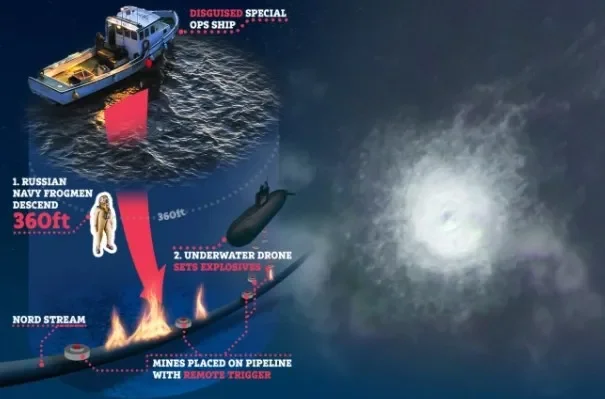
(4 years ago)A number of Russian Army special unit divers allegedly are behind the attack on the Nord Stream gas pipeline, security experts report, broadcast the Sun”. Spetsnaz a secret group of Russia's Army with the help of underwater drones allegedly damaged the pipeline. Large bubbles appeared on the surface of the sea in [...]
A number of Russian Army special unit divers allegedly are behind the attack on the Nord Stream gas pipeline, security experts report, broadcast “The Sun”.
Spetsnaz a secret group of Russia's Army with the help of underwater drones allegedly damaged the pipeline.
Large bubbles appeared on the surface of the sea near the Danish island of Bornholm, following reports of explosions near the gas pipeline on Monday. Denmark is a NATO member.
Sweden has confirmed that it had discovered two underwater explosions near the leak site, while German engineers reported having a decrease in gas pressure and the pipes were damaged and opened.
Western leaders accuse Russia of sabotaged this line to trigger an energy crisis in Europe before winter.
And according to an independent defence analyst, “is not far from thinking” to be believed that Moscow is behind this gas pipeline attack and the one before NATO's noses.
Marine war expert H I Sutton has said the Russian special marine unit GUGI, reportedly reporting directly to Russian President Vladimir Putin, may have used underwater fears to carry out the attack.
“Today Russia has one of the largest fleets of global intelligence submarines. These are based on arctic. They're able to destroy a tube at Baltic”, Sutton said. But it seems impossible”.
GU GI news directorate secret Theta Marine Research has a mission to give a disaster blow to the West and reports that this unit is commanding the highest naval command.
H Sutton also says the underground supply channel is about 70m deep and can be achieved by professional divers, who may have placed bombs on it.
“People will always point to Russian Spetsnaza diver in Baltic. It's not far from your mind”, Sutton said.
He has said Russia also has higher-level underground fears and is able to carry out deep sea attacks.
Russia has underground fears. A new center for their development is in St. Petersburg. Some of this might be appropriate”, Sutton said.
But he said it took a ship to send the drones there.
Danish Defence Researchers Anders Puck Nielsen has also expressed these concerns. He says Putin's military could put explosives in the gas pipeline.
If technically speaking, it's not difficult. I need a boat. It takes some divers who know how to set up explosive devices. If we see who would benefit from this, more chaos in the gas market in Europe, I think there is only one actor who would actually benefit, is Russia”, Nielsen says.
Another possibility is that Russian military forces have secretly installed underwater mines and deported them several days or weeks later.
Ukraine has accused Russia of terrorist attacks after three leaks into two strategic tubes located under the Baltic Sea.
Poland's Prime Minister, Matthews Morawicki, has said it is a sabotage act, while Denmark and Sweden have also praised it as deliberate actions.
Swedish Prime Minister Magdalena Andersson has said that information received from intelligence suggests that it was a deliberate explosion. /Time/