9 minutes ago
Tens of diplomatic missions, but only seven military attachors
Periskopi(4 years ago)
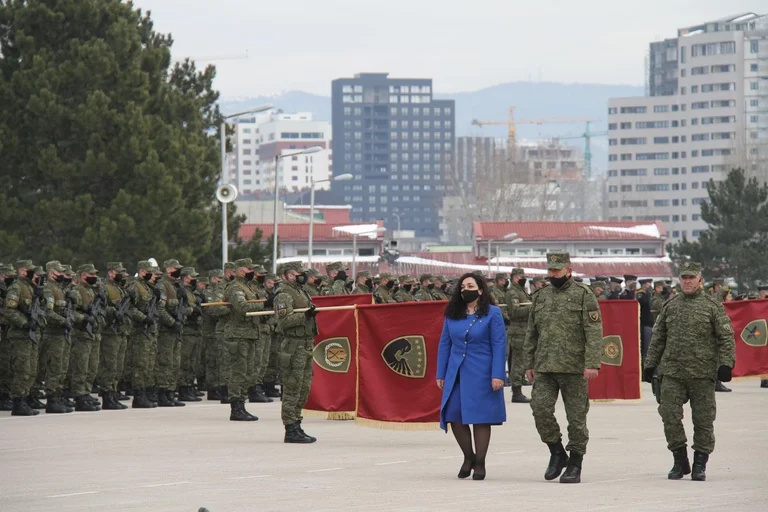
(4 years ago)Of the more than 60 embassies and consulates, the size of the Republic of Kosovo in the world, in only seven of them there are military attachors. These Kosovo envoys currently serve in missions in the US, United Kingdom, Germany, France, Turkey, Albania and Croatia. At the Kosovo Defence Ministry, they say they are in the process of praising [...]
These Kosovo envoys currently serve in missions in the US, United Kingdom, Germany, France, Turkey, Albania and Croatia.
In the Ministry of Defence, the Kosovo Ministry of Defence says domestic assessments are under way with the Ministry of Foreign Affairs to increase the number of participants in states that have recognised Kosovo's independence, which was declared in February 2008.
Kosovo's defence ministry, currently, has the number of defence attachés in line with its policies in the field of international co-operation, as well as the process of integration into regional and Euro-Atlantic defence structures”, says Radio Free Europe Colonel Sefer Isufi, chief of strategic communications at the Defence Ministry.
Under the law in Kosovo, the task of defence attaching is to develop and promote defence interests in the country they are assigned to, as well as to strengthen military and defence relations with that country.
Defence attaché is an active member of the Kosovo Security Force. He is not a career diplomat, but enjoys diplomatic immunity according to international acts and conventions in power.
The attaché is resolved following the passage of several contests within the Ministry of Defence and then, with the proposal of this ministry, is passed into consultation at the Ministry of Foreign Affairs and is prosecuted further.
Isufi says the focus of the Ministry of Defence is further strengthening the authority of the military attaché in countries that consistently support Kosovo and have a bearing on decision making, as far as global defence and security are concerned.
He does not mention a specific location with a view to sending new ones.
Deputy Minister of Foreign Affairs and Diaspora in Kosovo Kressnik Ahmeti says sending military attachés to various states is determined on the basis of plans and priorities Kosovo has.
Because of the sensitivity in defence and security, of course, [the work of military attachors] is not reflected in public, as other matters can be reflected. But the goals and successes of these groups are those that surround our army, the Kosovo Security Force, with the armies of host countries, and also with various defence organisations, such as NATO”, Ahmeti tells Radio Free Europe.
Kosovo's first military attaché: We weren't quite ready.
Xhavit Gashi was the first Kosovo military attaché to serve in the United States.
He was appointed in April 2011 and served until 2016.
When Kosovo was given the first opportunity to have military attachés, we were not fully available and familiar with what had to be secured...”, Gashi says.
I, when I was in Washington, not only did military co-operation work, but I was also engaged in events involving foreign policy, so not only those of security and intelligence, which should be the focus”, he adds.
According to Gashi, military attachés also cover the intelligence sector and it is good for Kosovo to have as much as possible.
“In the countries we have friends, it doesn't mean that we do some spying or get information from their institutions, but, along with that, we can get important information about joint goals”, Gashi says.
Avni Spahiu, who has served as ambassador to the Republic of Kosovo in the United States and Turkey, says the need for increasing the number of attachors in diplomatic missions defines the foreign ministry, in co-operation with the Ministry of Defence.
I think there's been some kind of negligence. It means, not only in terms of the appointment of military attachés, but also in diplomacy in general”, he says.
In recent years, there have been some delays in appointing new ambassadors to several Kosovo embassies in the world, including the US.
The “should be seriously thought that Kosovo's representation, both in a military way, is worthy and as required for a state, especially for a new state, which has ambition to be part of Euro-Atlantic structures”, Spahiu tells Radio Free Europe.
After Russia's invasion of Ukraine in late February, Kosovo has called for accelerated membership in NATO's military alliance.
But as a hurdle in this direction is Kosovo's non-recognition by four NATO member states: Spain, Greece, Slovakia and Romania.
The role of diplomacy in changing this situation is seen as incomparable.
Haki Abazi, chairman of the Kosovo Parliament's Commission for Foreign Affairs and Diaspores, says it is time for institutions to focus on appointing as many attachities, not only on military, but also economic and cultural issues.
“If our priority really is NATO membership, military attachés play an important role in two aspects: in building bilateral capacities, training high-level military cadets through the academys of host states, but also in their support for the NATO membership process... so that their role would be in the phase in which we are located<1>, Abazi says.
Declared independent 14 years ago, Kosovo is recognised by 117 states in total.
Nearly half of them have recognised it in the year of its 2008 declaration of independence.
In the last five years, meanwhile, only four states have recognised Kosovo. This, despite the fact that the International Court of Justice found in 2010 that Kosovo's independence “does not conflict with international law”.
Kosovo's diplomacy has often been criticised for its inactivity, especially in the face of Serbia's campaign against recognition of its citizenship.