23 minutes ago
Why are Serbian students in Kosovo not included in helping the Government?
Periskopi(4 years ago)
(4 years ago)Student Marko from the territory of the Gracanica municipality, near Pristina, this predominantly Serb municipality, has no right to apply for financial assistance from the Kosovo government. He is absolvent at the Law School at the University of Northern Mitrovica. In a statement to Radio Free Europe, he stresses that even students [...]
He is absolvent at the Law School at the University of Northern Mitrovica. In a statement to Radio Free Europe, he stresses that Serbian students should also have the right to receive financial assistance because they are citizens of Kosovo.
According to him, the Kosovo Government's decision that only students of Kosovo-accredited faculties have the right to this aid is “discrimination”.
If we talk about some involvement of the Serb community in Kosovo society, this will only take everyone away. We are those new forces and forces that need to start the reconciliation process, while such actions of the Government of Kosovo send us back”, says Marko, student.
“just, I think they deserve it (help), they're here in Kosovo, they study in Kosovo and then give 100 euros to students of a community, and others forget it completely, it's an obvious form of discrimination. More than that, if we talk about some involvement of the Serb community in Kosovo society, it will only remove everyone. We are those new forces and forces that need to start the reconciliation process, while such actions of the Government of Kosovo send us back”, Marko says.
Irena, a student at the Faculty of Biology in North Mitrovica, supports Marco's opinion. She stresses that financial assistance would be welcome for students at this time, but it is not surprising that the Government of Kosovo has not enabled such a thing to students from the Serb community.
I have to admit that their action has been expected and we haven't hoped, which is good”, consider Irena.
Why don't all have the right to help the Government of Kosovo?
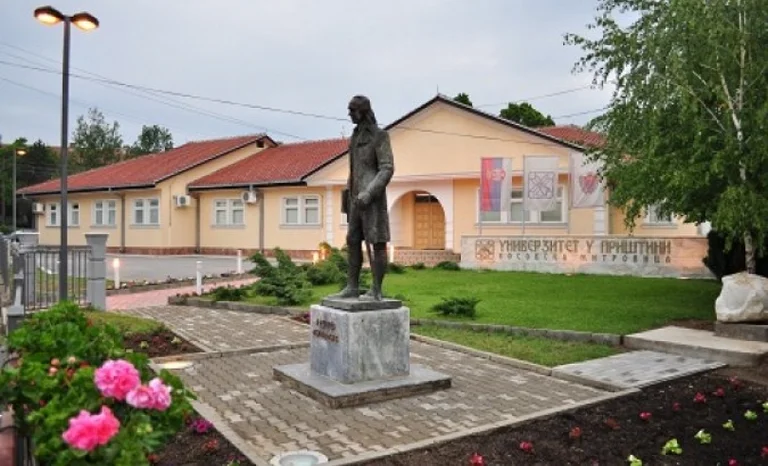
Students of the Serb community in Kosovo do not have the right to apply for financial assistance from the Government of Kosovo, because they primarily study at the University of Northern Mitrovica faculties, which functions according to Serbia's system.
On May 7th, the Ministry of Finance, Labour and Transfers of the Government of Kosovo announced that all students active and regular, studying at one of the public or private faculties accredited in Kosovo, have the right to be submitted for assistance in the amount of 100 euros.
However, the University of Northern Mitrovica is not accredited in Kosovo, and for its authorities this university is an illegal or parallel institution.
On the other hand, the Kosovo Ministry of Finance has enabled for assistance from the Kosovo Government to apply foreign students, either those studying at one of the Kosovo faculties, but are not citizens of Kosovo.
Remembering that the University of Northern Mitrovica is not accredited by Kosovo institutions, registered students (in that university) do not meet the conditions for this kind of aid”, the Kosovo Government Free Europe Free Radio reported in a written response.
This university moved from Pristina to northern Mitrovica after the war in Kosovo in 1999.
Word comes, in Kosovo's inhabited environments, all educational institutions, including pre-school ones, operate according to the Serbian system and have no contact with the Kosovo system.
Only students without support
In addition to students, the Government of Kosovo has earmarked from 100 euros for workers in the private and public sector, as well as for pensioners, meanwhile, social assistance beneficiaries have received double compensation in cash for April.
Kosovo Prime Minister Albin Kurti, presenting the assistance measures on the part of his government in late April, said that “all citizens would benefit”.
Almost all members of the Serb community in Kosovo who meet the conditions receive Serbian and Kosovo pensions. Also, there are those who take advantage of the social assistance paid by Kosovo, but also the assistance for which Serbia shares money.
However, for these categories there has been no obstacle to receiving 100-euro assistance from the Government of Kosovo, although the Kosovo system and Serbia's “are not recognised”, either side has no knowledge whether someone already receives pension or social assistance in the other system.
Also, most Serbian List officials -- the leading party of Kosovo Serbs -- have double positions, in the Kosovo and Serbian system.
On the other hand, students Marko and Irena stress that their countrymen are unable to study according to the Kosovo system and see nothing conflicting in the fact that they are all enrolled in North Mitrovica faculties.
Can Serbs study according to the Kosovo system?
According to the Kosovo Constitution, minority communities have the right to education in one of the official languages, at all levels.
In Kosovo, official languages are Albanian and Serbian, but under the Law on Use of Languages, Turkish, Bosnian and Roma have the status of official languages in municipalities that make up at least five percent of the general population. Deputy Minister of Education in the Government of Kosovo, Dukagjin Pupovci, in a proposal for Radio Free Europe, does not specify whether Kosovo's system allows members of the Serbian community to attend lectures in their native language, but said there are several research programmes in Bosnian language, at public faculties in Prizren and Pec.
“also, at Pristina University, there is direction for Balkans, where speeches are held in Albanian and Serbian. There are also private institutions of higher education that organise speeches in Bosnian language”, Pupovci says.
The Balkan is a four-year research programme that has opened at the Pristina University Philological Faculty since this academic year, with the aim of, among other things, promoting interlingual and intercultural communication in Kosovo and the Western Balkans. This also means that the Serbian language is taught for the first time at Pristina University since 1999, in teaching that works according to Kosovo's educational system.
Pupovci stresses that the University of Northern Mitrovica, which operates under the Serbian system, does not want to integrate into the Kosovo system.
In August last year, the director of the Office for Kosovo in Serbia's Government, Petar Petkov, laid the cornerstone for the construction of the new University in North Mitrovica. It is scheduled to extend to 10,575 square metres and the Faculty of Natural-Matematic Sciences, the Jurydic Faculty, the Economic Faculty and the Rectorate building will be established.
Nongovernmental and high school diplomats
In Kosovo, there is no primary or high school in the Serbian language, which functions according to the Kosovo system, meanwhile, Kosovo institutions do not recognise the high school diplomas received at the <x0-celli”, that is, those released by Serbia.
However, Deputy Education Minister Dukagjin Pupovci stresses that only the qualifications gained on the territory of the Republic of Serbia are recognised in Kosovo.
There is no agreement at the moment for recognition of the qualifications and diplomas taken at pre-university institutions operating in Kosovo's inhabited Serb environments and outside the education system of the Republic of Kosovo”, Pupovci explains.
What is the key to integrating the Serbian educational system?
Under the initiative “Open”, which consists of influential nongovernmental organisations and Serbian media, a study of Kosovo Serbs' main problems called “Key” was published in April of this year. (Kljuc), who also points to problems in education.
The study finds that the education system can be integrated into Kosovo only through the Association of Serb-run municipalities, for which agreement has been reached within Kosovo-Serbia dialogue.
The process of mutual recognition of certificates and diplomas would also be facilitated, it would be easier to get textbooks and textbooks from Belgrade, meanwhile, Pristina would have access to curriculum”, the study said.
Isak Voguciq, director of Radio Television KIM from Caglavica, near Pristina and author of this study, has found that investments of two governments -- Kosovo and Serbia -- would be regulated through the Association of Serb majority municipalities, whether there would be much less room for manipulation.
The “Finances Belgrade continues to send to Serbian institutions in Kosovo, but also that Pristina shares for education and health, primarily through bonds, would be passed through an umbrella organisation (the Association of Serb-run municipalities), which would essentially be Kosovo's”, Vorguchic praised.
The association of Serb majority municipalities -- the agreement reached in 2013 as part of Brussels' dialogue -- is a long-term obstacle to Kosovo-Serbia dialogue on normalising relations between the two sides.
Two years after the signed agreements (in 2015), reconciliation was reached for principles for establishing the Association, for which the Constitutional Court of Kosovo, in December of that year, found that they were not fully in line with the spirit of the Constitution.
On the basis of that Constitutional Court decision, it is controversial that association is not based on multiethnicity, but collects municipalities in which an ethnic community is a majority.
Kosovo authorities refuse to implement this agreement, explaining that the Association of Serb majority municipalities is harmful, while the Serbian side insists on implementing the agreement and requires that the issue be raised again within dialogue.