19 minutes ago
Continued circulation of sticky paper even though the deal expired yesterday, view from the border points
Periskopi(4 years ago)
(4 years ago)At border crossings linking Kosovo and Serbia, drivers from both sides of the border are moving around using contagious letters on state symbols on their car plates. Contagion papers are continuing to be used for covering state symbols on car plates from Kosovo and Serbia on April 22nd. As they report [...]
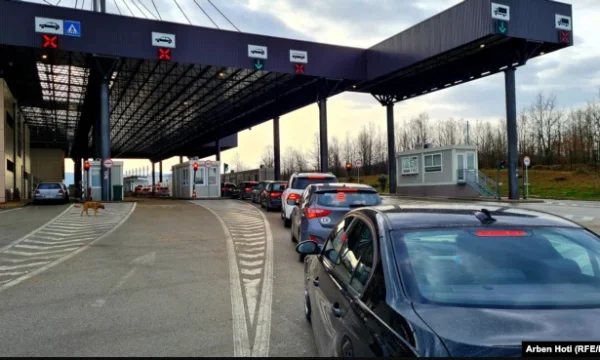
Contagion papers are continuing to be used for covering state symbols on car plates from Kosovo and Serbia on April 22nd. As Radio Free Europe journalists report, at border crossings, drivers continue to provide these sticky letters from Kosovo and Serbia border officials.
Meanwhile, several police raids have been seen on Zvecan-Janja Street.
Contagion letters are being used despite the provisional agreement on this, reached in Brussels between Kosovo and Serbia, expired on April 21st.
Kosovo and Serbia disagreed on any permanent solution to the plates, as after meetings that were held on April 21st, with the European Union's mediation, the two sides accused each other of failing to make a deal on the issue.
Radio Free Europe journalists have visited border crossings in Merdare and Jarinje on the morning of April 22nd and report that cars are moving in sticky paper, and their circulation is continuing normally.
Nasko Hodovq, the driver of a transport vehicle from Serbia's Novi Pazar, who entered Kosovo on Friday morning, told Radio Free Europe that he crossed Kosovo's border, just like the days before.
“They gave us sticky letters. Everything's working smoothly”, he said.
A truck driver from Serbia placing sticky paper on state symbols on plates. Jarinje, April 22, 2022.
The same confirms the driver of a truck from Raska, Goran Popovic.
Also, a Kosovo license truck driver, introduced by the name of Fatos, confirmed that the same is happening during the crossing of the border with Serbia, where drivers are being equipped with sticky paper.
What happened in Brussels on April 21st?
Kosovo and Serbia had deadlines for April 21st to reach a long-term agreement on the license issue. But, at meetings between Kosovo's chief negotiator, Besnik Bislimi, and Serbia's Petar Petkov, with EU mediation, the parties failed to reach agreement.
After the trilateral meeting that followed bilateral meetings with EU officials, Bislimi said Serbia was not ready for a license agreement.
Our working group has again been trying yesterday to get to a drop-down project that will be delivered to us today for discussion. Unfortunately, there is zero willingness by the Serbian side to agree to a possible solution within the framework that has seen the third point of the September 30th” agreement, Bislimi said, referring to the provisional agreement point where the working group of both states was required within six months to present the findings of a permanent solution to the issue.
The indictment for non-preparability for the agreement also had Serbia's chief negotiator, Petar Petkovic.
He said he will now continue to implement the taped card regime, despite the provisional agreement that has implemented.
Meanwhile, Bislimi said no immediate action would be taken and that Kosovo would handle freedom of movement, just as Serbia would.
But, despite failing to reach agreement by the 21 April deadline, EU special envoy for Kosovo-Serbia dialogue Miroslav Lajcak called on the parties to continue talks on the license issue.
“We expect all sides to refrain from actions that could jeopardise security on the ground”, Lajcak ordered through a Twitter post after the talks end.
Why did the sticky letters come up?
On September 20, 2021, the Government of Kosovo, led by Albin Kurti, imposed reciprocity on the plates. The move meant that once it entered Kosovo's territory, drivers of Serbian license plates would have to receive test plates, valid for 60 days and costing five euros.
With a similar move, Kosovo license drivers had faced years of circulation on Serbia's territory.
But that move sparked discontent among the Serb population in Kosovo, which blocked roads leading to border crossings with Serbia, in Jarinje and Brnjak.
To reduce tensions, with the European Union's mediation, the interim agreement on license plates was reached on September 30th. This agreement, meant to be in effect for six months until Kosovo and Serbia's working groups found a long-term solution, led Kosovo license drivers with Kosovo plates and with those of Serbia to place sticky letters on state symbols on license plates whenever they crossed the border of these two states.