13 minutes ago
Kurti: despotic Putin targets new conflicts, even endangered Kosovo
Periskopi(4 years ago)
(4 years ago)The Russian despotic President is requesting a new Yalta conference. War is necessary, and this is what he did, but the expansion of conflict even outside Ukraine has not yet been necessary. My impression is that Putin wants to sit at the negotiating table [...]
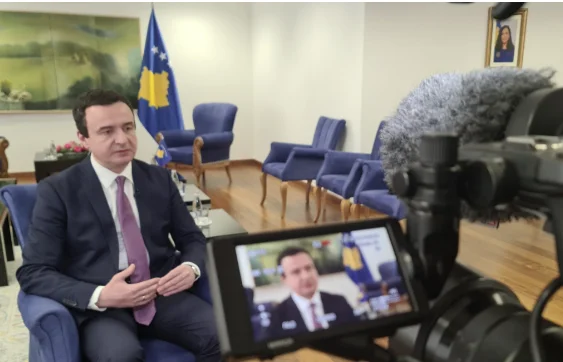
The full interview of Republika Kosovo Prime Minister Albin Kurti for the French News Agency, AFP
Question: Mr. Prime Minister, we are beginning with the crisis in Ukraine. The aggression over Ukraine from Russia creates the impression it has shaken, has deeply jeopardised the existing security order in Europe, which was created with the overthrow of the Berlin Wall. Many analysts say it's a tectonic blow, and our first question is, do you think, is there any hope that this system will be restored, restored?
Prime Minister Kurti: The Russian military aggression and invasion were shocking but not surprising. They were not surprising, since we have seen him prepare and build in terms of political legalization by the Kremlin, but also of the gathering of large military forces with heavy artillery at Ukraine's eastern borders. The images are shocking, it's hard to believe what you're seeing, but no one can pretend to be surprised. This is a war warned earlier, because Russian hegemony, Russian imperialism wanted at all costs new territories, wanted expansion and confrontation with the European Union and NATO. Russian despotic President Putin is looking for a new Yalta conference, but Yalta's new conference is not possible without war. So we also had this military aggression and Russian invasion.
Of course, the architecture of the European continent's security should be reconsidered because we no longer have conditions for peace after the fall of the Berlin Wall. Wars, which took place over the next three decades on other continents, have now come to Europe and to Russia, which is led by a person who is also very angry and very nostalgic. We also had the wars under the violent break-up of the former Yugoslavia, but what we see today is the Russian Army march, one of the most powerful armies of the world and the time, and no doubt NATO would have to now increase its mobilization, but also think about how to respond to Russia, in terms where the hybrid war clearly turned out to be no substitute for war, but a preparation phase for it.
Question: The largest country in Europe has been attacked. Even among Western observators can be heard considering this attack, this aggression even as an attack on Western civilization. Do you think that this aggression and all the impact this aggression has created has made widespread divisions in Europe, in NATO countries, non-NATO countries, countries of the European Union, non-European countries, that is, all are exposed to the same danger?
Prime Minister Kurti: I agree. Differences, which exist within the European Union and within Europe as continent in general, have become second-hand issues not to say third-hand issues, face Russian invasion and military aggression in Ukraine. So, if the European Union and NATO don't use this moment to be united, as time imposes, but I believe the will of people, civic rights and prosperity on the European continent, then we will pay very dearly with our future and our children.
Therefore, it is imperative that there be added institutional unity, just as it is popular. I am convinced that now the peoples of Europe have never been more united, except this kind of union should find its expression in politics even in representative institutions.
The European Union must be united because Ukraine has been attacked, which presents with territory the largest state on the European continent. Thus, there is no other country, which is in all its territory on the European continent, more than 1,000 square miles [600 sq km], such as the case with Ukraine. Thus, the most eastern state on the European continent is also the largest with territory and is now in a devastating attack, wanting Ukraine's territory for Russia but without Ukrainians.
Question: You have said aggression imposes Europe's unification as the first response to this attack on a sovereign and independent European country. Do you think they have begun creating conditions and imposing conditions on Russian aggression, establishing the new collective security order, where they will unite under the same umbrella to find all European countries, whether they belong to or not to European Union and NATO mechanisms?
Prime Minister Kurti: Europe and the democratic West in general need a coalition, which is of defence and security, but not only, against the Russian Federation. And what's happening in the Russian Federation, Europe can find in its history.
My powerful impression is that the period from Gorbachev to Yeltsin presented only the Russian version of the Republic of Vajmar. We had a decade of the Republic of Vajmar in the Russian Federation and now we have a despotic leader who has built his war machine against a people who neither provoked nor wanted war. In this political and security context, we must respond to a coalition, with which we should not limit ourselves to the existing formulas of international organisations, but it would have to advance them, and perhaps create new ones, because the situation is extraordinary.
Question: Does Kosovo have reason to feel threatened after Russian aggression, especially when it is considered the existence of very high relations and tensions with Serbia, which is considered Russia's main ally in this region?
Prime Minister Kurti: Russian despotic President is requesting a new Yalta conference. War is necessary, and this is what he did, but the expansion of conflict even outside Ukraine has not yet been necessary. My impression is that Putin wants to sit at the negotiating table with American President Beden rather than with Ukrainian President Zelensky. His goal is a new Yalta conference, Yalta 2, with what cases would divide the interest spheres, and thus the Russian Federation would aim to compensate for the dissolution of the Soviet Union. Therefore, since they will also target new conflicts, the Western Balkans in general, and especially Kosovo, are at risk. In the past, the Russian president mentioned us once a month, now mentions us from several times a week, and it clearly seems that the Republic of Kosovo is a dump that he considers to be stumbling in its project. Two months after Kosovo's liberation, the Russian president had become prime minister of the Russian Federation in August 1999, already on the occasion of the two anniversary of the Russian troops' arrival at Bosnia and Herzegovina's airport in Bosnia and Herzegovina in June 1999 -- that is, June 2001 -- to visit Russian troops right at Pristina Airport. Let us not forget that this is the president who also annexed South Ossetia and Abkhazia in Georgia, just in the year that Kosovo declared independence, yet a week after Kosovo's declaration of independence, the agreement between Serbia and the Russian Federation was signed for the granting majority of shares of the oil industry in Serbia to Gazprom and also the gas base at Banatski Dvor in Vojvodina was signed again on Gazprom. Out of 250 deputies as long as Serbia's Parliament -- 151 -- more than 60 per cent -- are in Serbia's friendship group, the Russian Federation. In the Kosovo Assembly, there are a dozen deputies in groups of friendship with various states. So there over 60 percent of parliament are in the friendship group with the Russian Federation. When we add to this the fact that there is more than a decade that Russia is very active in Serbia, especially with the “Russian Humanitarian Centre”, as they call it in Nis, and with Sputnik standing in the region downtown Belgrade, of course we should be very vigilant, careful, but never afraid of them.
Question: There is no following a single proposal of senior Kosovo leaders from the crisis explosion in Ukraine, at least I have not seen, where there is no appeal for Kosovo's NATO accession. Do you think that the Balkans as Russia's traditional interest zone could be Russia's next target after this is completed in Ukraine?
Prime Minister Kurti: At best we can say that the Russian president is unpredictable. He's actually predictable. He's a leader of war, not of peace. He's interested in taking all of Ukraine, if he can all of a sudden take it apart like Bosnia, turn Kiev into a second Grozni or Sarajevo, and also share the conflict, where he will use the factors of actors he controls in the Western Balkans. In this extraordinary situation, we cannot conduct ourselves in a normal way. Therefore, membership in the European Union and NATO membership cannot be according to old ways.
It is extremely necessary that Brussels both capital and NATO and the European Union think of a new way of internal integration and enlargement in the Western Balkans. The Western Balkans and Kosovo at the heart of this Western Balkans are part of the European continent. In the case of EU and NATO integration, the external border of these two most important peace bodies since the end of World War II, the external border decreases by about 3 thousand kilometers, which means security is also very good.
The six Western Balkan countries still unintegured in the European Union for the population are roughly the size of the Netherlands, and for grossly the combined local product is roughly the size of Slovakia. Consequently, it is not a big burden for the European Union to speed up our region's integration.
Question: Does it mean that the urgency of the situation also imposes an emergency in the accession procedure, enlargement of NATO and the European Union?
Prime Minister Kurti: The old methods of expansion of NATO and the European Union can have very high costs after Russian military aggression and invasion in Ukraine, which I believe aims not to remain alone in Ukraine.
Question: And in the end Kosovo and Ukraine have no diplomatic relations. Ukraine does not recognise Kosovo's independence, but Kosovo's current support for Ukraine, political, moral, financial with these modest conditions of Kosovo has made Kosovo, to create impressions, leaders in the region in support of Ukraine. Where does this solidification come from with a country that s'e has recognised Kosovo?
Prime Minister Kurti: In the defence and liberation fight of the people of Ukraine, we find many similarities with our situation a quarter century ago, when a much larger northern neighbour wants to attack you, crush you, exploit you, discriminate, create apartheid and also prove genocide, which in Kosovo left but was prevented by the intervention of NATO, so we would not have the extermination of Albanians in our country. So we had on the one hand the Kosovo Liberation Army, which began the resistance and the struggle for liberation and freedom, and this awareness of international public opinion, the world diplomacy to support us. No one like the people of Kosovo sees the similarity of what has happened to us in our lives, not in history books, in our lives, with the current context in Ukraine, where the protection and liberation struggle of the Ukrainian people is finding a remarkable solidarity and admiration in the Western democratic world, as in us in 1998 and 1999.