5 minutes ago
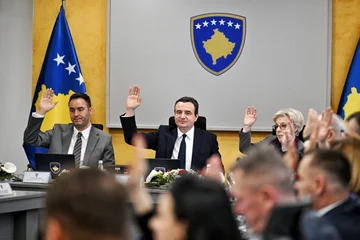
Blic: Prime Minister Albin Kurti will raise wages for nothing less than 780 euros (Dok. )
Periskopi(4 years ago)
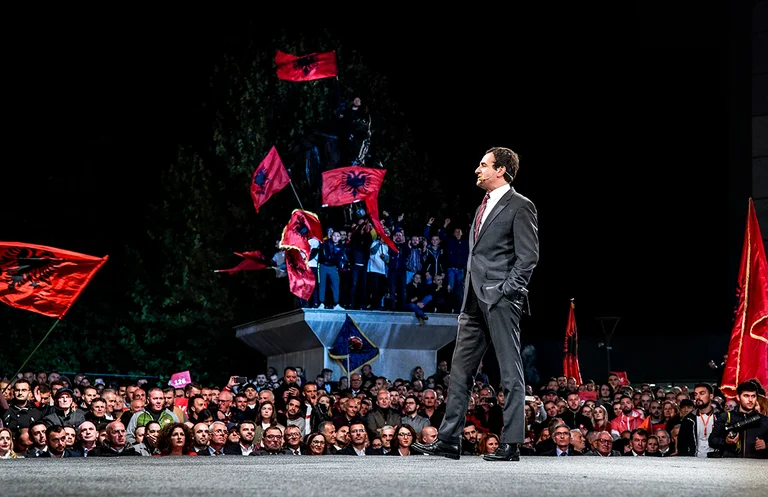
(4 years ago)In February 2020, just a few days after Kurt had become Prime Minister for the first time, he had proudly presented the decision through which he was abolishing his predecessor's decision. Kurti was thus lowering his salary from 2,950 to 1,500 euros. But this pay, [...]
But his salary will benefit him only briefly. Prime Minister Kurti will increase income from wages because it is thus envisioned in the Law for Salaries, which is drafted by the Ministry of Internal Affairs in co-operation with other government dictatorships.
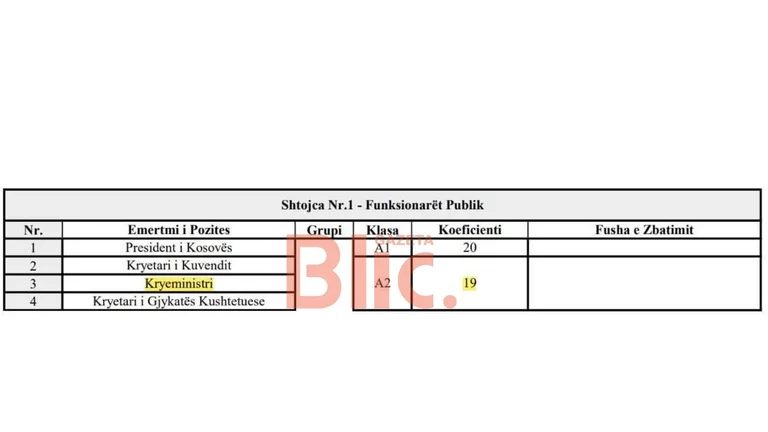
The newspaper Blic has secured a copy of this bill, which is expected to be approved by the Kosovo government, which is headed by Kurti.
Under this bill, Kosovo's prime minister will have the 19. The value of a cofficiency has not yet been identified in the bill, but Blic newspaper teaches it will be 120. So if the pay cofficiency is multiplied, 19, at its monetary value, 120 euros, then Prime Minister Kurti's basic salary will be 2,280 euros, without including additional additions. His salary will rise for 780 euros.
Similar wage value is expected to be held by the Kosovo Parliament Speaker and the head of the Constitutional Court, while Kosovo's president will stand higher for a co-aficulant -- that is, with the salary of 2,400 Euros.
The wage bill has begun to stir numerous reactions through which its contents have begun to be rejected.
In mid-January, Minister of Internal Affairs Jedal Svecla has announced that the Law for Salaries will be processed for approval in Government in March this year.
The new wage bill is strongly opposed by the United Education Union and Kosovo Police.
It was former Prime Minister Haradinaj who in 2017 had doubled his salary as well as his cabinet.
By that time the prime minister's salary was around 1500 euros, to be raised to 2950 euros.
Under that decision, the deputy prime minister's salary was 2,500 euros, while the ministers' salary was 2,000 euros.
This decision had prompted numerous reactions, sharply criticising Haradinaj for the rise of wages for himself and his ministers.
During his rule, Haradinaj had also issued the Law for the Salaries, which was subsequently overturned by the Constitutional Court, where pay levels were presented under this law.