7 minutes ago
License deal, German president: This shows how important EU is in the region
Periskopi(4 years ago)
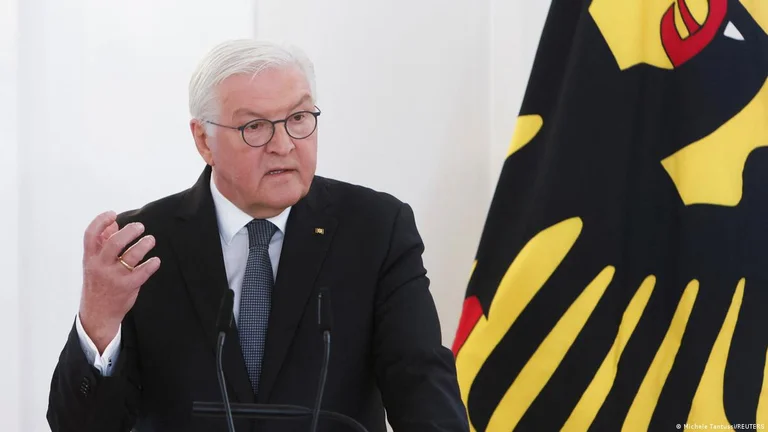
(4 years ago)Germany's President Frank Walter Steinmeier has talked about recent developments in Kosovo on the license agreement that was reached days ago. He has declared that resolving this issue between Pristina and Belgrade shows that the European Union has managed to avoid conflicts “in terms of conflict, I think this is about the question [...]
He has declared that resolving this issue between Pristina and Belgrade shows European Union has managed to avoid conflicts
As far as conflict is concerned, I think this goes with the last question, because the conflict settlement has probably shown once again how important Europe is, how important the European Union is in the region. If it were not for this wish towards Europe, then Europe essentially would not have negotiating powers in such conflicts between Serbia and Kosovo”.
But since the desire to come to Europe, to become once members of the European Union, is still highlighted in all the countries of the Western Balkans, Europe has this negotiating power, this negotiating opportunity and managed to avoid this conflict, at first glance, then even the biggest conflicts in normalising relations between Serbia and Kosovo must be addressed, and in that sense, resolved peacefully<1x>, Steinerme has said in an interview for the DW.
Interview:
Deutsche Welle: ZOti President, you are travelling to northern Macedonia and Albania. The Ukraine war has created a new dynamic in the Western Balkans and Europe. Will this fight accelerate the Western Balkans' EU integration process?
Frank-Walter Steinmeier: I don't know if I'm going to speed it up, but my trip is exactly intended to signal that the Western Balkans are not forgotten at all. Of course, we have also had debates with colleagues and colleagues from the Western Balkans who have expressed their concern that Ukraine's desire for membership in the European Union would be addressed perhaps faster than all other candidacys made by Western Balkan countries. I understand impatience, but like many others, I will assure you that the Western Balkans are not forgotten at all. And travel to northern Macedonia and Albania also serves to send the message to the entire region: If they make their respective progress in their countries, then the path to membership in the European Union will become more manageable.
However, the EU does not have a timetable for the Western Balkans. Thus, some countries have set their own dates for membership, such as in 2030. Would you tell MPs that this date is realistic when you speak to the parliaments of these countries?
I am the President, not the prophet! It depends, as I said, on the internal will to reform and the willingness to implement reforms realistically. But today we can argue differently with the states of the Western Balkans. Because, for example, Northern Macedonia and Albania have taken decisive steps forward. This strengthens confidence in these countries and also makes it clear to others in the Western Balkans that this step is worthwhile. And let us not forget that beyond the question of close membership, even on this journey, progress is recorded. The Western Balkan Process began many years ago in Berlin. As I recall, it was very difficult at first. But in view of the recent summit, then I think that the ID trip, the mutual recognition of school and university diplomas, the willingness of Europeans to help increase the price of energy, is significant progress. So I understand impatience, of course. But we're not even at the stage when we need to talk about discouragement. Not only because of Ukraine, because we are all keeping an eye on the Western Balkans, but also in terms of Macedonia and Albania, where there are steps ahead.
The EU expects rapid reforms from the Western Balkans, but also says we must reform ourselves first before we are ready to accept new members. And how long do you think this could last?
It should be done as soon as possible. But I have to admit that I see no sign as soon as European institutions are reformed. Since I've known European institutions for many years on the inside, I know we're in a series of multiple crises, I remember the euro crisis, we remember the refugee crisis of 2015 and 2016. As the EU, we have had a major challenge with fighting pandemic. Of course, all of these were rapidly following crises, and as we can see, the pandemic crisis is not over yet, and the fight of Russian aggression against Ukraine is a burden to all of us. Such things absorb energy and leave no space in people's heads for internal reform, although I agree they are urgent.
In the Ukraine war, most Western Balkan countries are showing great solidarity. They are implementing sanctions against Russia, despite major concerns about the consequences. Exception makes Serbia, which repeatedly shows its proximity to Moscow. Does the EU reward these solidarity positions of Western Balkan countries enough? And how should she treat Serbia?
To answer the first part of the question, that's one of the reasons why I'm in the region right now. Because I want to create an impression of the atmosphere there. And I think we'll probably get a general view of the atmosphere. That Northern Macedonia and Albania not only testify to solidarity with Ukraine, not only demonstrate common attitude, for example, in increasing economic pressure on Russia, but also meet their obligations within NATO, in addition, Albania is represented even outside NATO, at the UN Security Council, I think it deserves recognition and respect. But this is something that should promote confidence in these countries. If so, I will surely see it during my journey. And as for Serbia -- your second question -- we are trying to convince Serbia that the path Serbia is making now -- raises questions about seriousness, with which it is making its way towards the EU. I've been following the Western Balkans' route to the European Union for nearly 20 years, and I've often been in Serbia. I am sure that people in Serbia do not want to stay behind the wish, which comes from other Western Balkan states to approach the European Union and become its members once. In this respect, I can hope and will continue to try to convince the political leadership in Serbia to follow this path without any hesitation.
Finally, two more words for the conflict between Serbia and Kosovo that was resolved in the last minute. What can Germany and Europe do to effectively and in terms of this security risk in the region?
As for the conflict, I think this is about the last question, because resolving the conflict has probably shown once again how important Europe is, how important the European Union is in the region. If it were not for this desire towards Europe, then Europe essentially would not have negotiating powers in such conflicts between Serbia and Kosovo. But since the desire to come to Europe, once to become members of the European Union, is still highlighted in all the Western Balkan countries, Europe has this negotiating power, this negotiating opportunity and managed to avoid this conflict, at first glance, then even the biggest conflicts in normalising relations between Serbia and Kosovo must be addressed, and in that sense, resolved peacefully.