5 minutes ago
British Reporter: Images from the liberated Kherson remind me of Kosovo of 99
Periskopi(4 years ago)
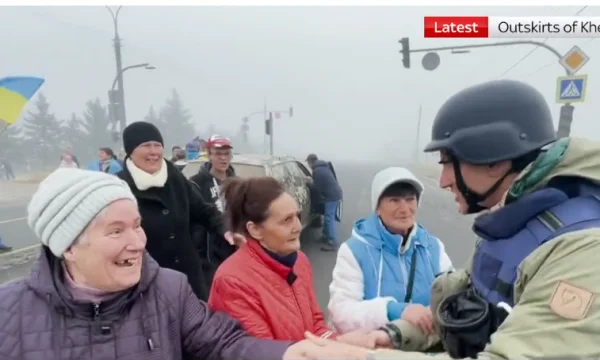
(4 years ago)The images of Kherson, the city of Ukraine, which managed to break free from Russian forces after more than eight months of war, have brought former British journalist Brendan Paddy back to memory Kosovo in 1999. In his account on the social network “Titter”, he has distributed some images where he sees a “journalist. Sky News” that [...]
The images of Kherson, the city of Ukraine, which managed to break free from Russian forces after more than eight months of war, have brought former British journalist Brendan Paddy back to memory Kosovo in 1999.
In his account on the social network “Titter”, he has distributed some images where he sees a “journalist. Sky News” received hugs from Ukrainian residents while reporting on the outskirts of the liberated Kherson. “This gives me memories of reaching Kosovo in 1999”, Paddy wrote.
As the war entered its 260th day, following the withdrawal of Russian troops from Kherson, Ukrainians raised flags and celebrated on the street. Like this region, President Volodimir Zelensky pledged that he would be released and Donbassis and Crime. Russia's occupied village of Hornostaveca, was bombed by Moscow with Grad rockets to convince residents to evacuate. This was reported by Kherson Oblast's governor, Yaroslav Yanhushevych, adding that six houses were destroyed in the attack.
While rescue teams provided assistance and evacuated 110 civilians from dangerous settlements in the Donnetsk region. Meanwhile, police have helped evacuate 188 other people. On November 2nd, free evacuation has continued from the Donnetsk region towards the territorial communities of the Ternopil region. As reported during these days, the Donnetsk region is under the ongoing attack of Russian missiles, and in the region there are problems with energy, heating and water supplies.
More than 1.2 million people fled the region, in which 1,6750,000 people lived before the total invasion. By winter, no more than 235,000 people involved in protecting and maintaining critical infrastructure must remain in the region.