11 minutes ago
Reciprocity, license plates, tensions in the north: Jamie Shea willing to help Kosovo
Periskopi(4 years ago)
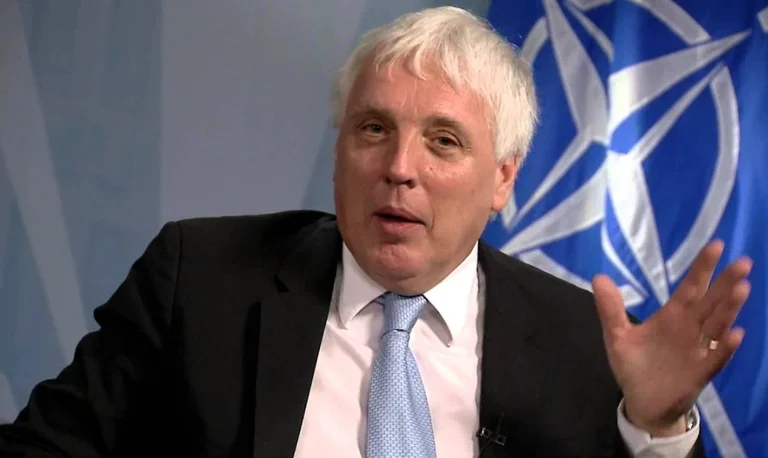
(4 years ago)Former spokeswoman NATO during the war period in Kosovo, Jamie Shea, has talked about Kloncosova.tv, about recent developments in the country, concerning the situation created with dialogue and the issue of license plates in relation to Serbia. Now Professor of Strategy and Security Shea gives his position that he does not see another armed conflict [...]
Already Professor for Strategy and Security Shea gives his position that he does not see another armed conflict between Kosovo and Serbia.
NATO's”Forca of KFOR remains in Kosovo to ensure the security environment. Moreover NATO has reserve forces that can be sent to Kosovo with brief announcement to support KFOR and help preserve peace if necessary. From time to time, we could see some tensions or demonstrations, as we recently saw on the issue of car license plates, but KFOR in co-operation with Kosovo police has learned well to deal with these situations and restore peace and order”.
And the statements by Prime Minister Albin Kurti, who often mentioned war, estimate they came as a result of disappointment from the lack of progress in negotiations between Kosovo and Serbia.
I see the prime minister [Albin] Kurti is expressing disappointment over the disappointing lack of progress in the Pristina-Belgrade Dialogue, but I do not see another armed conflict”.
While in terms of the situation created by Russian aggression, Shea says of clakosova.tv, that Ukrainians are effectively backing the Russians, however, that Putin is using reckless measures including here and nuclear threats.
”Ukrains certainly succeed in backing the Russians. Putin is clearly on foot and is using desperate and reckless measures as mobilizing the Russian civilian population and attracting Iran to war by relying increasingly on Iranian fears and missiles. He is also making completely irresponsible nuclear threats in an effort to intimidate the West to accept the results of Russian aggression and access “Might is Right” to its democratic neighbours”.
Because Putin cannot win the battle field, he is embracing a new barbarous strategy of destroying Ukraine's civil infrastructure, in order to deprive the Ukrainian people of electricity, heating, food and water as he approaches winter. This is a deliberate target of civilians and a war crime, and I believe Putin and his associates will face indictments by an international war crimes tribunal once the conflict ends. But the resistance of democratic Ukraine is inspiring, and NATO and the EU do not issue their determination to support Ukraine with advanced weapons, humanitarian aid and finance”.
As Serbia's approach, listing alongside Russia, calls it extremely disappointing, predictable. That's because, as former spokeswoman specified, NATO, Serbia wants to be in two positions.
The” is disappointing but at the same time predictable. Serbia wants to balance between East and West and be in European camp, as well as in the authoritarian camp at the same time. So Belgrade has refused to implement international sanctions against Russia following its aggression against Ukraine. Serbia continues to host Russian business, especially in the energy sector, and to co-operate militarily with Moscow. But sitting on the fence is not a viable strategy on the long-term”.
” If Serbia wants to be part of Europe and join the EU, it must support and respect European values and demonstrate solidarity with its European partners. An EU member state cannot adopt an approach to the EU, where close personal interest always takes priority and the country enjoys all economic benefits, but refuses to take responsibility for EU foreign policy and security objectives”.
However, this thing should easily be absorbed, says Shea, about the clankosova.tv.
” After all, the Serbian people will have to choose in which system they want their country to live in the future: liberal democracy and individual freedom in a European Union or in isolated and closed societies of authoritarian camp”.
How do you assess the last agreement between Serbia and Russia?
The” is one of several and one reason why the European Commission noted in its latest enlargement report, published last week, that Serbia must comply with EU foreign policy and security objectives (for example sanctions against Russia and Iran) if the desire to become an EU member state is serious.
On the effect of this Russian-Serbian agreement, Jamie Shea, points out that Serbia should by no means become a member of the European Union, without formally recognising Kosovo's independence and normalising its reports with him.
My”Pictum and I've stated many times, is that Serbia should not become an EU member until it has officially recognised Kosovo's independence and normalise its relations with it (including its campaign ban to keep Kosovo out of international organisations)”.
”Comatibility to resolve disputes peacefully and pursue good relations with neighbours in a spirit of compromise and constructive commitment seems to me as an essential value of EU membership. Of course this means that Kosovo should demonstrate the same constructive approach, but negotiations should be based on realities, and Belgrade's denial when it comes to Kosovo's treatment as a real country and an independent state does not help things”.
” As far as the EU is concerned, Brussels does not say Belgrade cannot have a relationship with Moscow if it wants one. There are EU leaders still talking to Putin (even though less than in the past) and President Vuciq can certainly do the same. But what the EU rightly expects is that candidate countries negotiating to join the EU and take all the benefits of membership, should show solidarity and implement EU foreign policy and security measures, such as economic sanctions”.
And for Kosovo's security journey, since the post-war, the noted professor for Strategy and Security, says that none of the leaders of the defence institutions in Kosovo has communicated.
However for tensions warned by former spokeswoman NATO, which helped Kosovo during the wartime, says willing to help again in any way.
I haven't been to Kosovo for years unfortunately to see leadership and exchange prospects. I'm willing to help in any way I can, but not intervene”.
As for the international recommendation that the Kurti government postpone for 10 months the implementation of reciprocity for the license plates, Jamie Shea says this should happen only if there is a constructive solution, until it is expressed to Klonkosova.tv, that even the public administration in the north should comply with Kosovo standards as a whole.
I understand the merits of a postponement provided that the time earned is used for serious negotiations and with the aim of agreeing to constructive solutions, and not just to postpone things and extend the status quo”.
It is clear that public administration, especially in the north, must be reformed, modernised and adjusted to Kosovo standards and norms as a whole. This is a feature of every modern state subject to the rule of law and proper public administration”.
Former official of NATO, Jamie Shea, also disagrees with the idea that between Kosovo and Serbia, this year could have a final agreement, however, a little optimistic appears.
This, as it points, Brussels and Washington are recognising the strategic importance of the Western Balkans, following a period of negligence.
” Considering the past precedent and current state, perhaps not. But it is important that the EU, the US and the international community continue to try and continue the pressure. Fortunately, the EU and the United States are now re-admissioning to the Western Balkans by appointing special envoys and increasing their presence”.
The past” European Commission finally recommended that Bosnia and Herzegovina be granted EU candidate status. So Brussels and Washington, after a period of relative neglect, recognise the strategic importance of the Western Balkans and are working together better to move the region forward. So that makes me a little more optimistic that we will finally see real progress even in the Pristina-Belgrade” dialogue.