13 minutes ago
German diplomat from Tirana confirms the good news of visas: Green Light is given at the end of the year
Periskopi(4 years ago)
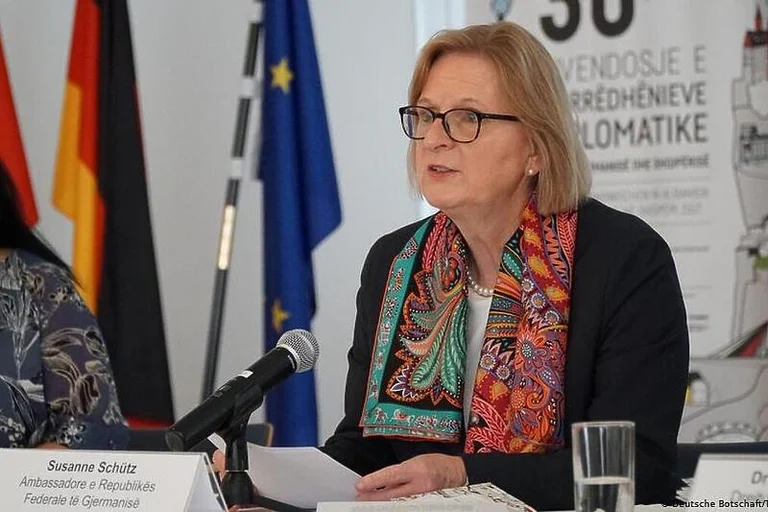
(4 years ago)Germany's charge for the Western Balkans, Susanne Schersz, in the interview for DW, expresses optimism about visa liberalisation for Kosovo and relates its expectations from the upcoming Berlin Process summit. We're talking about the Berlin process, the Common Regional Market. Meanwhile, human capital flight continues in the region. [...]
We're talking about the Berlin process, the Common Regional Market. Meanwhile, human capital flight continues in the region. For example, Albania has the highest percentage of migration among Western Balkan countries. More than 1 million Albanians have emigrated so far. How do you think this phenomenon can be prevented?
Of course, the right conditions should be created here in Albania, for people to stay, to see that the future for them and their children is here, in Albania, in the region. You know that Germany has been working for years as one of the biggest bilateral donors to support Albania in creating the right economic and educational conditions, we have worked in the education sector for adults. We try to support Albania, but obviously, more effort is required, initiatives by the government itself to ensure the right employment opportunities for people, for employment to be done on merit, and for the fight against corruption to become very serious and active.
What would be the message that Germany and the EU would convey to the government Rama, the government of Albania, for its initiative regarding the government's plans for a fiscal amnesty without the obligation to declare money sources?
It is very important that Albania will now work very closely with the Commission and member states to advance the EU accession process. As for legislative initiatives, they must be, as yet, in line with EU regulations and regulations. Regarding fiscal amnesty, the EU is conducting close consultations with the Albanian government, and has made experts available to advise Albania of this legislative initiative. We think that Albania should closely follow the EU's advice on designing this initiative.
Mrs. Ambassador, what was the purpose of your visit to Tirana this time?
This time I came to have political talks with representatives of the government, opposition and civil society, as well as to hold annual political consultations with Albania's Foreign Ministry.
What are the messages you conveyed during the negotiations you just mentioned?
We are very aware in Germany, in Europe, but also in this region, that the world is no longer the same after 24 February. The fact that Russia is expecting a recession in the fight against Ukraine has increased the sense of uncertainty even in the Western Balkans. And of course we are aware that all of Europe, but especially here, in this region, there will be increased economic challenges. Therefore, we are very happy that in the context of this war, the EU and also its partners in the Western Balkans, they have shown great unity in condemning war. I must say that we have welcomed a lot that Albania, but also Kosovo, Montenegro and Northern Macedonia have been very clear and have reconciled 100 per cent to EU sanctions against Russia and Belarus.
Your visit to Tirana this time took place on the eve of the summit of the 6 countries of the Western Balkans, within the Berlin Process on 3 November in Berlin. How would you characterise the current situation in the six Western Balkan countries?
We are very happy that on 19 July, Albania began negotiations and for EU membership. This is truly a historic moment on Albania's road to becoming an EU member. And we are also very happy that finally North Macedonia was given the green light, because it was an important signal for the rest of the region, that the EU enlargement process is still dynamic and that the promise given to the 6 Western Balkan states to become EU members is reality. We are convinced of this and we will. You mentioned the Berlin Process and we are very happy that the German government of Chancellor Scholz has taken over and will continue. For two years the Berlin Process was conducted only in virtual format, and this year for the first time, there will again be meetings at the ministerial, foreign, economy and home affairs level. And on November 3rd it will be the summit of the Berlin Process, of the heads of state and government. We will continue with initiatives undertaken under the Berlin Process, from the beginning of it, especially with the information agenda, the interconnection of people, youth and civil society. There will be other initiatives like those in energy, security and solidarity, and also following the EU green agenda. A very important topic, at the very top of the agenda of the Berlin Process, is the achievement of the Joint Regional Market agreement, which was drafted in 2020, but is still awaiting progress in 4 agreements, which have not been signed so far due to disagreements between Kosovo and Serbia. But I can say that we are working hard to overcome the remaining problems within the next few weeks, so the Common Regional Market becomes applicable to all people in the region. We are very sure that it will be very useful for all -- to travel with ID cards, to recognise professional degrees and also academic qualifications.
So you are optimistic that on 13 October the EU Council will come up with a positive decision on visa liberalisation for Kosovo?
Yes, on 13 October, in Brussels, there will be a meeting of the visa working group. We are very happy that the Commission will present a technical update of its report regarding visa liberalisation for Kosovo. This time we count the support of all member states. Germany is very supportive of visa liberalisation for Kosovo. This has even been said in our government's coalition agreement. We see that there is support now even from countries like France, so we hope that by the end of the year all EU member states will give the green political light to move forward with visa liberalisation and will be a question of practical implementation on the ground. We want to see that this promise the EU gave before years is now fulfilled for all citizens of Kosovo.
Let me go back to the Berlin Process. We have two initiatives: The Berlin and the Open Balkans process, the latter as an attempt to implement the Berlin Process in everyday life. Do you think that operating both of these initiatives will be faster, or do you think that Western Balkan countries need a unified co-operation mechanism?
The Berlin process was created as a platform for all six Western Balkan states to act as a catalyst to accelerate their EU integration and, of course, regional integration. We believe that the totaling of six countries is very important. The Balkans opened so far is an initiative that functions in three states. We are that involvement in the process is important and that there should not be a duplication, but must be hand in hand. It is also very important that all agreements finalised in the Open Balkans initiative be in line with the EU acquis because if not, later or harder to reshape according to EU standards and regulations.
We're talking about the Berlin process, the Common Regional Market. Meanwhile, human capital flight continues in the region. For example, Albania has the highest percentage of migration among Western Balkan countries. More than 1 million Albanians have emigrated so far. How do you think this phenomenon can be prevented?
Of course, the right conditions should be created here in Albania, for people to stay, to see that the future for them and their children is here, in Albania, in the region. You know that Germany has been working for years as one of the biggest bilateral donors to support Albania in creating the right economic and educational conditions, we have worked in the education sector for adults. We try to support Albania, but obviously, more effort is required, initiatives by the government itself to ensure the right employment opportunities for people, for employment to be done on merit, and for the fight against corruption to become very serious and active.
What would be the message that Germany and the EU would convey to the government Rama, the government of Albania, for its initiative regarding the government's plans for a fiscal amnesty without the obligation to declare money sources?
It is very important that Albania will now work very closely with the Commission and member states to advance the EU accession process. As for legislative initiatives, they must be, as yet, in line with EU regulations and regulations. Regarding fiscal amnesty, the EU is conducting close consultations with the Albanian government, and has made experts available to advise Albania of this legislative initiative. We think that Albania should closely follow the EU's advice on designing this initiative. / DW