15 minutes ago
EU and US Emisars' Visit Encouraging Dialogue
Periskopi(4 years ago)
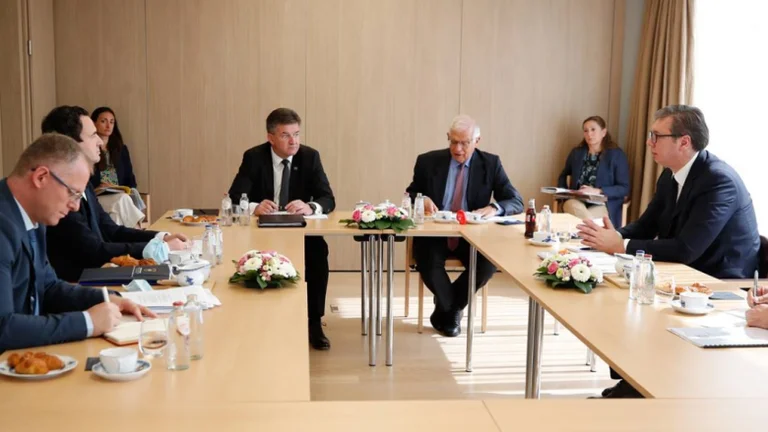
(4 years ago)The United States' special envoy for the Western Balkans, Gabriel Escobar, and the European Union's special envoy for Kosovo-Serbia dialogue, Miroslav Lajcak, launch a five-day visit to Kosovo and Serbia in an effort to encourage leaders of the two countries to continue dialogue on normalising relations. [...]
The diplomats' visit comes as Kosovo and Serbia, since July 2021, have not held any round of high-level talks, within the dialogue mediated by the European Union.
During the visit to Kosovo, Escobar and Lajcak are expected to meet with political leadership, as well as with representatives of the international community.
It is expected that the issue of the Association of Serb-run municipalities will be one of the topics to be discussed during the visit.
Kosovo and Serbia have repeatedly blamed each other for their unwillingness for dialogue, while the US and the EU have called on the parties to engage in this process, aimed at reaching a legally binding agreement.
Late last year, Kosovo Prime Minister Albin Kurti has declared greater readiness needed even from Serbia for continuing dialogue.
The “needs to change mostly Serbia. When meetings are held in Brussels, it is not up to me, since I have expressed my readiness”, Kurti declared on December 29, 2021.
Earlier, he has said it is expected that the agreement will be reached during his mandate as prime minister and during the mandate of the US President Joe Biden.
On the other hand, Serbian President Aleksandar Vuciq has declared on December 7th that Serbia wants continued dialogue with Kosovo, but that Pristina is what it does not want the dialogue to continue.
Serbian Foreign Minister Nikola Selakovic has said on January 30th that <x0-guilty” for failing to develop new negotiating routes is Kosovo Prime Minister Albin Kurti.
Our position and what doesn't change is that we're always willing to sit at the negotiating table and talk. It is clear to us that since Kurti has started leadership in Pristina, there has been no dialogue and perhaps there will be no dialogue, as long as he places”, Selakovic said.
Since Albin Kurti has become Kosovo's prime minister in March 2021, he has met only twice with Serbian President Aleksandar Vuciq, within the dialogue on normalising relations.
Both meetings have been unsuccessful and have proved how far the parties stay in their approach to dialogue.
That is what has forced European officials to declare that the third meeting will happen only if there is readiness for progress in the dialogue.
Serbia insists on discussing the Association of Serb majority municipalities within the dialogue before discussing any other topic that has been rejected by Kosovo.
For Pristina official, the issue of missing persons and free movement are among the priorities.
The association is part of an agreement that was reached in 2013, under the dialogue for normalising relations between Kosovo and Serbia.
The EU constantly calls for association to be established, saying that “is Kosovo's duty from the Brussels Agreement”, but Kosovo's current government, led by Kurti, says there can be no single-based association.
Regarding association, US Ambassador to Kosovo Jeffrey Havenier has said late that there are models the US thinks can function and that the Government of Kosovo has been asked to review them.
It has yet to be known what models for Association are.
Dialogue between Kosovo and Serbia on normalising relations started in 2011.
Although, initially, it has been warned that Kosovo and Serbia will have technical dialogue, which will lead the working groups of both countries, at the end of 2012, has started political dialogue on normalising relations.
So far, within this dialogue, 23 agreements have been reached at the technical and political level.
The first agreement, reached in 2011, has been for the books of the mother and then has been signed the freedom of movement agreement.
Other agreements, such as customs stamps, diplomas acceptance, integrated border management, representation and regional co-operation, telecommunications and official visits, energy, judiciary, etc. But these agreements have not all been implemented on the ground. / REL/