8 minutes ago
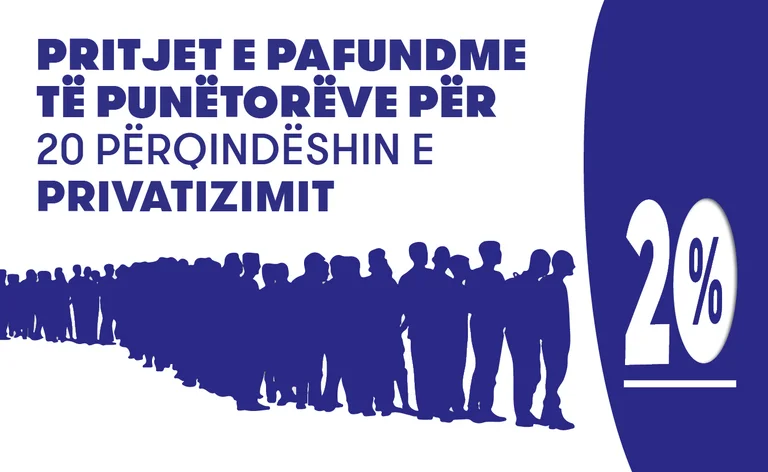
Infinite employee expectations for 20 per cent privatisation
Periskopi(5 years ago)
(5 years ago)More than a decade have been waiting for workers of several former social companies to get the 20 per cent money. In fact, there are times when the company has been privatized, while many workers have died and failed to receive the money they owe the Law. He's been lobbieing for workers' rights for a long time. It's [...]
He's been lobbieing for workers' rights for a long time. It's dealt with all sorts of cases of violation of their rights. However, one has been impressed on the chairman of the Union of Independent Trade Unions of Kosovo (BSPK), Avni Aydin. It has to do with a former employee of one of Kosovo's social companies, who had gone to the Kosovo chief union office to demand his right: partitioning 20 %s that belongs to the Law workers from the privatisation of social companies. Since the factory where he worked was privatised, he demanded his share of 20 percent.
But he never enjoyed this legal right. While giving his signature to finally receive the money that belonged to the company's privatisation, after a decade of waiting, the worker died in front of Aydin!
The worst case ever was when the worker in my office died, filling the 20% lists, just days before he took the money he owed, while he waited ten years to pick up the same”, Aydin said.
The process of privatising social companies in Kosovo began in 2003, by the UNMIK administration at the time. Initially, this process was managed by the former Kosovar Privatisation Agency(AKM), which was followed in 2008 by the Kosovo Privatisation Agency(AKP), following Kosovo's declaration of Independence the same year.
When the privatisation process of social companies in Kosovo had begun, UNMIK had adopted a Rule (200313), under which each worker has the right to participate in 20 per cent of the revenues from the sale if he/she has been registered as a social company worker at the time of privatisation or liquidation and has been on the company's salary list for at least three years. With such a regulation, the AKP still acts.
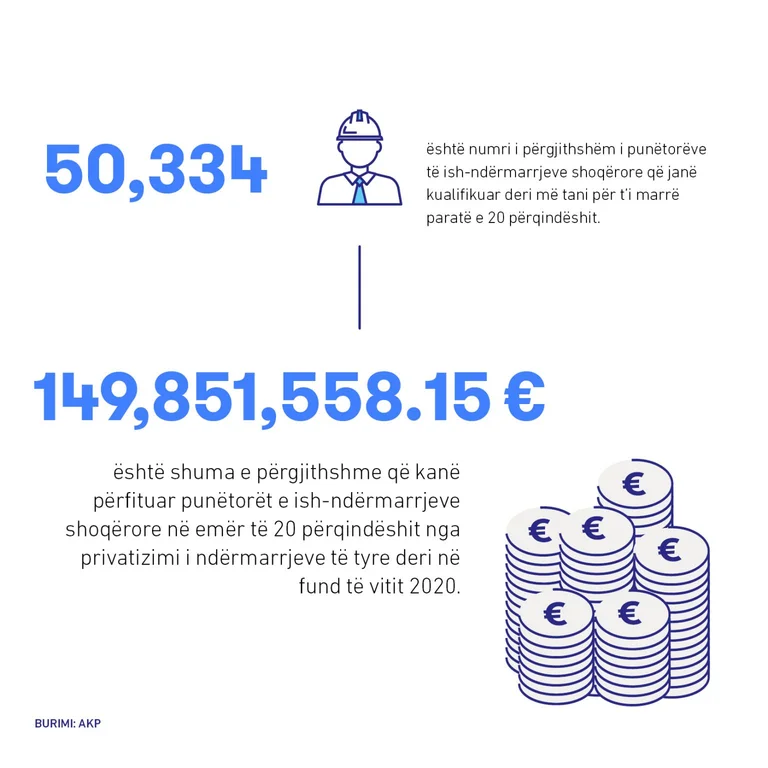
During the 18-year period, from the time the privatisation process has begun in Kosovo until now, the total number of workers who have qualified to benefit 20 per cent from the sale of social companies has reached0334. Over 50 thousand employees of privatised companies have been distributed about 150m euros on behalf of their share, from over 750m euros, as a total AKP has accumulated from the privatisation of social companies until the end of 2020.
Former employees of “Amortizers”, nearly a decade of waiting for 20 per cent tools
Bad luck like the aforementioned employee who died without taking 20 percent of his money has also been held by some workers of other already privatised social companies. Like those of the former company “Amortizers” in Pristina, on whose behalf their current representative, Ramadan Ahmeti, speaks. Hand fingers are enough to count his colleagues who died without receiving their amount, several years after the company's privatisation. That's a lot, 160.
The Amortizers' factory in Pristina in the past has produced large quantities of amortizers, there has also been military destination in the former Yugoslavia. As such, in many cases he had produced weapons for other countries.
“160 colleagues have killed us since the company was privatised, which has not even managed to get the first 20 per cent. And not the second”, Ahmeti indicated.
Some of their friends, who had the longest “”, managed to take advantage of something from 20 percent. Not all the amount, but, first part, at least that. Out of 1200 euros each, after 7 years of waiting.
The first piece of 20% from the company's privatisation has been received by workers, 628 thousand euros, respectively. And the second half of 825 thousand euros is yet to be taken. 496 employees have been regular. Now the measure for the second half has introduced 300 Serbian workers will drop us short. Somewhere from 300-400 euros for workers”, Ahmeti said.
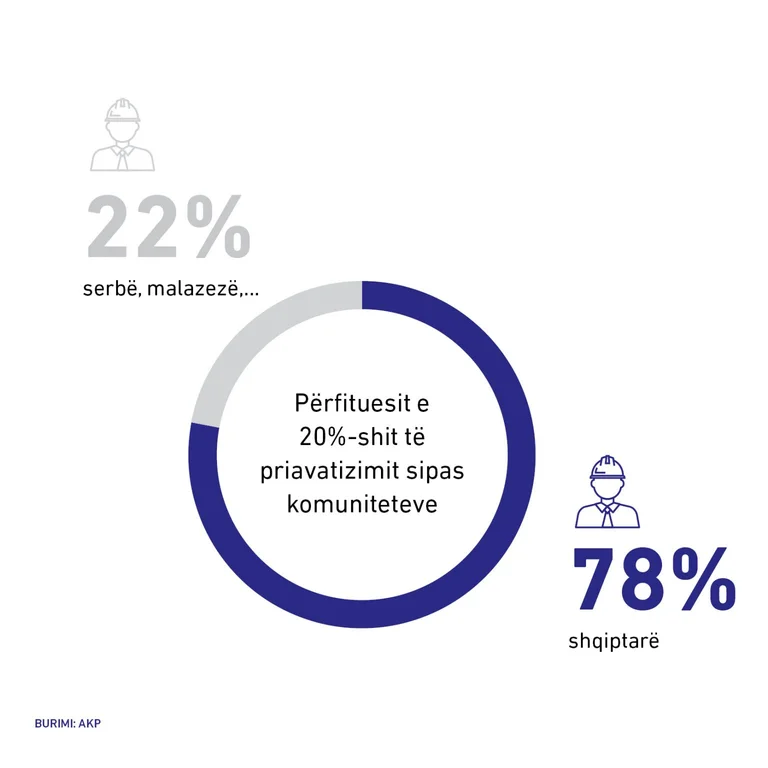
AKP officials have indicated that of the more than 50,000 workers who have received the money from 20% of the privatisation of companies, 78 percent are members of the majority (Albanian) community and 22 per cent members of other communities (Serbs, Montenegrins, etc).
<x)
The delay in distributing 20 %s and leaving work have made life difficult for former employees of “Amborizers”.
Their financial situation is nothing good. As Ahmeti points out, some of you will take him for a bite of bread. There are others who provide this basic product for life in various forms and overly heavy.
Many of our colleagues face great poverty. They store cans so they can take their children with bread to the house. Someone gets a little pension. Somebody gets nothing. No trouble, misery. This colleague of mine has three children, no sense before his soul. State institutions never care for him. The company gave him 10 or 20 cents for a bread”, confessed Ahmeti.
Soaking” social could at least facilitate the aloation of the second half of the 20% to which it belongs. And that is not known when it will happen.
From the Kosovo Privatisation Agency, they say the whole process of distribution of the second part to former employees of “Amorators” has been suspended. Because of this, opposition has been made to former workers for the sale of the company, who have addressed the Special Chamber of the Supreme Court of Kosovo.
The company's “associates have rejected the sale decision in the Special Chamber of the Supreme Court of Kosovo, and in this case they have demanded from the Court provisional measures to any action for the company in question. Until the conclusion of the Chamber's decision, the Agency has had no right to take any action on the distribution of 20% means for the Amortizer company in Pristina”, the AKP's response reported.
The Special Chamber of the Supreme Court (DHPGJS) has provided an answer to when this process will end. He has simply revealed the number of complaints in general about this company.
“In connection with NSH “Amortizers”, the complaints received in the DHPGS are a total of 520, in procedure and treatment are 222, whereas the finished classes are 298. In connection with NSH”Amortizers” in 2019, with a total of 519 complaints, says the Special Chamber of the Supreme Court of Kosovo response.
The promises in abundance were made by the chief unionist of “Amortizers”, Ahmeti, every time he went to knock for help at this “dere”.
I've been to the judge several times. He told us he was fine. He's doing fine. He's got to be careful. He'll help you. We're carrying”, Ahmeti claims.
It shows that they have protested twice the payment of 20 %s, but without effect.
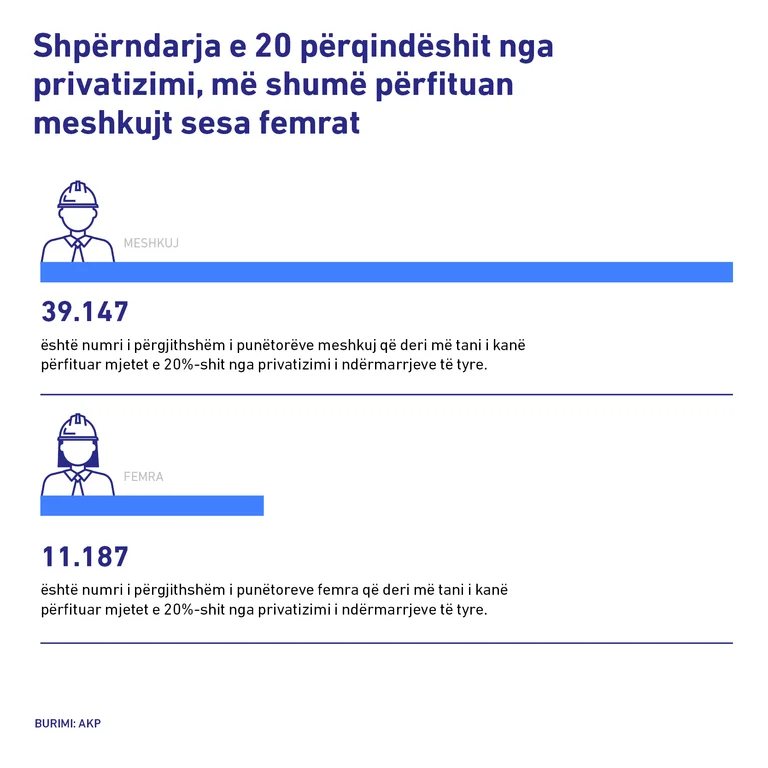
The distribution of 20 percent by privatisation has benefited males more than females
Of the 5534 workers of former social enterprises who have taken the 20% means from the privatisation of their companies, most are men.
According to the Kosovar Privatisation Agency, of the total number of aforementioned beneficiaries, 39 thousand and 147 are men, while 11 thousand and 187 are women. One of the latter is Ayshe Shehu. She worked at the “Amortizer factory” before even after the war. One time it has made its contribution to production, it has later been taken at the rate and wages of workers. She collected a 20% share, just like her male colleagues. He's waiting for the rest. He compares his dismissal to death.
It was heavy for me, like death, when I was told you can't ashes, because the factory was sold. I was taken away by guard because I didn't take my job. As a mother, as a woman, I felt bad. discriminated against”, it shows.
It says to itself that conditions are not bad because children carry it. He admits that if they weren't hard enough, he'd be able to stay alive.
It's like after the war, the kid's been working, we got a little bit of a life. Don't get me those words for living out here. It was supposed to sell house and land to”, Aysa said.
Since the postwar nearly 20 women worked at the “amortizers” factory.
Nearly 10 years waited for 20 per cent and former “workers IMF Kosova”
Hich less than a decade have been waiting to get 20%'s money, even the tributary workers “IMF Kosova” in Pristina. The latter, despite being a social enterprise and being listed for privatisation by the AKP, never underwent such a process. This was due to the fact that Pristina municipality in 2010, by the time it was led by Isa Mustafa, had asked the Government of Kosovo, which at the time was led by Prime Minister Hashim Thaci, to be declared the Special Cadastral Zone, where capital investments were scheduled to be realised.
The final word for this transfer of property from central to local power gave Kosovo's Assembly on July 10th 2010, while on February 4th of 2011, the Kosovar Privatisation Agency had announced it relinquished management of the company “IMF Kosova”
However, this transfer of property from the AKP to the Pristina municipality did not deprive company workers of taking the 20 per cent money, with regard to the allocated financial compensation of workers would make the municipality greater in Kosovo, Pristina.
Even in factory “IMF Kosova”, women, contributed. There's five of them. Kimet is one of those who worked in the company, which since 2010 with the government's decision has been given to the Pristina municipality. She was originally a cashier and then a financial leader.
Leaving his job made his life difficult. It was completely out of income until they gave her 24 thousand euros in her bank account. That's the first part of the 20, right? They came out after about a decade. For the rest, he'll have to wait.
We only got a piece. If a boy didn't help me, I couldn't even eat with an oatmeal”, she said.
S. GK: Loss of jobs mostly harm women
Adelina Tarshan of the Kosovo Women's Network, losing a woman's job, considers her financial independence to be a loss.
“Taking into account all the patriarchal challenges a woman must go through to secure a job in Kosovo, the loss of the workplace is one of the most frequent gender discriminations because leaving the workplace is the phenomenon which most often affects women”, Tarshan praised.
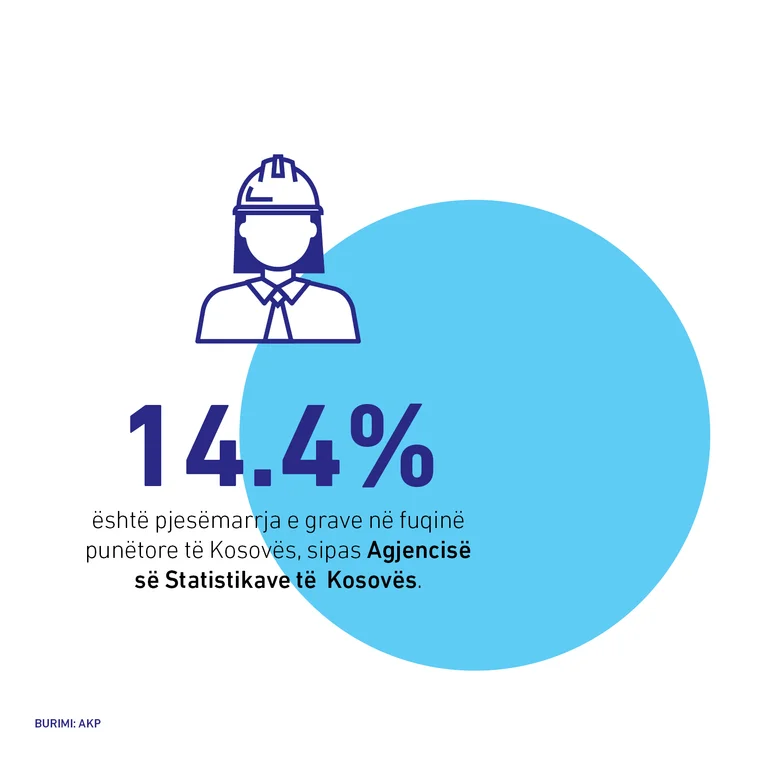
The participation of women in the workforce is 14.4 %. So shows the latest poll conducted in 2020 by the Kosovo Statistics Agency. That of multiple men higher, 44.0 %.
For this phenomenon to change Tershan has some recommendations, the implementation of which requires it from institutional mechanisms.
Be seriously treated and promoted more reporting gender discrimination cases in the labour market by all relevant institutions. The rise in the number of inspectors and judges, as well as their profile, enables treatment with priority of the work disputes, as the law in Kosovo defines”, Tarshan said.
Poverty “meets” former social enterprise workers
In company “IMN Kosova” More have dominated men than women.
Emin Neziri has an identical case as his colleague, Aysa.
But his financial condition was far more serious than that he at times had to ask his friends for money. He needed it to buy products, basics for living.
Emin Neziri, representative of workers “IMN KOSOVA”
There was no more difficult situation. For myself, I've been the boss at the time, the situation you know, the coma is 20 euros, 5 euros. For Idare, we haven't had any bread or corn. They also have the situation of other workers”, confessed Neziri.
Two things caused her poverty. First leave work. Second, the delay of 20 %s.
Part of the latter has already received, not yet.
Before taking the first piece, he says he didn't leave an institution without going. In some cases he even organized protests.
I ran into every institution for years. We did six protests in front of the Pristina municipality. Protested by 110. In the municipality, we were told to go to the AKP. AKP don't go to Government. Once we were executives, we weren't even expected. Later on, you're going to have to go to <x1...
Bluebox property “IMN Kosova”, located in downtown Pristina, was estimated at 23m euros. The Pristina municipality, after its request to declare the specific area was approved in the Assembly, did not pay the amount to the AKP, but only 20 per cent for the workers. Of the company's 23m euros, 4.6m euros were estimated for the workers. But after more than a decade, the Pristina municipality, which is led by Shpend Ahmeti, has transferred only 2.4m euros to Trebell workers, while 2.2 million have not yet been distributed.
Waiting for his second piece, there's Ferki Maxhun, once the manager in the factory.
Ferki Maxhuni, former manager at the “company IMF Kosova”
This shows that 20 per cent beneficiaries have been 113 workers from 278 applicants. He makes known the reason for the impasse.
The first <x0). The rest are left unpaid as if they complained to some workers who have not earned the right. Ankea has done 59 workers. The AKP for good reason has stopped them until court procedures” are stopped, he explains.
Work options at “IMF Kosova” confirms the Special Chamber. He says there are 60 of them dealing with the distribution of 20 %s.
“Regarding the IMN Social Company “Kosovo”, in judicial procedure there are a total of 111 substances related to the nature of Lyquidimi, while in the course C-II-200011-C0001, including 60 complainers”, the DHPS response reported.
The Kosovo Privatisation Agency said the means dedicated to beneficiary employees could not be affected until the Supreme Court's Special Chamber gives its verdict on these complaints.
“So far we have only a distribution of 20% for qualified workers, other tools dedicated to former company workers are preserved until the Supreme Court Special Chamber decision concerning workers' complaints”, the AKP said.
When would one from this room say so:
“Landants in the Special Chamber are handled according to priority and by”.
So far in this chamber, 10,965 complaints have been accepted by former social companies.
Among these, 1,339 sosh that are related to the work relationship, compensation for injuries at work, or compensation for damage because of earned illness at work.
Max: If Trebell were functional, Kosovo would not import from region
Former manager at the Tulell, Ferki Maxhun, says the Pristina municipality, where he spent several good years working, has planned to build a Trade Center. Asked about this and other plans, by local power capitalians, not even after two weeks of waiting have they returned any responses.
Maxhu talks about <x0nomin” that the company used to have.
The factory has had a lot. Sikkena could have produced as many requests at the market. The factory was found in regular post-war condition. We had capital. The State has not helped us. With 500K marks of post-war German invasion that had flourished. Serbia had not put a block on you here”, the former Nebulous Manager “is convinced IMF Kosova”
How does the process of 20 % turn out for former employees?
Privatisation in Kosovo has started about 18 years ago.
But how does the process of 20 %s involving itself come about?
In all companies the process of creating the original and final list lasts up to 6 months, the AKP says.
They say this is for a reason.
“Initially, the announcement is made for the company in question that former workers apply and hand over the necessary documentation for the profit of 20%, where the deadline for surrender after announcement is 30 days, then reviewing relevant documentation based on regulations and laws in force, should be considered within 30 days”, said by them.
Some more follow these procedures.
“then released the initial list in local and regional newspapers, where we expect possible objections to that list, some are not qualified, some object to the names found on the list, after the end of the date for the initial list complaint, we accept all complaints to the initial list and then are reviewed by us in the run of 60 days”.
After that, the final list received approval at the Agency's Board of Directors is published. However, the process does not end.
Since the dissatisfied parties have the right to complaint in the Special Chamber of the Supreme Court. However, this, according to the AKP, does not cause the approved problems on the final list.
“We apply to the Special Chamber to report only to the number of complainers in order to stop the share of the means for complainers and make distribution for the approved on the final list”, the AKP said.
Workers are not seen as priorities during the privatisation process
The process has sometimes been forwarded with numerous irregularities. All of this was under journalists' “pipe”.
Two of those reporting from the very beginning are Arbana Jarra and Serbze Hadziaj, who pose sharp criticism.
Jarra considers the privatisation process has not addressed workers at all as priorities.
“Institutions have not taken care of successful privatisation processes, and the work issue has not been a priority at all. Not only have they been out of work, they have not compensated, even for decades it has not been noted that in any review of the process there is at least a second option of”, said Jarra, who when the privatisation process began worked economics journalist in the newspaper “Koha Ditore”.
Hadziaj says the same.
It does not agree to the privatisation scheme, which, according to her, has not protected workers at all.
The “those who for a decade during the 1990s have suffered layoffs and discrimination on ethnic grounds after the war have been the target of planned privatisations and renewed job loss. They have been victims of job loss, payments and selective estimates of his having had to receive from 20% of the privatisation”, Haxhiaj stressed.
The same is Avni Aydin, chairman of BSPK. It estimates that the rights of workers of social enterprises have been violated by “2 feet”.
He blames the Government, which he says has not taken care of this category.
Kosovo's “government has never made a plan on how to maintain the social welfare of these workers, who have worked throughout their lives in the company, or even left their body limbs there”, he said.
Aydin says such state neglect has made social conditions worse for former social rabbs.
The social situation of former social enterprise workers is miserable, since the same ones when the company was privatised have been delayed and the young buyers have not been hired, many workers have been laid off due to technological developments”, he claimed.
The beneficiaries of 20% across the region, he leads Pristina.
The AKP has divided the 20 per cent beneficiaries into five Kosovo regions.
The total amount benefited from 20% workers by the end of 2020 is 149m and 851 thousand and 558 euros.
The largest “Kulaci” is earmarked for 13 thousand and 223 employees of the Pristina region, a total of 63m and 690 thousand and 493 euros.
Nearly half less, 32m, 92 thousand, 356 euros for 12 thousand and 277 employees of the Gjilan region. Over 25m euros for 9 thousand and 507 workers in the Pec region. Four million less, 21m and 175 thousand and 320 euros for 10,000 and 916 employees of the Prizren region.
The entire end comes workers from the Mitrovica region. For 4 thousand 411, how many are there, 7 million and 879 thousand and 734 euros were allocated.
This is where factory employees “enter Lamcos” in Vushtrri.
“Fat in disaster”, former “workers The flamingos” waited a year for the means they are entitled to
Even factory workers “Lamkosi” in Vushtrri fell to wait for the money of 20 %s. Not much, about a year.
The payments to them were not too neglected and came out almost immediately.
All company workers had a chance to withdraw them in 2006.
Their representative, Enver Jusuf, says none of them died without taking the money.
We almost immediately got the tools. All the workers, nobody's dead. 347 is playing. We have all the tools. Out of 1500 euros per employee we've been dropped”, he stressed.
Enver Jusuf, representative of company employees “Lamkos” in Vushtrri
Former “Fabric employees Lamkos” had the same fate as their colleagues who worked in other state factories.
Poverty and misery also touched them, and they were saved. The trade unionist Yusuf, who speaks on their behalf, cites examples of some of the workers who are in dire financial straits.
“Hject for all. They can't work. They were old. S'you get me a job. Two workers have jobs badly. They also take it for food”, says Yusuf.
The Lamkos factory once produced some 120 thousand tons of tin a year and employed 500 workers.
The factory owns about 18 hectares of land, buildings, production line, as well as machinery and equipment. It has not had a successful privatisation by being renewed several times.
Recently in 2019, it was sold to the company “Emona” for a price of 4.8m euros.
Privatisation in Kosovo, failure
The results of privatisation in Kosovo are not what have been expected.
The lack of investments and no job opening is pronounced.
These are well known to the chairman of the Kosovo Economic Ode, Berat Rukiqi. He has identified the main cause.
“has occurred to transform property. More importantly, transformation of property was the goal than economic development. In mind it has been to protect property from any claim by Serbia on property that is on Kosovo territory. We've been waiting for production growth and jobs. But the conflict between the two concepts has created this situation so that we do not have the expected results of privatisation”, he stressed.
Wildly, the privatisation process calls Avni Aydin from BSPK. Kosovo institutions, he thinks, have not done any detailed analysis of the privatisation process.
“There has been a process of subx1> privatisation “, where social companies that produced before the war, even as he says, that were “giant production” have been turned into different shopping depots, or wedding halls, while former workers have remained roads”, Aydin said.
That privatisation has not had any significant impact on production, says researcher Serbian journalist Haxhiaj.
The privatisation issue has never been submitted to any revised process to see the effect of the process on the country's economics. Also, this process needs a deeper investigation into the abuse and enrichment of a political group that has exercised full control in this process”, she stressed.
The critic also has Arbana Jarra.
It calls the privatisation process a failure, since Kosovo, according to her, has not benefited economically from it, nor has it impacted the opening of new jobs.
This process of very few exceptions is failed because Kosovo has not economically benefited. Foreign investment has not generated in order to impact the opening of new jobs, leaving existing workers on the road”, she said.
Otherwise, the privatisation process has benefited workers financially, depending on the price of sale of the company. The more expensive the company has been privatised and the fewer on the profits list, workers have benefited more financially.
The financial benefit record is owned by former company workers “Ratar” in Pristina, where each of its employees has benefited from an average of 228,433.75. At least money from the privatisation process has benefited former construction workers “Dratks” in Dragas, where each worker has won $184.
“Privating has been a kind of firing squad for former social enterprise workers. Many of them have been out of work at the worst of age, about 60 years old, while lacking institutional support for them, because at that age they have not been able to work or have filled their retirement years”, says Kosovo employee Avni Aydin.
(The publication and publication of this document is supported by the Kosovo Civil Society Foundation programme (KCSF) ) Kosovo, co-financed by the Swiss Development and Co-operation Agency (SDC) and the Swedish Agency for International Development and Co-operation (Sida). The contents of this document are the responsibility of journalists and not necessarily present the KCSF's, SDC or Sida's positions.