6 minutes ago
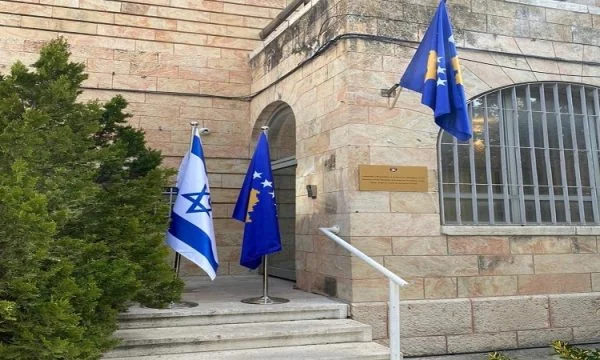
Expert Daniel: Embassy in Jerusalem testifies that Kosovo depends on Turkey, EU
Periskopi(5 years ago)
(5 years ago)Kosovo offers numerous opportunities for Israeli companies and perhaps the economy and development will be the direction of reports between Israel and Kosovo, Remi Daniel, an expert at Israel's National Security Studies Institute, says in an interview for Radio Free Europe. According to him, the calendar opening in Jerusalem is an opportunity [...]
According to him, the independence foreign policy that is not dependent on Turkey or the European Union is an opportunity for Kosovo.
In this interview, expert Daniel also speaks of the recent situation of the outbreak of violence and Jerusalem between Palestinians and Israeli forces.
In recent days we are seeing scenes of violence in Jerusalem. Can you tell us why this escalation of violence in this period?
Remi Daniel: I think this escalation is the result of a number of factors, which by getting together are creating an explosive situation on both sides. Initially Palestinianly, the Ramadan month is always a tense month in Palestinian politics. There is a rivalry among different political groups. Surely you know it was planned to hold Palestinian elections between Fatah and Hamas, which were cancelled. Hamas, who is more of a Islamist terrorist group, is trying to gain more power in Palestinian society. This has created opportunities for Palestinian groups to create a hot situation with Israel.
Meanwhile, on Israel's side is the fact that the political situation is very unstable, we have a weak government and an increase of right-wing groups that have supported Prime Minister Benjamin Netanyahu along with others. All of this creates a reconfiguration in which each event can be initiating and escalating the situation. So we've had the issue of several Palestinian houses in the Sheik Jarrah neighbourhood in Jerusalem, then marking Jerusalem's Day on the part of Israeli nationalist groups, and all of this led to escalation as a result of long-term, medium- and short-term problems on the side of Palestinians and Israel.
How do you view the situation in the days ahead. What can happen?
Remi Daniel: It's complicated to know what can happen. Obviously it won't stop today. Both sides have demonstrated that they are willing to continue and fight. Israel's army has said it will last at least a few days. However, there seems to be something that will last more than a week or two. No one wants that, but it is also true that it is a situation that is difficult to control. Whatever the parties aim to do and benefit from this round of fighting between Israel and Hamas, the situation may soon get out of control and we cannot know what might happen next.
Let's get to the Balkan region. Kosovo and Serbia are developing dialogue with the European Union's mediation for reaching a comprehensive agreement on normalisation of reports. Many analysts have said that if the Kosovo- Serbia continues to last, then could turn into a situation the same as between Palestinians and Israel, or even between Greek and Turkish Cypriots. Do you see similarities?
Remi Daniel: Yes, there are some similarities. Perhaps first we should talk about what these people think when they say that the situation may seem like a situation between Palestinians and Israelis, just a situation in which all efforts to reach a long - term agreement fail and people get used to it, or a situation where there is no peace, but war. In the case of Kosovo and Serbia, there are similarities, as it comes to the fact that the issue is about a relatively small territory, more conflicting issues, conflicts, then issues of legitimacy -- issues that are very sensitive and that stir many emotions in both societies. I also see an effort by the international community to play a role, even though it is not always positive. We've seen all of this and we're still looking at it in Israel's conflict with Palestinians. So the similarity between two cases is very relevant.
Western Balkan countries are aiming for membership in the European Union, but influence by other powers in recent years has increased. I mean China, Russia and Turkey. What is their purpose?
Remi Daniel: I think it is an interesting phenomenon because the Balkans constitute a strategic value, as for the countries mentioned to you, Turkey, Russia and China Balkan countries are a gateway to a part of the Mediterranean, but more of Europe. So the effort of these powers to extend influence in the Balkans is also to influence the European Union. They have a double policy, as they aim at influence in the Western Balkans, but they also need the European Union to remain an important player in this region because what these three powers want from the Western Balkans is not only their control but also their exploitation as a gateway to Europe. So it is a complicated game that these countries are trying to create with little or more success, but it is impossible to understand the goal to influence the Balkans without also looking at the European Union as a player in this region.
In your opinion, has Turkey's approach to Western Balkan countries changed? We have seen increased investments in Serbia, then a stronger commitment to cultural ties with Kosovo and Bosnia. Why has Turkey's interest in the region increased?
Remi Daniel: Increasing Turkish influence is not new, it has begun with the end of the Cold War, the beginning of wars in the former Yugoslavia. It's interesting because there have been several ways of doing things in the Western Balkans. We've had the 1990s and in the early 2000s working with the West, with NATO with the US and the EU, and then you have the most neo-Ottoman period based on religion based on common values, by 2016, and now we're in the third phase of Turkish activism in the Western Balkans, and this phase is based on personal ties between (Turkish president, Recep Tayyip) Erdogan and local leaders, for example, in Serbia is very important.
So why Turkey is so active. As I said, the Balkans are a gateway to Europe geographically, then for trade and political reasons, but there is also a region over which Turkey considers to be a special legitimacy, due to history since the Ottoman Empire. Then geographical proximity, unlike Russia and China, and the religious aspect and idea that Turkey may perhaps serve as a particular model for the countries of the Western Balkans. For all these reasons, Turkey considers that there is a special legitimacy, a special role to play in the Balkans, and perhaps considers that success in this region can be achieved more easily, in contrast with other Turkish foreign policy regions.
In February, Kosovo and Israel have established diplomatic relations. In Kosovo this has been praised as one of the most important recognitions of independence. In what ways will Israel develop co-operation with Kosovo?
Remi Daniel: It's a very interesting question because if we talk about what Israel from Kosovo can expect, you should look at the reports between Israel and the countries in large size with Kosovo. In general, there is political dimension that is reflected mainly through voting in international organisations, but in Kosovo's case it is a little complicated because it is not accepted in major international organisations. Then there is symbolic dimension and I think that in this respect, Israel has received the maximum of what it expected from Kosovo, with the opening of the Kosovo Embassy in Jerusalem. Thus, from these two perspectives, Israel may not have a space to develop reports, but there is a third way to cultivate reports that are development and economics. There are numerous opportunities for Israeli companies for Israeli development agencies and perhaps this will be the way for Israel to hold reports with Kosovo and perhaps also in co-operation with the new Israeli allies, such as the United Arab Emirates, which are also getting more and more involved in the Western Balkans.
The opening of the Kosovo Embassy in Jerusalem has sparked criticism of the European Union and Turkey. Even Turkish President Recep Tayip Erdogan has urged Kosovo's prime minister to reassess the decision. How have you seen such a situation?
Remi Daniel: The opening of the Kosovo Embassy in Jerusalem has been of special symbolic importance to Israel, as Kosovo is the first predominantly Muslim country in the world to open the embassy in Jerusalem. Thus, it has created tensions with Turkey and the European Union that differ on Jerusalem.
In Turkey's case, it is probably interesting to say this has come at a time when reports between Kosovo and Turkey are not at the best level. There have been several tensions between the two countries because of Gulen Movement, which is Erdogan's main enemy, some of its members are in Kosovo, and Erdogan is trying to force the Government of Kosovo to return them to Turkey, then we have had their kidnapping case that created tensions with the Government of Kosovo.
The decision to open the Embassy in Jerusalem is an opportunity for Kosovo to show there can be an independent foreign policy that is not dependent on Turkey or the European Union. Perhaps the most important thing that can be said about it is that it was enabled by the former American president, Donald Trump. Now that Trump is no longer in position, maybe Kosovo's maneuvering space in relation to Israel is less than when the decision was made earlier this year.