17 minutes ago
Wessel's defense: To drop accusations based exclusively on international custom rights
Periskopi(5 years ago)
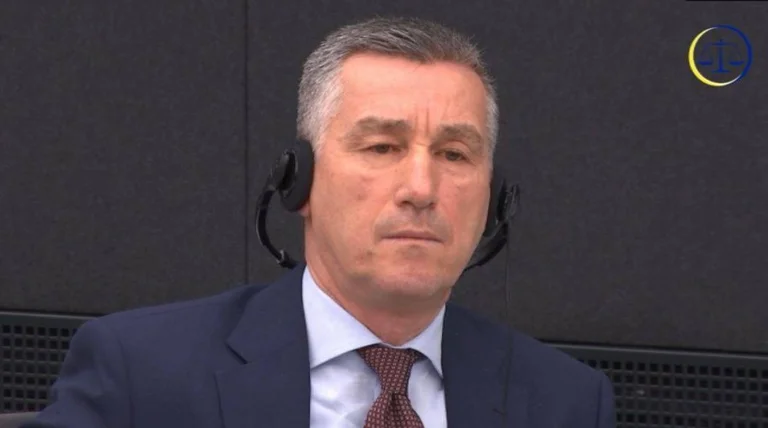
(5 years ago)The defence of former head of the Kosovo Republic of Kosovo's Parliament, Kadri Veselin, has asked the preliminary judge to drop charges based exclusively on international customary law and to order the Special Prosecutor's Office (ZPS) to change the indictment. Wessel's defense has revealed that the SPS in the form of the indictment and judge of the preliminary procedure [...]
The defence of former head of the Kosovo Republic of Kosovo's Parliament, Kadri Veselin, has asked the preliminary judge to drop charges based exclusively on international customary law and to order the Special Prosecutor's Office (ZPS) to change the indictment.
Wessel's defense has revealed that the SPS in the formation of the indictment and the judge of the preliminary procedure in his decision on confirming the indictment have lost sight of the fact that the Specialised Chambers are not an international criminal court, implementing international criminal law, reports the “Battle for Justice<1>.
According to the defence, this court is a local Kosovo court, linked to the Kosovo Constitution, restrictions that do not apply to an international criminal court and, according to Kosovo's judicial order, the constitution's provisions are higher than any other source of law, including international law.
The defence says the applicable internal law at the time of the alleged actions in the current indictment was the RSFJ Constitution and the RSFJ Criminal Code.
The RSFJ Constitution did not allow internal implementation of international humanitarian custom law to establish criminal acts, in addition to the measure that was in line with local legislation adopted to give the effect to Yugoslavia's international obligations”, the motion reported.
Meanwhile, defence says that in terms of principles of non-responsive criminal law against the accused, Article 3 of the RSFJ Penal Code predicted that no sentence of any other criminal sanctions could be pronounced against anyone for a work which, before being carried out, was determined by law [d.m.th. in a statute] as a criminal offense and for which the sentence is not set forth in the (4)x1> statute.
The RSFJ's <x0-Codi Penal Code banned genocide and war crimes at articles 141 to 144 of the code, but it did not include the VII principle of Nuremberg, described by the International Law Commission in 1950, regarding co-operation in war crimes and crimes against humanity”, the motion said.
According to the defence, instead, he predicted, in Article 15 of the Criminal Code, a criminal offence of “organising a group and promoting genocide and war crimes”. This work specifically limited secondary criminal responsibility to those who organised or united a group “in order to commit criminal acts referred to in articles 141 to 144x3> or that “resurrected or promoted the execution of criminal acts referred to in articles 141 to 144” These works require that the accused have the same specific purpose as the alleged chief.
The defence claims that Article 13 of the Law is unconstitutional as long as it aims to determine crimes against humanity, including, in the context of a NIAC, “prison” and “enforcement by force”, none of which were crimes under domestic or international law at the time of the alleged events in Aktakuza.
It also says of Article 14 (1) (a) that it is unconstitutional as long as it aims to define the <x0).%x1> as a war crime in the context of NIAC.
Meanwhile, says Article 16 (1) (c) is unconstitutional as long as it imposes criminal responsibility according to command responsibility principles that extend beyond Article 145 of RSFJ's Penal Code as it violates Article 33 (1) of the Kosovo Constitution interpreted in line with the ECHR judicial practice under KEDNJ's Article 7 (in line with Article 55 of the Kosovo Constitution).
On the other hand, says, Article 15 (1) (c) of the law violates Article 33 of the Constitution and Article 7 of KEDNJ in denying the temporary implementation of the softest subsequent laws of committing alleged crime.
“Article 15 (1) (c) envisions only the implementation of the softest laws in force before the alleged performing of the work. In preventing the implementation of more favourable laws for the accused who were adopted after the events in question, he violates Article 33 (4) of the Kosovo Constitution”, the motion said.
According to the defence, this is because Article 4 (2) of the RSFJ Penal Code, applicable at the time, imposed a mandatory request that the accused should be granted the benefit of a softer regime, including the most favourable law adopted after the crime was carried out.
The defence says the 1974 RSFY Constitution and the current Constitution of Kosovo do not recognise the direct effect of international law standards on criminal issues.
“While the 1974 RSFY Constitution clearly prohibits the direct effect of international custom law, the current constitution requires (i) criminal laws to be adopted by statute and (ii) criminal acts to be judged based on law in force at the time of events”, the motion says.
According to the defence, both of these requirements, which act as lex specialis, have priority over the general rating that allows for the inclusion of ratified treaties and standards of international customary law in the internal judicial system.
The “as a result, and in line with the established jurisdiction of other Kosovo courts, the defence predicts that the KSC has jurisdiction only to judge persons based on internationally ratified treaties or the alleged customary principles of international humanitarian law introduced in the internal system of Yugoslav by the statute at the time of incidents claimed in Aktakuza. That means articles 141 to 154 of the RSFJ Criminal Code (and specifically, in terms of secondary participation, Article 145)”, the motion said.
On the other hand, the Joint Criminal Company reportedly is neither clearly recognised in the Specialised Chambers Law nor in Kosovo's internal law.
Even if the Pre-Procedure Procedure Judge decides that international customary law has a direct effect on criminal cases in the Specialised Chambers, there is considerable evidence suggesting that the joint criminal enterprise III was not established sufficiently in international custom law in 1998-1999 to generate responsibility for the incidents allegedly taking place at that time”, it is now said.
The defence says that, in the alternative, even if the joint criminal enterprise III was founded as a way of responsibility according to international customary law at the time of the incidents, defence predicts that there is good authority to show that at the time of the international customary law review, it evolved by clearly rejecting joint criminal enterprise III as a way of responsibility in favour of a more objectively based theory of co-ordination.
The defence has provided that Specialised Chambers must enforce their national laws and that as a result. According to them, Specialised Chambers have no jurisdiction to carry command responsibility because the internal law applicable during the armed conflict did not recognise command responsibility as a way of responsibility.
In addition, it has stated that specialised rooms should enforce its national laws and that as a result, they have no jurisdiction to try alleged incidents of illegal detention as a war crime and forced disappearance as a crime against humanity because these crimes are not clearly recognized in the Specialised Chambers Law, nor in Kosovo's internal law.
The subx0 defence provides that international customary right cannot be used as a source of behavior for criminalisation because: a) International customary law has no direct effect and cannot be applied directly by the courts of Kosovo unless there is a corresponding criminal ban on domestic judicial order (the test of duality); and even if articles 13, 14 and 16 of the Law are regarded as importers of international law in Kosovo's internal judicial system, it violates the principle of legitimacy envisioned at Article 33 (4) of the Constitution and Article 7DBE, which has the superior force of any other law, including the International Law, the constitution, including the constitution, in the letter of the letter to the letter.
According to the defence, the Specialised Chambers must enforce their national laws as argued above, but otherwise, there is no legal basis for joint criminal enterprise in the Specialised Chambers Law.
In addition, the defence has provided that the Pre-Secretary Procedure Judge must conduct a case-by-case analysis to determine which way of responsibility, between those found in the international customary right, or those found in national law, is most useful to the accused.
According to the defence, this court has no jurisdiction to command responsibility, and the internal law applicable during the armed conflict with Serb forces did not recognise command responsibility as a manner of responsibility similar to that included in Article 86 and 87 of the Geneva Convention's State Protocol.
The defence suggests that SPS charges of combating arbitrary ban under Article 14 (1) (c) have no grounds in the Law.
In addition, the defence has claimed that this court has no jurisdiction either for illegal or arbitrary arrest and ban, as well as for forced disappearance.
Therefore, the defence has demanded that the judge of the preliminary procedure reconsider his findings in the decision to confirm the indictment.
On the other hand, it has sought to dismiss allegations based exclusively on international customary right instead of ratified international treaties included in the Yugoslav internal system at the time of alleged incidents in the indictment in line with RSFI 1974's article 142 and 145 Penal Code for lack of jurisdiction, including those related to the joint criminal enterprise, command responsibility, illegal detention as a war crime and the forced disappearance as a crime against humanity.
He has also demanded that the SPS be ordered to change the indictment.
Otherwise, on November 9th, in their first appearances, Hashim Thaci's Jakup Krasniqi has been declared innocent of charges placed on them.
Wessel has been declared in his presentation on November 10th, as has Selimi on November 11th.
The incident against Hashim Thaci, Kadri Veselin, Rexhep Selimi and Jakup Krasniqi is confirmed on October 26, 2020.
According to the alleged indictment, at least between March 1998 and September 1999, Hashim Thaci, Kadri Veselini, Rexhep Selimi, Jakup Krasniqi and other members of the joint criminal enterprise had the common goal of securing and exercising control over all of Kosovo through methods involving intimidation, mistreatment, violence exercise and illegal elimination of those considered opponents.
“Set up these opponents included persons who were, or who were considered to have been: (a) collaborators or forces, officials or state institutions of RFJ, or who (b) otherwise did not support the purposes or methods of the KLA and later QPK, among whom persons linked to the LDK and Serbs, Roma and persons of other nationalities (joinly, non-combatorsors). This common goal included crimes of persecution, imprisonment, arrest and arbitrary or illegal arrest, other inhumane acts, cruel treatment, torture, murder and forced disappearance of persons”, the indictment said.
In addition, Azem Syla, Lahi Brahimaj, Fatmir Limaj, Sylejman Selimi, Rrustem Mustafa, Shukri Buja, Latif Gashi and Sabit Geci are also mentioned.
“Among the other members of the joint criminal enterprise were Azem SYLA, Lahi BRAHIMY, Fatmir LIJAY, Sylejman SELING, Rrustem MUSTAFA, Shukri BUJA, Latif GASI and Sabit G ECI, as well as some other political and military leaders of the KLA and the KPK, including other members of the General Staff; ministers and deputy ministers of the QPK; commanders of KLA and QPK areas, deputy commanders of the area and other members of the command headquarters; commanders of brigades and units; commanders of police and intelligence services of the KLA and QPK; other KLA soldiers and other QP officials, as well as others acting in the name of the QKK and the QKK (KC) -- in the joint operation of the QKK (K) along with the CKK (K) HACH IN, Kadri V ESELIN, Rexhep SELEM and Jakup KRASNYYNY, jointly, NKP members. All these individuals, with their actions and inactions, contributed to the achievement of common purpose. As an alternative, some or all of these individuals were not members of the joint criminal enterprise, but were used by members of the joint criminal enterprise to commit crimes for the realisation of the common goal (with members of the NKP, jointly members and NKP instruments)”, says the accusation act.