a minute ago
Who waits to be tested for coronary in Kosovo
Periskopi(6 years ago)
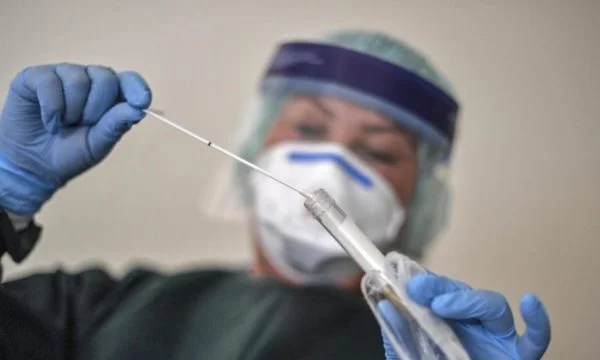
(6 years ago)Fatos Vokshi, a citizen from Pristina on Monday, for more than two hours, has stayed at the Infectious Clinic of the University Clinical Centre of Kosovo to prove that there are symptoms of coronaryism in order to be tested. But this was impossible, since medical personnel did not test it. According to Vokshi, patients should [...]
According to Vokshi, patients who should take the test for COVID-19, the disease that causes the Coronavirus, are assigned in order to choose that.
“I was a witness today. It means, it's really bad if it comes to treatment by clinics. This is my experience today, I waited two hours and I didn't do work, and I looked at other patients who were more familiar, that's selectively, accepted and tested”, Vokshi said.
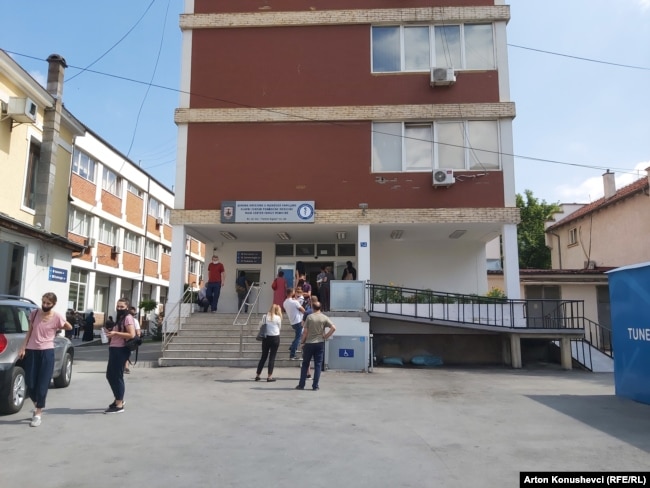
Since the University Clinical Centre's Infectious Clinic has not been allowed to take samples for testing PCR method, Vokshi has been directed to the main Family Medicine Centre to make the corporal test for coronarys.
The virological test, the method PCR, determines whether the virus is active, whereas the serological test indicates whether the person has been infected with coronary.
Another citizen from Pristina, who waited in line near the main Family Medicine Centre, to set the term for making the serological test, said it is pointless how the respective mechanisms are not acting in the right way in front of people who have symptoms of the new coronary.
I've had symptoms almost a week. Symptoms are 100 percent that's COVIED-19, at least according to what I've read, and I'm not finding it normal to go into a circle where maybe I suspect I have it (virus) and infect someone else, starting from the workplace, citizens, family persons at the age of<1>, said this citizen, who did not want to be introduced.
Health Minister Armenmen Zemaj told Radio Free Europe how much to test for COVID-19, the Kosovo National Public Health Institute is currently doing its best.
This is the maximum IKSHPK can do, according to protocol rules that are also set by the World Health Organization. Actually, the number of tests is according to the need and recommendations of health professionals. It is another fact that citizens have other demands, they also have concerns and they need to test”, Zemaj said.
Currently in IKSHPK, there are between 400 and 500 tests a day.
Minister Zemaj said that in the coming days there may be an increase in the number of tests, but, according to him, this could be done if it ends over time with regional labs and their device equipment. According to him, it is also being worked on licensed private labs.
We've started with the process of establishing six labs at regional centres. The rest related to the licensing of private institutions to conduct the necessary” tests are under way, Zemaj said.
The Ministry of Health, until now, has not licensed any other health institutions for conducting tests for coronarys.
Zemaj said this issue is still under way and that the established board is dealing with it.
“We will start with those who meet the conditions and criteria and guarantee supervision and connection with the Ministry of Health and the National Public Health Institute, to have tests from the private sector”, Zemaj said.
The Ministry of Health reports on Radio Free Europe that 80 private health institutions have applied to be licensed, to conduct tests for coronarys, while next week, the review of these apps is expected to begin.
In the absence of tests by IKSHPK, the diagnosis of coronary cases in Kosovo's regional hospitals has begun.
Pec Hospital Director Skender Dresey told Radio Free Europe that such an assessment stems from experiences with patients and their situation. He even stressed that this is a work diagnosis.
A stance is that all suspicious cases, which have elements of COVID-19, and until not proven otherwise, are treated as COVID-19. This is intended to have a more careful approach and this is a diagnosis of work, clinical diagnosis”, Dresaj said, adding that this is also the recommendation of the National Public Health Institute.
Minister Zemaj said regional hospitals are being worked on by the protocols and recommendations of health professionals.
The “what we have done is decentralisation of services in the region and empowering these services, that is, to provide service for cases with COVID-19. This is the opportunity. Enhancing capacity is necessary, but it needs to have confidence in professionals. This is the protocol that is offered not only here, but throughout the entire world”, Zemaj said.
Kosovo Prime Minister Avdullah Hoti has called on citizens to be careful during the coronary pandemic, until he has warned that even beds for sick people are shrinking.
In Kosovo, 276 new Corleone cases were confirmed Monday by testing 404 samples. In the last 24 hours, eight victims were also recorded by the Coronavirus. The total number of victims is currently 185.