5 minutes ago
Spectacular entities to Albanian politicians abroad, only Enver Hoxha did the risk ever
Periskopi(6 years ago)
(6 years ago)Remember. Al al publishes some of the most sensational incidents brought against top Albanian politicians abroad, starting with the assassination of Paris bombers and General Esat Pas Toptan in 1920 by Avni Rustemi, the murder of Avni on April 23, 1924 by Toptan people who paid one of [...]
If we go back to history and look at what has happened over the past 120 years, we will notice that with our politicians outside Albania, there have been serious events, murders, injuries and kidnappings of several prime ministers, ministers, etc., as Albanian politicians have preferred to solve “their problems, with “rifle belt”. Political bullets have not even been absent from the King of Albania himself, Ahmet Zogu, who has become an assassination in Vienna, where his loyal envoy, Major Left Topolaj, was killed. Of the only top Albanian politicians to have suffered no incidents in their visits abroad, there has been former communist dictator Enver Hoxha, whose “s took a toll on”, even though he weighed down “a mountain with crime and murder.
1920 The murder of Estat Pasha in Paris
The history of incidents with Albanian politicians outside Albania dates back to 1920, when Avni Rustemi shot a revolver in Paris and left General Esat Pasha Toptan, one of the most well-known politicians of the time who had served as Police Commissioner in Thessaloniki, deputy in Turkey's Parliament, and later as interior minister at the Church of Prince Vid in Albania, and had participated in one of the Albanian delegations to the Peace Conference in Paris. Avni Rustemi, after the assassination, was arrested by French police, and although during the trial hearings he accepted the murder, he was released by the Parisian Court under circumstances that remain unclear today. After that event, Avni Rustemi returned to Albania, where he was hosted as a hero and elected deputy in the Albanian Parliament. At the time, Ahmet Zogu reportedly sent word to Avni Rusthem, warning him to guard himself, as Toptans would find a man to pay for his murder and it would accuse Zogu as his political opponent. But Rustim not only did it not save, but rather very proud and haughty, he walked the streets of Tirana, with the brush of Laberia's bar holding wings over the MP's viewing suit. And so it did, Avni was killed on April 22, 1924, by relatives of Esat Papa Toptan, who paid a man who shot at him while he was walking with his pleasant friend, Hoxha Kadri Pristina, the very place where today the bust stands in the square that bears his name, the New Pazar. That murder served the opposition at the time, which used him politically and with his coffin in his arm to organise an armed uprising to force the legal government of Shefqet Vllac, released by the free parliamentary elections at the time. That event, by the history and propaganda of Enver Hoxha's communist regime, is known as the “Revolution of June”, which brought the Fan Noley Government to power.
1925 Luigj Gurakuqi assassination in Bari
The other assassination of Albanian politicians outside Albania was marked on March 2nd of 1925 in Bari, Italy, where Luigj Gurakuqi, who was one of the most prominent Albanian politicians since the Ismail Kemal government in 1912, was killed when he received the finance minister's portfolio. He also held the portfolio of Minister of Education, and in 1924, it was Fan Noley's right-hand arm at the “June Revolution” that brought him to power. Following the return of the ruling Bird in December 1924, as did many other politicians who had attended and led the June 1924 armed uprising, Gurakuqi also left Albania and settled in the Bari of Italy. The man who shot at Gurakucin was the son of his aunt Balto Istanbula, who is said to have prompted Zogu's Interior Minister Ceno Bryziu, by exploiting several family disputes they had had in their midst. At the time, the anti-zogist opposition who had been exiled outside Albania for the murder of Gurakuqi convicted Ahmet Zogu, but in the trial held in Italy, Gurakuqi's mother and brother, claimed Zogu had nothing to do with killing their brother's son.
1927 Kill of Ceno Beg Kryez in Prague
One of the other incidents recorded with Albanian politicians outside Albania was what happened in Czech capital, Prague, with the murder of Albanian Ambassador Ceno Beg Kryeziu, whose decree was signed by King Zog as the powerful minister of Albania near the Czech Republic that day. Ceno Beg Kryeziu was from the renowned Kosovo Chiefs' family and had married one of Ahmet Zogu's sisters, with whom he had a son, named Tati. Ceno Begu was one of the people who supported the return of the ruling Bird in December 1924 and the government established in January 1925, Prime Minister Ahmet Zogu gave him the post of interior minister. During the time Ceno Begu was in that post, the killings of Bajram Curri and Luigy Gurakuqi, which did not go without any consequence in Albanian politics, where the opposition of the time accused King Zog, who had ordered Ceno Bang for the elimination of two prominent politicians. In time, King Zog broke relations with Ceno Bang and after dismissing him from the post of interior minister, appointed him Albania's powerful minister in Belgrade. Relations between Zogu and his brother-in-law cooled even more because Ceno Begu began to follow a pro-Yugoslav policy at the expense of Albania's interests and Zogu himself. After that, Zogu named Ceno Bang as Minister of Power in the Czech Republic, where after a few days, he was killed by an Albanian student named Alquidh Bebi of Elbasan. His murder occurred on October 14, 1927, at ten o'clock in the night, as Ceno Begu was entering his favorite café “Passage”, located in “Vaclavski Namesit” Square. Albanian student Alqiwiadh Bebi, who was in front of her and drinking alone at the table, shot her several times with a gun to her body and head, leaving her dead in the country. After the murder, the Egyptian student did not leave, and the staff of the bar caught him and handed him over to the police. That murder at the time caused a big stir and was published by many European newspapers, which produced different versions of her motives, where she was not absent and the charges against Zogu, who, according to them, had paid the Albanian student to kill his brother-in-law. On the day of Prague, the trial began against Alciviadh Bebi, who admitted that he had been committed for political reasons, after he claimed Ceno Begu had betrayed King Zog, and his murder in the courtroom, by Zija Vuciterni of Kosovo, who served as Gani Beu's adjutan (Cennos' brother), who shot him several times with Bebi pistol, who fell dead on the court table and other bullets injured an Italian journalist. Ziya Vuciterna acknowledged the authorship of the murder at his trial in Prague, stating: “Morha venor of my brother Ceno Begut”.
1931 Bird attempt in Vienna
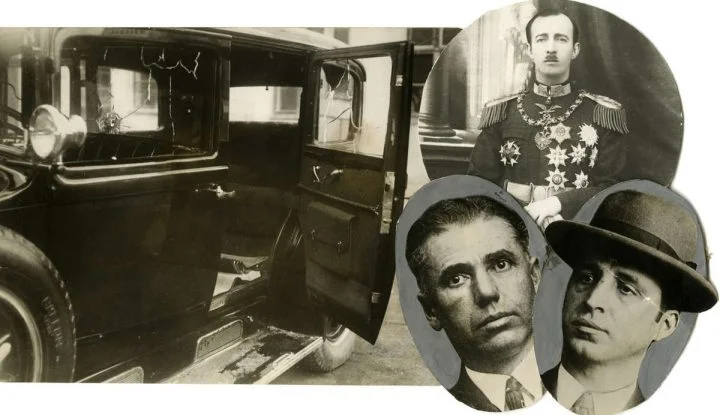
The assassination series against top Albanian politicians outside Albania followed by that against the remaining Zog in early 1931. At the time, King Zog, who suffered from a serious illness and the doctors of '%a, decided to go for treatment in Vienna, Austria, where part of the anti-Sogist political exile was then established that had left Albania at the end of 1924, when Ahmet Zogu returned to power. Although many of the King's relatives and loyal ones advised him that going to the Austrian capital would have consequences, he did not listen to them and that he decided to go there to make them a challenge. A few days after Zogu had gone to Austria on February 20, 1931, he decided to go to the Vienna Opera Theatre, where that day he played Opera “Aida” and that evening King Zog was accompanied by Court Minister Eqerem Bey Libohova and his two Adventists, Colonel Zef Serreqi and Major Left Topallaj. As predicted, the Albanian political exiles that were in Vienna decided to kill King Zog and for the implementation of the assassination volunteered, Ndok Geoschi and Asia Chami, two former military men who had left Albania as anti-zogists. Just as their supporters in that assassination were, there was Qazim Mulleti, former Albanian Parliament Presidents and close man of Fan Noli. That night after Zogu and the accompanying men joined the Opera, the King felt that something was about to be prepared for him and ordered the guides to bring the car to the back of the Opera Hall so that he could get away as quickly as possible. After the King's car approached the back gate of the hall, the first came out to Major Lly Topolaj, who was dressed in the King's uniform, and Nic Gelloshi, who was ambushed in the garden, accusing him of being King Zog, shot several times and killed him on the spot. At this time, Asia Chami came near to shoot the others coming out, shooting a gun at Bird and Eskerem Libohov, who and they responded, shooting him five times. As Asia Cham was shooting at Zogu and Eqrem Beun, he was beaten by the gun and the other bird's agent, Jeff Serreqi approached and disarmed him immediately. Because of the noise it was made there, local police immediately arrived and arrested the two bombers, Chamin and Geoshin, who went to trial in Vienna, sentenced for the murder of Topolaj and the wound of Libohova. On the other hand, that assassination's ideal and commander, Hasan Pristina, left Austria without falling into the hands of Austrian police. This was the second failed assassination of King Zog, since the young man from Matti, Becir Valter, on February 23, 1924, who was driven by Louis Gurakuqi and Avni Rustemi could only wound King Zog. His official, King Zog, not only did he not condemn, but after he showed the two men who had pushed him, he awarded him a state scholarship and sent him to Vienna, Austria. From where he would return to the country's occupation period, taking a post of minister (of People's Culture), which was “-serveu” communists to sentence him to death in the Special Court and execute him.
1933 Hasan Pristina assassination in Thessaloniki
The series of murders against Albanian politicians followed on 14 August 1933, with the assassination of Hasan Pristina in Thessaloniki, Greece. Hasan Pristina was one of Albania's leading politicians since 1911-1924, who had been elected three times as deputy who in Turkey's Parliament and later in Albanian and held the post of Albanian prime minister in April 1921. His political activity, Hasan Pristina, had started since Turkey and later at his birthplace in Kosovo and Albania, where in 1913, the member of the Ismail Kemal government was elected. During 1920-9524, Pristina was perceived as a very active politician, and after Zogu's return to power in 1924, he emigrated outside Albania, being one of King Zog's most staunch opponents, against whom he organised the assassination in 1931. Hasan Pristina remained killed in Thessaloniki by an apparent attack, carried out by an Albanian named Ibrahim Celo, but the opposition at the time charged Ahmet Zogu and Serbian districts, since he had headed the Kosovo Defence Committee. By the 1960s, Hasan Pristina was considered a traitor in Albania's history texts and was later rehabilitated, and in 1977 his remains were brought from Greece to Albania and buried in the town of Kukes.
1946 Former Prime Minister Kota kidnapped in Greece
When only a year after the end of the war in Albania had passed, former Prime Minister Koco Kota, who had escaped and stayed in Greece since 1939 when he fled with King Zog, was kidnapped by people of the Albanian communist government's secret services, led by Nevzat Haznedarin (after general-major), and was thrown into a van in Albania. For his kidnapping and conduct in Albania, Albanian secret services were assisted by EAM's Greek communists, who at the time controlled a considerable Greek territory, where the former prime minister of Albania lived. Koco Kota was filed before the Special Court in Tirana, along with Padre Anton Harap, and Socrat Dodbibe, and his lawyer Dr. Spiro Stringa, argued with facts of his client's innocence, who had been Secretary of the Lusnje Congress in 1920, was sentenced to 25 years in prison, charged with being “the Albanian people'stragier. Koc Kota passed away under highly suspicious circumstances in Burrel Prison, shortly after she was there to serve her sentence.
1946 Enver Hoxha in Paris
When more than a year and a half had not passed since Enver Hoxha's arrival in power in 1946, he attended and headed the Albanian delegation, which was invited to the Paris Peace Conference, consisting of Hysni Kapo, Behar the Kahreman Star column, which was accompanied and by Prof. Petrac Pepo, who was a journalist. To secure Albania's top delegation, two deputy interior ministers, Miftar Tare and Vaska Koleci, as well as military attaché Colonel Pellumb Dishnica, were appointed. Since the end of the war, it was the first time that Enver Hoxha was breaking into a Western country and his arrival there, on the part of State Security who led Koci Xoxe, was then considered problematic, because at the time in France and Italy, there were focused and there were a large part of anti-communist political migrants who had left Albania in November 1944. Enver Hoxha and Albanian delegation after hosted at “airport Charles-Dog Gol” by state security people (External Intelligence Director) who had been sent there earlier spent under the diplomat's clothing and taken all security measures, followed in, and arranged at the <x2-mperial <X3> Hotel. During the three weeks that Enver Hoxha stayed in Paris, he sometimes made visits to different tourist sites and spots and had no problem with the anti-communist Albanian political exile that had gathered those days there. In Paris, those days had gone to meet Enver Hoxha and many Albanians from St. Etjen, Montpeljeya, Lyons etc., who had been exiled there since the period of Monarchy. According to the testimony of the Myftar Tares Colonel, one of Enver Hoxha's leading associates at the time in Paris, Albania's communist leader, did not receive any of the immigrants who had gone to meet him, because the risk was too great, and he feared that in their midst any remaining anti-communist from Albania could penetrate. However, Enver Hoxha's visit to Paris went smoothly, and he remained Albania's only senior politician, who, during his visits abroad until 1960, suffered no incidents./Remember. al