3 minutes ago
Police advised Corleone patients from family members
Periskopi(6 years ago)
(6 years ago)Kosovo University Clinical Hospital Service authorities have taken steps to prevent the access of families of the sick of COVID-19, as well as other unauthorised individuals, to clinics where they are being treated. Despite the illness caused by COVID-19, family members of Corleone persons are denied free flow [...]
Kosovo University Clinical Hospital Service authorities have taken steps to prevent the access of families of the sick of COVID-19, as well as other unauthorised individuals, to clinics where they are being treated.
Despite being denied free circulation outside their homes because of being considered close contact with the infected person, in some cases family members have found ways to enter clinics where their infected family members are being treated.
Even Kosovo University Clinic Hospital Service officials (SHSKUK) confirm this.
Furthermore, no person, who does not belong to the health staff who cares for these patients, is allowed access to clinics as well as contact with coronarys.
Valbon Krasniqi, the task of Kosovo University Hospital Hospital Service director, tells Radio Free Europe that all citizens of the country, especially family members of persons infected with coronary and who are receiving hospital treatment, are under obligation to apply the recommendations of health and government institutions.
“They are not allowed to leave their homes. They must be self-insulated because they are cases of contact. So, I'm talking about close family members. First, then, they must not leave their homes. While physical security (at QKUK) has all the powers to prevent access. Unfortunately, sometimes there are people who find alternative ways to get to clinics and inside them. But I think there's still room for improvement in this matter. However, I think it is now going in that direction, and clinic managers are taking steps to prevent this from continuing”, Krasniqi said.
Radio Free Europe reported 5 July on several occasions when family members of patients with Cavid -19 have claimed to have stayed close to their relatives during KKUK treatment.
Humoll: Patient association with COVID-19 within QKUK, contrary to O's instructions BSH
Officials of the World Health Organisation (OBSH) in Kosovo have stated that the access and presence of people who do not belong to health staff to infected persons in clinics where they are being treated is prohibited.
Isme Humolli, O emergency official The BSH in Kosovo, speaking of Radio Free Europe, says that the presence of family members or any individual who is not part of medical staff in clinics where patients treat coronary, conflicts not only with WHO recommendations but also with the Law to spread infectious diseases.
“Insisting family is subjective. They want to be close to their families. We need to understand that. But there are institutions and the system, which should not allow that. We, as public health workers, have to convince them that this is wrong, communicating with them. Only this, explaining that the possibility of carrying infections, not only of COVID-19 inside the hospital, but also of other infections, is too large”, Hummol noted.
Police help prevent unauthorized access to clinics
On July 1st, the Government of Kosovo has adopted additional measures to curb the spread of COVID-19 disease. One of these came before “, halting visits of patients to health institutions”.
But also, in this recommendation, it was said that only one person is allowed according to the need”.
According to Humoll, this recommendation, which is currently out of reach, was said incorrectly.
It's not a misunderstanding, but it's probably even said wrong. But she's actually suspended. With the new measures set, it is no longer valid. When new measures are taken, any measure that has been earlier is suspended. But no one can dare, except patients and health staff, to be present at health facilities in cases of epidemic and pandemic”, Hummol said.
The efforts of individuals assigned to enter into clinics where the coronary patients are being treated have continued, although not at the intensity of several days ago.
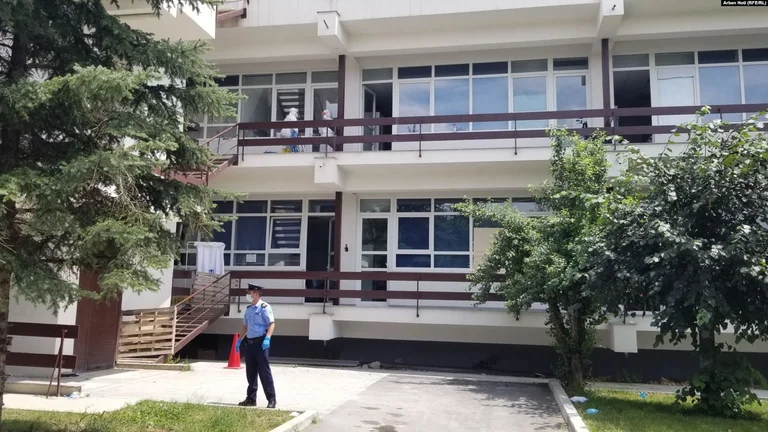
Illegal visits to clinics where patients are being treated with COVID-19, to the Infective, Pulmology Climate and the Centre for Sports Medicine have prompted USSKUK officials to increase physical security, in particular for these clinics.
Krasniqi says he has already sought the help of the Kosovo Police.
“I've asked the directors (the clinics) to follow the rules concerning not allowing family in patient rooms. In addition, I have sought in official and written form by Kosovo police. For the Infectious Clinic, it was earlier. But I also requested that the Pulmology Clinic and the intensive unit of the Sports Medicine Center be assisted with a medical team and a police team, static, 24 hours a day. We already have three patrols, one in Pulomology, one infection and one at Sports Medicine”, Krasniqi said.
The presence of Kosovo Police members in the area of the University Clinical Centre of Kosovo to prevent the access of unauthorised persons to clinics where patients are being treated with COVID-19 has confirmed for Radio Free Europe and Kosovo Police spokesman Baki Kelani.
Kosovo's “Police, based on its planning, with the aim of preventing the pandemic, co-operates and co-ordinates its activities, including providing assistance to other institutions, such as health, sanitation and other”, Kelani stressed.
Within the framework of the clinics of the University Clinical Centre of Kosovo (QKUK) and general hospitals in Kosovo, over 300 patients diagnosed with the disease causing the Coronavirus are currently undergoing treatment.
Since the first Corleone cases were recorded until July 14th, 5,18 cases have been recorded. Of them 108 patients have died, 2,370 have recovered, while active cases continue to be 2,640 patients.