5 minutes ago
Here you can read the Constitutional Court's decision on the warrant
Periskopi(6 years ago)
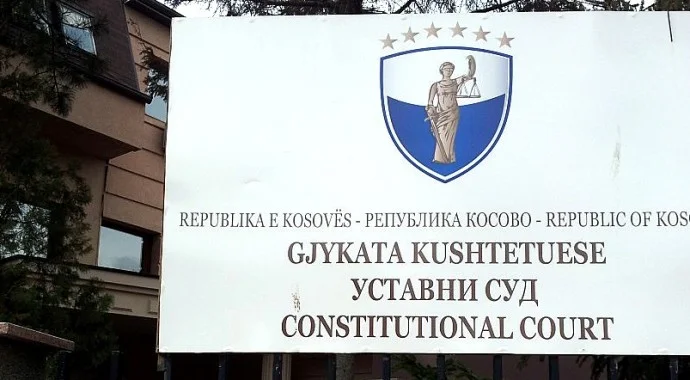
(6 years ago)The Constitutional Court has granted the right to Kosovo President Hashim Thaci regarding his decree for the LDK candidate for Kosovo prime minister, Avdullah Hoti. According to the Constitutional Court's act, President Thaci's decree is in line with the Constitution. “In assessment of the Decree [r. April 24/2020]
The Constitutional Court has granted the right to Kosovo President Hashim Thaci regarding his decree for the LDK candidate for Kosovo prime minister, Avdullah Hoti.
According to the Constitutional Court's act, President Thaci's decree is in line with the Constitution.
“In assessment of the Decree [r. 24/2020] of April 30th 2020 of the president of the Republic of Kosovo, through which “Z. Avdullah Hoti, nominated to the Constitution of the Republic of Kosovo candidate for Prime Minister to form the Government of the Republic of Kosovo”, the Court, ruled: (i) unanimously that the demand of the petitionors is acceptable; (i) the consecutive decree that the President's countered is in agreement with Article 2 of Article 82 [the Constitution's division], consistent with the results, that the successful voting of a no-confidence motion of the Government does not result in the binding distribution of the constitution, and allows for the formation of the new set-up of the constitution [the constitution], with the constitutional verdicts defined by the implementation of the constitutional verdict of the constitution (definance) by the constitutional verdicts of the 310. ”, says the Constitutional Court ruling.
Full verdict of the Constitutional Court:
1. Actual
Subject: KO 72/20
Foreground: Rexhep Selimi and 29 other Republican Parliament deputies
Kosovo
The object of the issue of demand was to assess the Constitution of the Constitution of the President of the Republic of Kosovo No. 24/20, of April 30, 2020, with which Mr. Avdullah Hoti was nominated to the Republic of Kosovo's candidate for prime minister to form the Government of the Republic of Kosovo. Predators claimed that the decree is not in agreement with Article 1 [The Foundation of Government and Power], paragraph 2 of Article 82 [The Framework Division], paragraph 14 of Article 84 [The President's Comissions], as well as Article 95 [The Government's Voice] of the Republic of Kosovo Constitution.
The request was based on Article 113, paragraph 2, sub-paragraph 1 [Juridision and authorised parties] of the Constitution, on Article 29 [exacting] Law No. 03 L-121 for Constitutional Court, as well as rule 32 [Preparation of requests and responses] and 67 [requirements in accordance with Article 113.2 (1) and (2) Constitution and Article 29 and 30 of the Law] of the Constitutional Court's work regulations.
Finals:
1. In recognition of the Decree [r. 24/20] of April 30th 2020 of the president of the Republic of Kosovo, through which “Z. Avdullah Hoti, nominated to the Constitution of the Republic of Kosovo candidate for Prime Minister to form the Government of the Republic of Kosovo”, the Court, ruled: (i) unanimously that the demand of the motion for the forgers is acceptable; (i) the construed decree of the president is in agreement with Article 2 and 82 [the Assembly of the Constitution], consisting in principle, that the successful voting of a no-confidence motion of the Government does not result in the binding distribution of the constitution, and allows for the formation of the new set-up of the constitution [the constitution] by the constitutional constitution (decision) of the constitutional constitution, which is defined with the constitutional verdict of the 310] by the constitutional decision of the 310st of the constitutional verdict.
2. The full prejudice, containing detailed reasoning, will be published in the coming days. Until its publication, the following summary reflects the basic conclusions of the Court.
3. The court recalls that the constitutional issue involving this Act is compliance with the Constitution of the Opposed Constitution of the President of the Republic, through which Mr. Avdullah Hoti has been nominated to the Kosovo Assembly for candidate for prime minister. In the context of assessing the constitutionality of the Supreme Decree, based on the claims of the petitioners and arguments and objections of other interested parties, the Court initially praised whether after the successful motion of no-confidence voted by two-thirds (2/3) of all Parliament deputies on March 25th 2020, the president of the Republic, based on paragraph 2nd of Article 82th of the Constitution, was obliged to distribute the Republic's Parliament and proclaim early elections. Furthermore, the Court clarified the procedure to be followed in forming a new government, following a successful vote of no confidence in the Government in the Parliament, and also gave its assessment if, under concrete circumstances, the procedure followed for terminating the new government has resulted in a constitutional secret.
4. To finally interpret the constitutional provisions that connect with the concrete circumstances of Article 82, 95 and 100 of the Constitution, the Court also took into account: (i) the constitutional principles on the role of the Parliament and the president; (ii) its judicial practice, including the Kono10314 Act, and all cases cited by the parties in the procedure; (ii) the relevant opinions of the Venice Commission (iv) the Constitutional Analysis, including those referred to by the pre-tellers; the Constitutional Court (v) answers to the Constitutional Court. Supreme, part of the Venice Commission Forum; and (vi) the preparation documents for drafting the Constitution.
5. The court initially recalled that the Constitution consists of a unique set of constitutional principles and values on which the Republic of Kosovo is built and should function. The first standards with the Constitution should be read in links to each other because only that is how they get the correct sense. Constitutional standards cannot be drawn out of context and interpreted mechanically and independently by the rest of the Constitution. This is about the fact that the Constitution has an internal cohesion under which each part has a link with other parts. The structure of constitutional norms that connect with the establishment of state institutions stemming from the vote of the people should be interpreted in such a way as to live rather than block the establishment and effective exercise of respective functions. Any uncertainty of standards should be interpreted in the spirit of the Constitution and its values. No constitutional standards can be interpreted in that way to block the effective establishment and functioning of legislative and executive powers, nor the way they balance each other in terms of power sharing.
6. The court also stressed that all the powers and carriers of public functions, without exception, are under obligation to carry out their public duties in the service of living values and principles on which the Republic of Kosovo is built to function. The rights and obligations stemming from the Constitution should be exercised in the service of effective establishment and prosperity of state institutions.
7. As for the constitutional arrangement for distribution of the Parliament, the Court stressed that the Constitution envisions the obligation to distribute the Parliament under the circumstances of Article 1 of Article 82 of the Constitution and the possibility of distributing the Assembly under the circumstances of paragraph 2 of Article 82 of the Constitution, following the successful vote of a no-confidence motion. More precisely, the Assembly can only be distributed in three cases: (i) if within the 60th (60th) deadline from the day of the prime minister's appointment by the president, the Government can't be formed; (ii) if two-thirds of all Parliament's deputies vote (2/3), and (ii) within the 60-day term of the start of the presidential election procedure, the latter is not elected. While, in the event of a successful vote of no confidence in a government, the president has the opportunity, but not the obligation to distribute the Assembly.
8. The president's ability to distribute the Parliament cannot be exercised independently or contrary to the will of the Parliament, but must be exercised in co-ordination with the will of the necessary majority of representatives of the people represented in the Assembly. Using the verb “can” in context of paragraph 2 of Article 82 of the Constitution reflects only the president's possibility to distribute the Parliament, given consultations with political parties represented in the Assembly. Such a conclusion regarding the presidential competencies that connect with the verb “mund” [“moe”/“may”] in the context of the distribution of the Assembly, is confirmed even in the opinion of the Venice Commission involved in this Act.
9. The court stressed that the Assembly is the only institution in the Republic of Kosovo to be elected directly by the people for a four-year term (4). Besides the Constitution, the people's representatives do not submit to any other power and no binding mandate. Neither the president who has been elected from the Assembly has the ability to distribute it without the will of the Assembly; nor can the exercise of the Assembly's competence for expressing disbelief in a government that has chosen it, result in the end of its Parliament's mandate. The Assembly cannot be conditioned to the dissemination of itself if it chooses to express distrust of a government elected by him, since the no-confidence motion as the Government's constitutional control mechanism as a representative body would make no sense. Such an approach is contrary to the constitutional principle of parliamentary control of the government embedded in Article 4 [The Force of Governance and Power Division], paragraph 8 of Article 65 [The Frameworks of the Assembly] and Article 97 [the responsibility] of the Constitution and fundamental democratic principles.
10. The high threshold of the vote needed for the distribution of the Parliament itself by MPs reflects the weight and importance that the Constitution has determined for that purpose. In addition to the earlier high threshold for the Constitution's amendment, which calls for the adoption of two-thirds of all MPs in the Assembly, including two-thirds (2/3) of all Assembly deputies holding guaranteed seats for representatives of communities that are not majority in the Republic of Kosovo, for the distribution of the Assembly, the constitution has set the highest possible threshold, respectively, the vote of two-thirds of its deputies, equal among other MPs, with the vote needed to retain sovereignty for the state, as is determined in the 20th constitution. By contrast, the Constitution for the success of a no-confidence motion against the Government has defined the lowest threshold of the necessary vote, respectively, sixty-one MPs.
11. If the president could hand over the unilateral Parliament after a no-confidence motion, then the president would have the equal power of two-thirds (2/3) of the people's representatives' votes, as well as arbitrarily reduce the necessary two-thirds will of MPs for distributing the Assembly in only sixty-one (61) votes, as much as necessary for a no-confidence motion. Such power, the presidents, based on the opinions of the Venice Commission, do not even have it in most countries with presidential arrangement.
Twelve. In fact, the analysis of other constitutions reflected in this act, including those constitutions that have been used in the arguments of the petitionors, relevant opinion of the Venice Commission, as well as answers to the Venice Commission Forum, confirms that no Constitution determines the binding distribution of the Parliament only with the fact that a no-confidence motion has been successfully voted. On the contrary, the successful vote on a no-confidence motion results in three possible situations: (i) the new prime minister's immediate election, in cases where the Constitution foresees “constructive emotion”; (ii) an additional opportunity to elect a prime minister; or (ii) the return of competence to the relevant president, to follow the procedures specified for the government's election, to the extent the same stipulates. In all these countries, only when all constitutional opportunities for choosing a new government have been exhausted, the Parliament is distributed and early elections are announced.
13. The president's competency to distribute the Convention, defined in paragraph 2 of Article 82 of the Constitution, applies correctly, only when, after a successful motion of no-confidence voted by at least sixty-one (61) MPs -- (i) the necessary majority of MPs are missing to form a new government, and at the same time (i) the majority of two-thirds of the deputies, to distribute themselves. So this possibility, on the one hand, presents an additional opportunity to form Government within the existing legislature and avoid elections, while on the other hand, presents a deadlock in cases where there is no will, nor a majority needed to form a new government from the Assembly within the same legislature.
14. To date, Article 82 of the Constitution has always been implemented in this way, more precisely: (i) the third and fifth legislature, were distributed by the president in the third year of their term, in 2010 and 2017 respectively, when there was neither the will nor the majority needed in the country to form a new government; meanwhile, (i) the fourth and sixth legislature, in 2014 and 2019, respectively, have been distributed by two-thirds of the vote of all MPs, and this has been distributed only by relevant presidents.
15. The circumstances of the concrete case clearly differ from those of past legislatures. In this case, (i) a no-confidence motion has been voted by two-thirds (2/3) of all representatives of the people, and the same need not the president's help to distribute; and (ii) most political parties and coalitions represented in the Assembly -- and most of the people's elected, respectively, have been declared in favour of creating a new government following the government's expression of no-confidence in office. Dispersement of the decision by the president against the will of the people's representatives would be arbitrary and clearly contrary. On the contrary, the president has been obliged to initiate procedures to enable the formation of a new government based on provisions of Article 95 of the Constitution.
16. The manner of electing the government in the Kosovo Constitution is defined through Article 95. The procedure to follow in choosing a Government is clarified in the Court Act in the KO1/03/14 case. The court stands by the principles defined through that Act. He has clarified that for the formation of a Government, the Constitution stipulates two possibilities. The first right to forming the Government belongs to “political party or coalition that has won the necessary majority in the Parliament to form Government”, the political party or the winning coalition of elections, respectively. The president has no discretion regarding the right to this political party or coalition to propose the candidate for prime minister and only mandate the same. In the event of the failure to elect this government in the Parliament or reject this mandate from the winning political party or coalition, the right to form the government passes to the political party or the coalition represented in the Parliament, which in the president's discretion, has the greatest chances of forming Government in order to avoid elections. While the failure of these two possibilities results in the president's obligation to declare elections, as defined in the Constitution.
17. Article 95 of the Constitution defines the procedure for selecting a Government along an election cycle. The same, stipulates two possibilities for electing a Government, both after the elections and after the resignation of the prime minister/government. The court has clarified that the effect of a prime minister's resignation results in the resignation of a Government, as does the effect of a successful vote of no-confidence motion for “governance as a whole”, on the resignation of the same. Such an attitude is also in line with comparisonal Analysis, the Venice Commission's quoted opinion and the contribution handed down to the Court by members of the Venice Commission Forum, in which, after a successful no-confidence motion, the prime minister/government is in resignation, and is enabled constitutional provisions pertaining to the government's election, except those cases that have been envisioned by the constructive “ <xmodion”, or have provided only one option for the election of prime minister/government, following the corresponding motion.
18. Therefore, in all cases when the resignation of the prime minister or the remnant of the relevant free post for other reasons has resulted in the government's collapse even when the resignation of the government is the result of a successful no-confidence motion, provided the motion has not followed the distribution of the Parliament according to the principles clarified above, triggers Article 5 of the Constitution, which forces the president to mandate the new candidate for prime minister. The political party or coalition, which has the first right to the mandate proposal for prime minister and the formation of the Government, is again the political party or the winning coalition. The procedure defined through paragraph 2 and 3 of Article 95 of the Constitution must be followed for the formation of this government, while the failure of the necessary vote in the Assembly or rejection of this mandate exceeds the right to form the Government of a political party or coalition that may have the necessary majority to form Government, as defined in paragraph 4 of Article 95 of the Constitution and by principles set out in the KO114 Act. The court explains that through the Ko1/03/14 Act, it has never determined that the winning political party or coalition has the exclusive and sole right to propose the prime minister's mandate and form Government.
Nineteen. The court also emphasises that the competency of the Parliament to choose and express distrust of the Government is defined in paragraph 8 of Article 65 of the Constitution and is implemented through articles 95 and 100 of the Constitution, for the Election of Government and Non-confidence, respectively. The latter is one of the most essential mechanisms of exercise parliamentary control of the government and, therefore, balance the powers. The democratic legitimacy of a Government elected by a Parliament stems from the belief that representatives of the people point to in their choice. That belief ceases at the moment when the majority of all Parliament deputies have voted against it. As a result, it loses the trust of the representatives of the people, and hence the constitutional authority to exercise respective competencies.
20. The court re-exemplifies that under the circumstances of the concrete case, on March 25th 2020, a two-thirds no-confidence motion by (2/3) of all Parliamentary deputies was voted against the winning political party's election leadership of October 6th 2019. The same political party, in contrast with most of the constitutions reflected and reflected in Aktjudi, following the vote of a successful no-confidence motion based on the Constitution of Kosovo, again has the first right to candidate proposal for prime minister. Such a proposal has not been made even after (4) the president's four requests, beginning April 2, 2020, until April 22, 2020. Political party in question, Movement V, respectively SEVENTION!, in essence, claims that (i) after the no-confidence motion, the president is forced to disperse the Assembly and announce early elections; and that (ii) there is no constitutional deadline for the mandater's proposal for prime minister, therefore, is in the full and unaffordable disreputation of the winning political party, to propose the prime minister's mandate and “only when political, administrative and technical conditions are met. Consequently, as a matter of assessment of this act is the following: (i) the deadline within which the candidate for prime minister should be proposed; and (ii) unless this candidate's proposal by the political party, which has the first right to propose, reflects the refusal to take the mandate of prime minister.
21. As for the deadline within which the proposal for prime minister should be made, the same one must be analysed in a sense: (i) the constitutional deadline system that the Constitution has set for the purposes of forming the Government; and (ii) the nature of “calling” between the president and the political party or coalition with the right to propose the prime minister's mandate, including mutual responsibilities and obligations among them, for the purpose of the same appointment.
22. First, the Court stressed that the appointment of the president's mandate results in the flow of two types of constitutional parallel deadlines: (i) that the distribution of the Assembly if the government's election does not take place within sixty (60) days of receiving the mandate; and (ii) those defined in Article 95 of the Constitution, which connects with two options for forming the Government, respectively, the 15th term 15th) a day within which the candidate for prime minister represents the cabinet's composition and requires approval from the Parliament; (ii) (i) the term specified by ten (tor), within which the candidate prime minister's name for the first term, the prime minister, in the case, the prime minister's failure to secure the vote in the country, or the proper mandate; the constitution, with the same term for the former prime minister, the constitution, and the constitution for the constitution for the next term, the government's. These precise deadlines reflect the purpose and importance the Constitution has given to the government's quick establishment, setting a 15-to-day deadline for the candidate for prime minister, to negotiate and reach agreements to secure the necessary votes of the Parliament's deputies for the proposed Government; and also the 60 (60) daily term for forming a Government, and the corresponding consequence of the Assembly distribution if that deadline is not respected.
23. Second, the Court recalled that in the Ko1/03/14 Act, it has made a difference in the nature of “consultation” between the president and the political party or the coalition with the right to propose the first and second mandate. In the first case, the president has no discretion and it is quite clear what is the political party or coalition that proposes the mandate for prime minister, therefore this “consultation” includes a fully formal and technical process between the president and the winning party or coalition, for proposing a mandate and mandate of the same. In contrast, in the second case, it is not clear who the political party or coalition is with the right to the mandate proposal, which remains in the president's discretion to consult with all political parties and coalitions represented in the Assembly to assess what is most likely to form Government in order to avoid being elected. Consequently, this process “consultation” is more complex than in the first case, and yet the Constitution stipulates the obligation for the president to exercise this discourse, to implement it in ten (10) days.
24. Therefore, in context: (i) the incompatible importance of effective functioning of a Government as one of three fundamental pillars of state power; (ii) the system of exact and short deadlines defined in the Constitutions regarding the formation of a Government; (ii) the completely clear and formal nature of the term of the second term “consultation” between the president and the political party or the coalition, for the purpose of appointment of the first mandate; and (iv) the limit of the constitutional term in ten (10) for the mandate of the second term “, the more complexity of the coalition does not mean the most of the parties in the deadline, or the parties's decision to the parties. Rather, the spirit of the Constitution reflects the clear and self - conscious purpose of the need for quick action.
25. In that sense, the Court notes that a deadline for term of prime minister's mandate has not been specified in the Constitution not only for the political party or the winning coalition for the mandate proposal, but not within which the president is obliged to decree the proposed mandate, or convey the same to the Assembly. The court stresses that the mandated term for prime minister did not only include the president's obligation to decree it, nor only the right of the winning political party to propose this mandate, but also included the obligation of the latter to propose or refuse to propose the candidate for prime minister. More precisely, the mandated term for prime minister includes the obligation of mutual co-operation by the president and the winning political party in this process. Moreover, considering the technical and formal nature of “consultation” for the purposes of the appointment of the first mandate, which set in motion the government formation process and the initial deadlines with the Constitution, the Court stresses that it is self-intelligible, that this “consultation” must be completed as quickly as possible and in itself include the demand for quick dynamic interaction.
26. On the contrary, all high constitutional norms related to deadlines and goals that include them related to forming the government would be without any effect and completely unnecessary. The Government's choice would remain hostage to the unlimited <x0/ax1> and to the full discretion of the political party or the winning or even presidential coalition. The first would hold the formation of the Government hostage, being called to full and unafforded discretion to make the proposal for the prime minister's mandate, while the president would also be called to the complete and unfathomable discretion to decree the same. This “complete and unfathomed timeframe”, meanwhile, is connected to the Government's election, the competence of another power, the Assembly, respectively. Such an approach and interpretation would be arbitrary and clearly contrary to the structure of constitutional standards, its purpose and spirit, but also contrary to the fundamental principles of a parliamentary democracy. The court, in this regard, also stresses that despite pre-launch claims linking with the extension of procedures to establish post-election institutions, with emphasis on the 2014 situation related to the extension of the Parliament's constitutionalisation process, the Court at the Ko119/14 Act has not addressed the issue of time terms related to the constitution, since the same has not been the object of review at the Court.
27. Regarding the lack of a mandater's proposal for prime minister from the winning election political party, the Court, in this Act, has analysed the exchange of letters to the chairman of the winning political party, at the same time the incumbent prime minister and the president. These paperwork reflects two characteristics: (i) the president's request for the candidate proposal for prime minister on one side; and (ii) lack of proposal and demand for distribution of the Assembly and for announcing early elections by Movement V On the other side.
28. The court, in this verdict, has stressed that (i) for the purposes of “consultation” for determining the mandate between the president and the political party or the winning coalition, the relevant one is only the candidate proposal for prime minister and his mandate; and (i) this “consultation <xx3> cannot include either cases related to the distribution of the Assembly or the pre-election election declaration, because none of these issues are in the exclusive competence of the president, nor the winning party of the government's leadership/re taking office. This is because, it is clear: (i) the cases of mandatory distribution of the Assembly are correctly defined in the Constitution; (ii) the possibility of the distribution of the Assembly by the president, as it has already been clarified, is not the competence exercised by the president without co-ordination with all political parties and coalitions represented in the Assembly, and not only with what the government has won in the election; and (ii) the government has no constitutional authority neither with the distribution of the Assembly nor election declaration. On the contrary, regarding these two issues, the role of political parties or coalitions represented in a government is equivalent only to their power that they have through representation in the Assembly. The will of the majority of the Parliament in the current circumstances has obviously unable the president to distribute the Parliament and proclaim early elections.
29. The court stresses that under the circumstances of the concrete case, the political party that has led the government, to which a no-confidence motion by Kuwait has been voted, has not made a proposal for another prime minister's mandate for the purpose of forming the new government. However, the petitioners claim they have never specifically refused receiving this mandate.
Thirty. In terms of refusing to take the mandate, the Court recalls that in the Ko1/03/14 Act, it had concluded that “is not ruled out that the party or the coalition in question would refuse to receive the” mandate. Despite the fact that it was not a case in the case before the Court in 2014, she had predicted the possibility of rejection, precisely to prevent the possible block of establishing government in the future. This Act, however, had not accurate the way in which rejection of the relevant mandate could be made. Therefore, the pre-launching claim that “The court has said the president can bypass the winner of the election, only if this leaves his right expressly, but in no other circumstance” is not accurate. That is because, even authorisation for the winning political party to refuse to take the mandate would only expressly do it, that is, the possibility of not proposing a name for mandated mandate and at the same time not to expressly reject that right would point to the winning political party with the right to block the process of appointment by the president.
31. Such an opportunity would have been unable to implement the president's competence for the appointment of a mandate and proposal of the same Parliament, at the same time making it impossible to exercise the Assembly's competence to elect the Government. Rather, as has already been clarified, the mandated term for prime minister requires immediate interaction in meeting mutual obligations and responsibilities between the president and the party or the winning coalition. Therefore, rejection actually means not taking action in order to fulfill this obligation, lack of concrete actions and candidate proposal for prime minister from the party or the winning coalition respectively. The constitution and its spirit determine that this right and at the same time obligation -- for both the first party and the president -- cannot be abused and should be exercised in trust and in the function of forming the Government.
32. From the exchange of official paperwork between the president and the winning political party in this case, not only does there be no proposal for mandates, but not one single indicator regarding the goal of proposing a mandate for prime minister is reflected. Rather, the demand of these documents is the distribution of the Assembly and the announcement of early elections. These demands rule out the possibility of a prime minister's proposal.
33. Under the circumstances under which a two-thirds of the people's representatives have successfully voted no-confidence motion (i.e. two-thirds) and the possibility of forming a new government, if the claims about (i) were confirmed (i) the unlimited deadline of time and the full discretion of the winning political party, and (ii) the right to only expressly refuse the mandate for prime minister, combined with the sole requirement for the distribution of the Assembly and early elections, the formation of a Government would be blocked indefinitely, keeping in office that has lost the trust of representatives of the people. This is not the spirit of the Constitution of the Republic of Kosovo.
34. The president, balancing his obligation to ensure the constitutional functioning of the established institutions with the Constitution, as defined in paragraph 2 of Article 84 of the Constitution, including in this context and the decision of the Parliament to elect Government, as defined in paragraph 8 of Article 65 of the Constitution, on the one hand, and on the other side, considering that the winning political party of the elections had already declared no single action towards the prime minister's proposal for prime minister's demands against the president's demands, but had continued to seek the distribution of the constitution and to declare early elections, despite the majority of the coalition parties or the coalition, where they had already declared the option of the president, without determining the constitutional framework of the party with the constitutional verdict, with the constitutional decision of the party. As a result, the procedure for mandated new candidate for prime minister had begun, in consultation with and after the political party's proposal, which, based on relevant consultations, has resulted in the greatest likelihood of creating Government and in order to avoid elections. On the contrary, it would be impossible to live the essential competencies of the Republic Assembly to choose the Government of the Republic of Kosovo.
35. The right to propose the prime minister's mandate is also responsibility and privilege. That name's proposal includes in itself the highest point of success of a political party or coalition within an election cycle. The first right to propose the candidate for prime minister has been guaranteed to the ruling party or coalition of elections through the Constitution. The exercise of this right, not even with the authorization to block the formation of a Government within an election cycle. Such an attitude would have made the party or the winning coalition hostage, all of the most essential state institutions.
36. The tribunal in the end stresses that the democratic functioning of institutions is the primary responsibility of each person who is charged with public authorisation. All actions taken by those charged with power or public authorisation should be in accordance with the Constitution and its spirit and contribute to the prosperity and co-ordination of public interest to the Republic of Kosovo, so that the latter can develop and live up to the values and principles upon which it is built and the aspirations embedded in its Preambula.