4 minutes ago
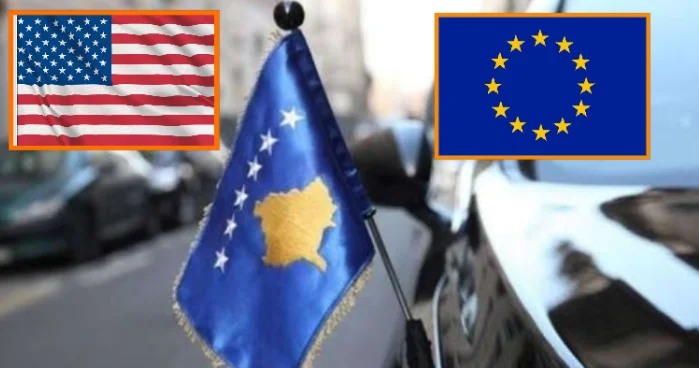
Pro-indentation. US or EU reflection in uncertainty related to dialogue
Periskopi(6 years ago)
(6 years ago)Internal political controversy in Kosovo is also being manifested in Kosovo institutions' reports with the United States of America and the European Union, political analysts in Pristina say. According to them, statements that have often been heard by some political leaders in Kosovo that the US or the EU can offer or impose certain solutions under [...]
Internal political controversy in Kosovo is also being manifested in Kosovo institutions' reports with the United States of America and the European Union, political analysts in Pristina say.
According to them, statements that have often been heard by some political leaders in Kosovo that the US or the EU can offer or impose specific solutions within dialogue with Serbia are unstable and more tell of the inability of Kosovo leaders to build themselves a platform and position on this process.
Demush Shasha, Executive Director of the Institute The EPIK, Free Europe told Radio that polarisation of Kosovo's foreign partners is a reflection of the internal polarisation of the political scene in Kosovo.
So, an internal anomalies, we are now exporting it to external policy”, he says.
Internal divisions, he sees especially in relation to the dialogue on normalising relations with Serbia, which he thinks has never enjoyed the broad consensus of the political spectrum of Kosovo, and this has since been reflected in other aspects of relations with the US and the EU.
I don't see the problem in Brussels, Berlin or Washington, but in Pristina, the lack of political consensus to approach unanimously normalising relations with Serbia”, Shasha points out.
I consider that attempts to line up against the US or the EU are wrong and will only do Kosovo state-building damage. History has proven that Kosovo has won every time when it was the unifying pillar of transatlantic allies not the divisive” factor, Demush Shasha says.
Dialogue with Serbia, according to analysts, even in the past has divided leaders and political parties in Kosovo due to the deepening mutual distrust. Political leaders in Kosovo have often accused each other of being lined up behind options, described as harmful to Kosovo in dialogue with Serbia, such as partition, exchange of territories or the idea of creating a kind of Serb republic within Kosovo.
Such an approach has often surpassed internal policy strains, listing leaders of world states as to who is against these options.
Political analyst Faton Abdullahu says polarisations have existed, but they have been particularly highlighted recently as a consequence of Prime Minister-in-Office's approach to Albin Kurti, in relation to dialogue with Serbia.
“We in Kosovo have rulers, in this case Prime Minister Kurti, who prejudged dialogue with Serbia. This prejudice brought a kind of rejection, a kind of fear of the offer that could be made for dialogue with Serbia. This was the basis on which he was then determined most for Brussels, hoping that he would get help for what he prejudged was that in Washington, the White House, we were having an agreement that would be at the expense of Kosovo”, says Abdullah.
Kurt's clashes with the US, according to Abdullah, resulted in the Democratic League of Kosovo's secession from the coalition with Kurti and Vetevendosje, under the claim that the LDK is a pro-American party.
Such a lineup, unusual and, for the first time since the post-war, had two directions of this nature, was born and dealt with by the Kurti government. This is harmful, but I think it has to be over”, he points out.
So that the approach (of the Prophet) may be exceeded (in good or evil deeds) in respect of those who do good, and those who transgress (it)? US, Abdullahu says it is necessary for Kosovo to return to its Euro-Atlantic agenda and the agenda aimed at friendly reports with Washington.
Until Vetevendosje and its leader, Albin Kurti, are blamed for the rest of the political spectrum for undermining Kosovo's reports with the US, Kosovo President Hashim Thaci, former Prime Minister Ramush Haradinaj and the Democratic Party of Kosovo, in many cases have openly expressed their distrust in the European Union, especially in terms of Brussels' role in dialogue and the lack of decision on visa liberalisation for Kosovo citizens.
In the end, however, there were no few reactions in Pristina even regarding the European Union for Foreign Policy and Security's statement, Josep Borrell, as a result of dialogue between Kosovo and Serbia.
It's not up to us to tell Serbs and Kosovars what they should agree to. If they agree on something, we should still study that agreement, because any agreement between Serbia and Kosovo has influence in the region”, Borrell has said among other things.
After 11 years, how many EU has been at the helm or leadership of dialogue and lack of agreement on normalising Kosovo reports Serbia, Kosovo President Hashim Thaci has said openly that dialogue should be led by the US. Even the LDK, which is claiming to form the next government, has in some cases expressed itself in favour of the US leadership role in dialogue.
Dialogue with Serbia is designed to conclude with an agreement, as has been warned historical and binding for both states, so in Kosovo, alignment on the US side, as if giving most security to most Kosovo leaders on the eve of what has been described as the great “final of dialogue.
While the official Pristina, or part of the leadership, is seeking a kind of conveying of the dialogue process from Brussels to Washington, the first task to be envisioned for Kosovo's future government, whether it formed before or after the elections, is considered to be restoring the wavering trust in the American administration.
Kosovo's reports with the US had actually started much earlier, since the end of 2018, when the then Kosovo government, led by Ramush Haradinaj, had imposed a 100 per cent tax or fee on imports from Serbia, which had become an obstacle to continuing dialogue on normalising reports with Serbia.
On February 12th, 2019, Kosovo representatives had accepted a letter from senior American officials, who have expressed their disappointment over the failure to perform the customs duty.
In the letter they signed, US Assistant Secretary of State Matthew Palmer, Deputy Defence Secretary Laura Cooper and Deputy Director for European Affairs at the Council of National Security, John Earth, said that following continued US demands for the suspension of the fee, they have decided to take steps “to express our concern, including our partnership in the security field”.
Kosovo has no better friend than the United States. We have worked together for years to build the future, for the people of Kosovo to live the way they chose, in peace. It is amazing that after all that we've done together, Kosovo appreciates our friendship so low, so far as to ignore our advice”, it was said in that letter, which was then gradually repeated in numerous statements by American officials that openly expressed their differences with blocking dialogue through customs duty.
The government's continued refusal, initially of Haradinaj government and later of Kurti to abolish tariffs and start dialogue, had resulted in the suspension of the US Government's Millennium Challenge Corporation (MCC) programmes in Kosovo. Among the toughest measures, however, was the warning of the withdrawal of American troops from Kosovo.