16 minutes ago
PDK: From the failures of Kurti Government with pandemic, more than 1 billion euros in economic losses and thousands of jobs less
Periskopi(6 years ago)
(6 years ago)The Democratic Party of Kosovo has held Kurti Government responsible for leaving for mismanagement of the economic situation during the time of pandemic. It proved inadequate, inefficient and failed to address the needs of the country's economy. At the Media Conference, Economics expert PDK, Blerand Kadrijaj, has listed a series of failures, also offering [...]
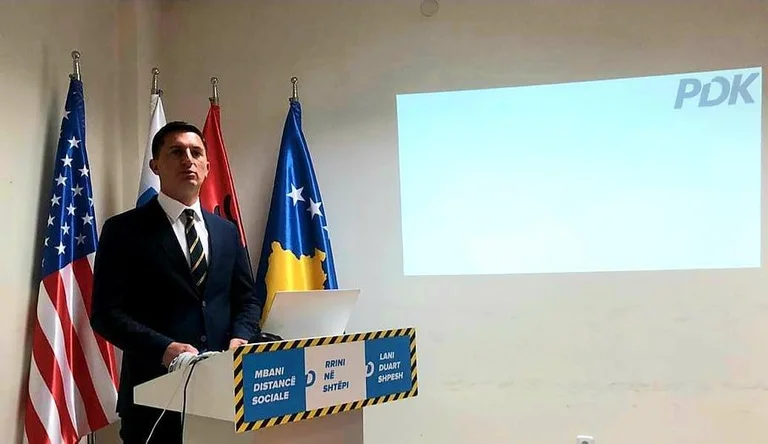
At the Media Conference, Economics expert The PDK, Blerand Kadrijaj, has listed a series of failures, providing as well as concrete recommendations both to get out of this situation.
This is a full statement:
The government now most dismissed Kurti, comprised of the Vetevendosje Movement and the Democratic League of Kosovo, due to poor budget management, and especially Pacos Emergency Financials during the pandemic has jeopardised Kosovo's macro-fiscal stability. The government, with its wrong policies and delayed implementation of Pako, has jeopardised the bankruptcy of many private companies. Thus, it has affected the loss of thousands of jobs and placing thousands of Kosovo citizens in poverty.
This scenario of an economy in collapse has been able to avoid whether the government now most dismissed would have taken seriously management of the country's economic situation by focusing on the needs of citizens, not on their political interest in organising protests threatened by independent institutions.
Although Kosovo's economy had the highest growth in the region in recent years, which was projected to grow by over 4% in 2020, as a result of the government's controlling measures and the timely implementation of the financial emergency package, according to the World Bank, the economy is now expected to suffer a decline of over 11% according to the pessimistic scenario; the region's high-profile decline. Also, the undesirable scenario comes as a result of continuing the cooling measures, not stimulating the country's economy through adequate policies.
In numeric value, the 11.3 per cent economic downturn in Kosovo means contracting/resulting BPV of about 800m euros in 2020.
Despite the official position of the fired government, which had stated that depending on the duration of the problem with pandemic, on annual grounds, projections speak of a possible quantum drop of tax revenues from 7.5 to 12.5% of the annual budget. In monetary terms, this means that the state budget may have up to 200m euros less inflow than those calculated in February.
The current situation is much more serious than the minister of finance's moderate forecast. The real decline in budgetary accession based on official data is 242m euros, or 28% more, compared to the same period for 2019.
As for the execution of the budget, the Ministry of Finance and Transfers has worked in opposition to good practices and basic economic theories on how to act in times of recession. Through capital investment increases, private sector financial incentives, support delivery to ensure liquidity, economic activity, as well as the temporary suspension of tax burdens to the private sector, it helps revis the overall economy.
The Kosovo government has done the opposite, increasing spending on three operational categories: salaries and wages 13 million (6.6%), goods and services 2 million (2.7%), subsidies and transfers 18 million (8.8%), while reducing capital investments for -30 million (34%), compared to last year, or 75 million (56%), compared to the year 2018, directly damaging private sector economic activity.
As for implementation of the Government's Financial Emergency Pack, so far we have identified these shortcomings and problems:
- The Emergency Package has been late and without legal grounds, the Parliament of the Republic of Kosovo has been bypassed, especially the opposition that has been willing to co-operate.
- The Emergency Package has been flawed, largely treating the social situation and ignoring the private sector as the largest employer in the Republic of Kosovo. While the focus mainly on social scheme, it is of importance that not all social categories are involved in this package.
- The Emergency Package has been and continues to be difficult implemented, very unclear for the profit parties. While it has been implemented with selective approaches, especially to entrepreneurs who have not shown close proximity to the Vetevendosje Movement and the Democratic League of Kosovo, not paying time, or being paid at all.
- Independent and critical media have been bypassed by the government, even though they have played an extremely important role in informing citizens during the pandemic.
The total value of implementation of the Emergency Financial Pack is around 179m euros, which so far has been adm euros, while 54m euros, or 30% of the planned value, have been executed. It is important to note that at this stage, most countries in the region are implementing the second package for the recovery of their countries' economy.
The consequences for the economy of the Republic of Kosovo, as a result of mismanagement;
- BPV drop for around 800m euros
- Remittances around 150m euros less with the current trend in 2020.
- 2020 budgetary losses with current trend, over 300m euros
- Job Loss
- Banking of Many Local Enterprises
- Foreign direct investment losses:
- Contour Global, 1.3 billion euros in energy investment, for 5 years
- In the event of losing an arbitration case, more than 20 million damage
- Loss of foreign funds, including MCC funds of 200m euros.
- Over 150 thousand citizens will be poor in Kosovo, according to World Bank report
- Low wages in the public sector are at risk, as well as the execution of payments for social schemes in the last quarter, based on the current trend of budget revenues.
Recommendations:
- Restructuring the Economic Pack, the government urgently begins planning and implementing the package for economic recovery. The package will be focused on the private sector, supporting workers as well as entrepreneurs overcoming the economic and social crisis.
- The overall opening of the country's economy in line with practices recommended by health institutions, Kosovo's economy must be opened overall. By not creating restrictions or obstacles to entrepreneurial operation.
- The opening of the border with countries in the region and with the European Union in the fastest term to ensure the circulation of goods and services, as well as the circulation of citizens of the country.