4 minutes ago
The EU-Western Balkans Summit: Consistent but Not very concrete
Periskopi(6 years ago)
(6 years ago)The EU helps the Western Balkans get out of the coronary crisis and renews the promise of accession. Another small step towards membership. “Samat of Zagreb” This inscription on the post office following the rotating president of the EU Council, Croatian Prime Minister Andrej Plenkovic, seemed somewhat provocative, even though he was the only participant in Zagreb, [...]
The EU helps the Western Balkans get out of the coronary crisis and renews the promise of accession. Another small step towards membership.
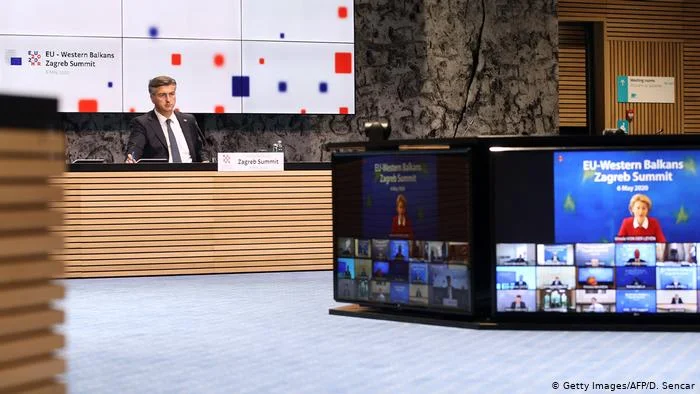
Zagreb's “Samat” this inscription on the post office following the rotating president of the EU Council, Croatian Prime Minister Andrej Plenkovic, seemed a bit provocative, even though he was the only participant in Zagreb, of the virtual meeting. He seemed a little lost, so he sat in the conference room of the National Library, by a large table built for 27 heads of country. There was only one wall in front of the participants from their desks. The “is a pity we cannot meet physically,” said Plenkovic.
The Croatian presidency had decided to make this summit of the 27 EU nations with the six Western Balkan countries at the peak of its sixth-month EU summit. Andrej Plenkovic, whose country joined the EU in 2013 as the youngest member, was particularly concerned about the summit with neighbouring Croatia. Twenty years ago, today's prime minister, then the new diplomat, attended the first summit of the then 15 EU member states with republics out of Yugoslavia.
Signal for Western Balkans
Corona's pandemic had thwarted plans for an amazing summit in Zagreb, but the political message had to remain the same. The Western Balkans remained a top priority for the EU”, EU Enlargement Commissioner Oliver Varhely had earlier said of Deutsche Welle. According to EU diplomats, the fact that participants needed three hours to keep their short speeches on his part was a success in the turbulent time of Corona.
27 heads of state and government reiterated their pledge that all six Western Balkan countries (Serbia, Montenegro, Albania, Northern Macedonia, Bosnia and Herzegovina and Kosovo) have a European “perspective”. According to the Commissioner for Enlargement, Varhely, this is nothing more than the prospect of full membership. In this summit, however, it was never mentioned when the moment will come to discuss new memberships.
No New Decision
Talks with Serbia and Montenegro have been in place for eight, six years, respectively, and are expected to begin talks with Albania and Northern Macedonia soon after the negotiation process has been reformed, under French pressure. Kosovo and Bosnia and Herzegovina still have a long way to go until accession negotiations begin. A Kosovo status agreement, which is not recognised by Serbia, must first be reached, but also by five EU countries. “I personally believe Bosnia and Herzegovina now deserves to be recognised as an official candidate for membership”, Prime Minister Plenkovic said, giving hope to the neighbouring state. But without giving a specific date. Because by June or October, there is still no agenda.
After the summit, EU Commission President Ursula von der Leyen made it clear once again that applicants themselves could influence the acceleration of negotiations. This is the incentive that enables the new methodology of negotiations. The sooner the promised reforms are implemented, the sooner we can open negotiating chapters. Meanwhile, several chapters at the same time, this is new,” said von der Leyen. Another innovation is that negotiations could be derailed sooner than before, if a candidate loses his zeal for reforms.
Aids to Overcoming Pandemia
The EU promised 3.3 billion euros in financial assistance to the Western Balkans to overcome the damage caused by the Corona virus pandemic. For the Western Balkans, the Union feels “a particular responsibility, especially in relation to the coronary virus”, EU Commission President Ursula von der Leyeen said. According to the head of the EU administration, the six states will receive more help from the EU than any other group of states. The EU also pledged in its final declaration to launch a broad investment plan for the region. But this plan was set in advance of pandemic.
“Many gratitude”
At the beginning of the Corona crisis, Serbian President Aleksandar Vucic expressed doubts that European solidarity existed, calling it an illusion. When the first aides came from China, he demonstratedly kissed the Chinese flag. From diplomatic circles it is said that some countries have demanded more gratitude from the Western Balkans for the donations made by the EU, but Croatian Prime Minister Andrej Plenkovic did not want to comment on a DW question at the virtual media conference he held after the summit. I cannot speak for the leaders of other governments, but it is very clear that the six countries are targeting the EU. This is their final target”, Plenkovic said. This summit helped to that end. “There is much gratitude in the region's capitals for what the EU is doing. And, if you look at countries, they're surrounded by the EU and they can't go anywhere else“.
In the summit declaration, EU countries urge the Western Balkans to adhere to Union foreign policy principles. It's about not allowing excessive influence from China, Russia or the US in the Balkans.
Croatia, as an organiser, recommended that summits in the Western Balkans be held regularly every two years. Ursula von der Leyen, the president of the Commission, expressed regret that she could not travel to Zagreb, but promised Prime Minister Plenkovic that she would also succeed a physical meeting. Kind of. Once upon a time, after Corona.