8 minutes ago
Businesses call for emergency response to their defence
Periskopi(6 years ago)
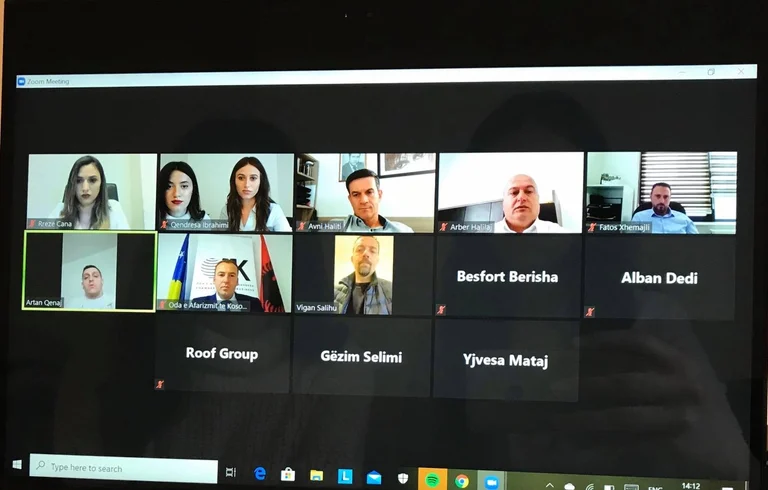
(6 years ago)The Kosovo Afarism Oda (OAK) held a virtual meeting with member businesses to discuss the challenges they are facing as a result of the pandemic and proposals for the recovery package, whose delay has caused major damage to businesses and their employees, as well as heavy [...]
The Kosovo Afarism Oda (OAK) held a virtual meeting with member businesses to discuss the challenges they are facing as a result of the pandemic and proposals for the recovery package, whose delay has caused major damage to businesses and their employees, as well as burdened by the pandemic situation.
During this meeting, some of the points agreed together that should be included in the economic recovery package, which would contribute to overcoming the situation.
Avni Haliti from the InterSoft A Computers business highlighted the challenges he is facing as business during this period, where even though he did not stop the exercise of activity on the part of institutions the problem was isolation, resulting in a lack of customers. Haliti also stressed the importance of close communication between institutions and businesses so that the packages will be as good as possible and this situation will be overcome with as little damage as possible. Even the critics did not miss the execution of the first package, which had caused widespread dissatisfaction.
Arber Halilaj representatives from the R&Rulcoli business stressed that the economic recession behind the pandemic is inevitable, whose size will depend on the duration of the pandemic in Europe and the way of opening the economy. The situation caused by the pandemic has also affected the supply and demand. Listing the damage that has been done to this business in particular, Halilaj unveiled several post-cavid proposals, including: reprogramming loans for at least another three months, subsidising operational spending for businesses, the state developing a loan guarantee programme through the credit guarantee fund, the importance and unification of the Albanian market, by removing all obstacles of tax or non-tariff barriers, thus stimulating export growth and production, and the aspect of the technical implementation of the recovery measures of other businesses as simple as being said by Hali.
Artan Dogaj of the Saranda Bread Saranda highlighted the decline of about 80% of the revenues, as there was a decline in customers as a result of restricting the movement of citizens as the business worked long hours. Also critical was the compensation of staff for the category of an additional 100 euros, which has benefited only workers in the ministry and not those in production, and at only 80 euros.
Vogan Salihu of Scan Cole Yysk stressed that there is still much uncertainty as to the execution of the first package in terms of subsidisation of wages for employees in the amount of 170 euros and compensation of rents, so stressed that it is necessary for the recovery package to be easy and applicable and insisted that it be much clearer.
As for the recovery package, it stressed the importance of providing long-term loans and with the gistperide at least a year, with 0 % interest that would help businesses. Subvention of interest for advance loan extensions, at least to a certain extent, would facilitate businesses in overcoming this situation.
Fatos Xhemajli of the Connect pointed out that business has worked, but their clients have been locked down during this time. Xhemajli stressed the importance of being unified and insistent on their demands so that they can jointly exceed this period.
Gezim Selimi from Misit Calabria Industries stressed the importance of supporting local producers and consumerizing their products, reducing tvs for 10%. He also demanded that the execution of payments from the marketing network take place in shorter periods so that the workers will operate without difficulty.
Besfort Berisha from business The AMC, which handles the renting of event management equipment, festivals, weddings and the like of the entertainment field, highlighted the fact that companies of these services have enormous impacts as events have stopped and many festivals have been put off for the next year and many have been completely cancelled. This means that over a year it will affect staff reduction and infertility during this period, so at least for the preservation of professional staff it is necessary to provide loans to cover staff salaries. This problem affects not only companies but also contractors. And the loans this sector has, it is necessary to postpone for a full year, as these companies cannot return the means unless they manage at least a full sector to function and generate access to plans, since their nature is active mainly in the summer months.
OAK, based on direct business demands, has prepared the document with proposals so that the recovery package can be a literal package that will be a business aid.