20 minutes ago
Hoor: Kurti is provincial, fails to understand international policy, undermine Kosovo reports - US
Periskopi(6 years ago)
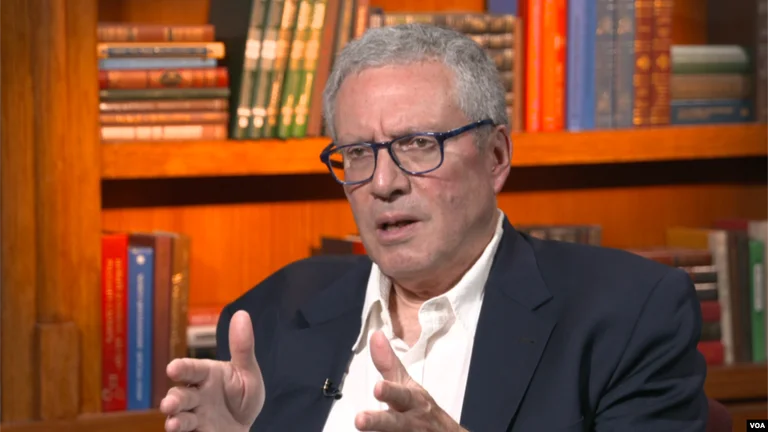
(6 years ago)Former US State Department official James Hooper says the US administration is aiming for a comprehensive agreement between Kosovo and Serbia, and that it is unhappy with the approach of Kosovo's now incumbent Prime Minister Albin Kurti's government. Hoor an interview for Voice of America says the aim is to end the Kosovo conflict [...]
Hoor, an interview for Voice of America, says the goal is to end the Kosovo conflict -- Serbia -- and if this does not happen, the risk for Kosovo is that I can lose the US military shield.
Voice of America: Mr. Hooper, the Kosovo Parliament brought down Prime Minister Albin Kurti's government with a no-confidence motion. Many Europeans voiced confidence that the United States helped radiate the government. What do you think?
James Hoor: I think that for the American government, for the administration of President Trump, the most important issue is an agreement between Kosovo and Serbia that would end their conflict. I don't think this is the most important issue for Prime Minister (Alb) Kurti. Actually, I think he's against it. I think the U.S. government has seen it as an obstacle, as a problem. The point is, it shouldn't have come to such a situation. Prime Minister Kurti, I haven't spoken to him for some time, but I know him and I think he's a very honest and deeply worthy man, but I don't think he's very good at managing international crises, managing and understanding how international and global situations work in managing international relations.
I think he has a flat view about how these things work and this is not a sophisticated view of how the international community works. And what happened is that he allowed relations with the United States to be endangered under his leadership. Now he is fragile in the face of accusations, and I think they are fair accusations that he mismanaged relations with the United States. I think there are many things in Kosovo that leaders can or cannot do and can be criticized or not, but as far as I know, relations with America are very important for Kosovo citizens, as I think the situation in Kosovo is important to the American government. I think he put himself in a position where he mismanaged and dried up his relationship with the United States and created a collision with the United States when there shouldn't be such a collision.
Voice of America: Have relationships really been damaged and to what extent have relationships been damaged?
James Hoor: I don't think they're seriously damaged in Congress yet. I think that in Congress there is a consensus on the situation in Kosovo and more tolerance for the situation. I think the administration's pretty damaged and it shouldn't have been. That's the problem I see.
Voice of America: Following the no-confidence vote, Prime Minister Kurti said the reason for his fall was the removal of the obstacle Kosovo President Hashim Thaci and Serbia President Aleksandar Vuciq to exchange territories as part of the final agreement between Pristina and Belgrade. American diplomats, Richard Green, Philip Costnet and Matthew Palmer then issued a joint statement saying that “has no secret plan for exchange of” territories between Kosovo and Serbia. What Is the Truth According to You?
James Hoor: There's no plan for division, and it's not something Mr. Vuciq and Mr. Thaci talked about. They have talked about new relations between Kosovo and Serbia. And those relationships would have a number of components, one of which included demarcation of borders. It also included Kosovo's membership in the United Nations and included the outcome of the conflict between Kosovo and Serbia. The issue for Kosovo citizens is whether they want to end the conflict with Serbia. That's what this deal involves and I think there's a deal between President Thaci and President Vuciq. There is a deal about terms of reference to end conflict. This will require demarcation of borders and for Serbia to be part of the European Union. This is a very important part. Everyone knows it and it's not a secret. I think it is in Serbia's interest to be in the EU and it is in Kosovo's interest that Serbia is in the EU, even if Kosovo does not join the EU at the same time as Serbia.
It is in Kosovo's best interest for Serbia to become an EU member, because when you become a member of the European Union, there are limits. You can't do whatever you want, but you have to consult partners and that's very good for Kosovo security. Kosovo will become a member of the UN when Serbia becomes an EU member. I think this is part of the deal. What Prime Minister Kurti is doing is defining this as a vote for partitioning Kosovo. Any closure of the conflict will have territorial components. This deal will have such components that will have implications for Kosovo and Serbia. If you see it as a separation agreement, if citizens see it as a separation agreement that's the wrong way to look at it. It will be an agreement to end the conflict with Serbia. The people of Kosovo should think about what they are willing to accept, what they are about to release, what to do to end the conflict.
Voice of America: Since the formation of Kosovo's new government was found under heavy pressure from the United States to lift tariffs on Serbian goods. US lawmaker Eliot Engel warned that, meanwhile, there is no pressure on Belgrade to end the campaign to attract recognitions of Kosovo independence. Why is that so, Mr. Hooper?
James Hoor: I still think it's a misunderstanding of the situation. In fact, it all started with agreements brokered by Mrs. (Cathryn) Ashton, the 2013 Brussels accords, which were supposed to be the first step towards a broader agreement. It wasn't meant to be the last step. It did not solve and aim to solve all problems between Kosovo and Serbia. What we saw is that the Association of Serb majority municipalities, which was part of the agreement, was not accepted in Kosovo. Serbia concluded that Kosovo cannot implement what they agreed on. Then Mr. Vuciq and Mr. Thaci decided to seek a comprehensive agreement, for there was no room for partial agreement. What Mr. Haradinaj initially and then Mr. Kurti did when he came to power, with tariffs tried to reach even a partial agreement. By imposing tariffs, they said they would withdraw if Serbia abandons the recognition campaign. This was an attempt through the side door for a partial deal. Americans saw that another partial deal won't work. Therefore, they want to lift tariffs to ensure the resumption of talks on a comprehensive deal. Vuciq is not saying he rejects any agreement. What he's saying is, if you try to understand it, and I don't think Mr. Kurti doesn't understand, Mr. Vuciq is willing to accept an agreement but to make it comprehensive.
Voice of America: But Serbian President Vuciq is looking for something in return, is he looking for Kosovo's north or not?
James Hoor: People in Kosovo must understand and have to decide on this; any agreement reached with Serbia will not be an agreement in which Kosovo meets all its maximum requirements. Kosovo must admit that it has territorial components in the agreement. Any comprehensive agreement should have territorial components. That's what Mr. Vuchyk is saying. But, he is seeking comprehensive agreements that included Kosovo's membership in the UN and the end of the conflict. People in Kosovo must decide whether they want to continue to insist on their maximum demands, which they will not win, I am clearly telling you, right or wrong, you will not win and it will not bring you any good to repeat them. This is what Mr. Kurt is saying, not those words. While Mr. Vucic is saying he is willing to accept a comprehensive deal, but no longer a partial agreement. I think Mr. Thaci understands that there's no room for partial deals, so the only way ahead is a comprehensive deal.
Voice of America: A comprehensive agreement without Kosovo's north?
James Hoor: A comprehensive agreement with territorial components that does not give Kosovo everything it wants.
Voice of America: What should Kosovo give up?
James Hoor: There will be territorial components in demarcation of the border. If Kosovo wants an end to the conflict with Serbia, it should be agreed with the fact that the agreement must have territorial components. Otherwise there won't be a comprehensive deal. Both sides must take much of what they want, but none of what they want. This is compromise. But there will be territorial elements in the deal.
Voice of America: Can you be more specific about the territorial elements, and has this been discussed in the White House?
James Hoor: I think the American administration understands very well the territorial aspect of the comprehensive agreement. If you see what Mr. Green is doing is trying to advance a comprehensive deal. I think he's frustrated with Mr. Kurt, who's still looking for a partial deal that won't be acceptable. What is being worked on is a new relationship between Kosovo and Serbia. That's what this is about, not a few kilometers of territory. For nationalists, and I think Mr. Kurti is nationalist, if you determine the issue that every centimeter of the territory is sacred and that we don't give up, that means you won't have an agreement, you won't have a new relationship with Serbia, you won't have comprehensive agreements that end the conflict and end the threat Serbia poses for Kosovo. Kosovo is not a threat to Serbia, but Serbia is a military threat to Kosovo. It is a threat to Kosovo's security. People in Kosovo should think more elaborately as they have done before, as they did during the war. What worries me is that some political leaders, and I don't want to be irreverent, I don't want to be negative, but I think Mr. Kurti's thinking reflects provincialism, reflects the lack of understanding of how things work in an international way. Again what is in the comprehensive agreement is a consensus between Mr Thaci and Mr. Vucic, that it will end the conflict with Serbia.
Voice of America: So to simplify this, this means that Kosovo must give territory to secure recognition from Serbia?
James Hoor: I think that to have a new relationship involving the end of the conflict, it means that people in Kosovo must accept that there are territorial components. Both sides can agree on it. Serbia must admit that it has territorial components and Kosovo must admit it has territorial components. At stake is Kosovo's security, the end of the conflict, UN membership, the strengthening of legitimacy and progress towards EU and NATO membership, that's what it is talking about here.
Voice of America: We have recently seen a deep divide between the United States and the European Union. How can such a division be explained, and what consequences can there be for Kosovo?
James Hoor: What the United States has seen is that if there is no progress towards the comprehensive agreement now, what will happen is that it will close the window and the possibility of such an agreement for 5, 10 or 20 years and maybe forever, it cannot be predicted. This administration doesn't want the window closed. There are people in Congress, Elliot Engel made that statement and he wants Kosovo people to understand that the United States does not turn their backs on them and that was a good statement. But the administration is driven by many things, but one of them is that if we leave this for better times, that means the window will be closed, there will be no comprehensive agreements and there will be no end to the conflict. Perhaps Americans feel that Europeans do not fully understand the possibility of ending the conflict.
Again, the problem is that if the conflict does not end and continues, the risk for Kosovo is that I can lose the US military shield. I don't think he has a European military shield, he has an American military shield, but this is already in danger. There have been many signs from Washington that the US government is getting tired of acting as a military shield for Kosovo. Kosovo must now act to maintain the progress achieved in the comprehensive agreement. Europeans, meanwhile, must face the fact that Serbia must get on a fast track towards membership in the European Union.
Voice of America: What is the future of Kosovo talks Serbia, and what is the right address for them? Washington or Brussels?
James Hoor: Both capitals should be involved because Serbia needs EU membership. It's part of Mr. Vuciq's view. I'm not saying that Mr. Vuciq is an ideal leader, but he has made progress and wants Serbia to be part of the West, part of transatlantic institutions. He is serious about this and wants to remove Kosovo as a determining issue, which any Serbian nationalist can take into his hands. Each agreement has three elements: reconciliation, ratification and implementation. I think there's a degree of trust between Mr. Thaci and Mr. Vuciq. They understand each other as leaders of nations that have been enemies. I don't think they're best friends, I'm not saying they are and I'm not saying they should be best friends, but I think they've found their way to be constructive, as opponents, to protect the interests of their countries and look forward to ending the conflict. I think they found understanding.
People in Kosovo should understand this and decide if they want to let this opportunity pass, because I do not believe Serbia will produce a better leader than Mr. Vuciq, however problematic it may be, he is prepared to bring Serbia ahead including the end of the conflict with Kosovo. Mr Thaci's drawn up point was whether Vucic can pass the agreement to ratify and implement. I think he's come to the conclusion that Vuciq can do this if Europeans and Americans do their part of the job. But Vuciq had the same question: if Thaci can implement it. What Mr. Kurt is trying to do is prove that Mr. Thaci can't do that. He is acting as an obstacle to the sweeping agreement that is not in accordance with his terms.
Voice of America: Can an agreement be expected before the American presidential elections?
James Hoor: You can expect an agreement before the U.S. elections if Mr. Haradinaj and Mr. Kurti don't block this. I think a deal's in front of my hands. I think the lines have been dropped and Serbian leaders and Kosovo leaders understand that. The vaccine is ready, he will implement it, he will make sure that happens. Kosovo's leaders are not ready yet, they are not willing to do so, and that frustrated the Americans.
Voice of America: And that's why Mr. Kurt fell?
James Hoor: I think that's why Americans are not sad that Mr. Kurti fell from the post of prime minister. I don't think there were tears of sorrow in the White House when the no-confidence vote passed through parliament. They're big issues in the game. The issue is the outcome of the conflict with Serbia that in the past led to war between NATO and Serbia, which was led by the United States. It was a big risk for President Clinton at the time. I don't think Americans want to see people in Kosovo stand aside and let the possibility of a comprehensive agreement that they have loved close. / VoA/