11 minutes ago
Seven things China has done to win the battle with the Coronavirus.
Periskopi(6 years ago)
(6 years ago)Chinese experience shows that Coddy-19 can be banned. China has already passed the peak of the coronary explosion, and this shows the new cases that are on the decline and the general situation of the improved epidemic. On Thursday China announced that nearly 80% of the 80,000 infected patients had recovered. By effort [...]
Chinese experience shows that Coddy-19 can be banned. China has already passed the peak of the coronary explosion, and this shows the new cases that are on the decline and the general situation of the improved epidemic. On Thursday China announced that nearly 80% of the 80,000 infected patients had recovered.
Thanks to difficult efforts, China has witnessed an internal tender in which the situation of preventing and controlling the virus is producing positive results. Life is moving towards normality, Chinese President Xi Jinping said. However, China still has to be alert to imported infections.
Below the window.net brings you seven things China has done to fight the deadly virus.
1. Full Answer

To combat an infectious disease, the first and most important task is the ban on spread. China, therefore, blocked the virus's epidera, Wuhan, where 10 million people live, on January 23rd. There were also some 60 million people in Cuba who faced restrictions on movement.
At the height of the virus, Hubei assigned 86 hospitals to treat the disease. Within about two weeks, he built hospitals on the ground, with a capacity of 2,600 beds for the seriously ill. The city added 13,000 beds to 16 other hospitals for people with mild symptoms. So far, all 16 temporary hospitals have been closed as patients have recovered.
The spread of the virus coincided with the New Year Lunar in China from 24 January to 2 February. The country launched a nationwide prevention campaign, urging people to wear masks, wash their hands often, self - control, and not gather in crowds. The drenched banderola was used to deliver sensitive messages throughout the country.
In China all fever patients, the major symptoms of the disease, were directed to clinics to prevent infection. Infected patients were sent to certain hospitals, depending on the level of severity. Tests were free, and hospital treatment was covered by health insurance. The National Health Commission in China released 7 publications with instructions on diagnostics and treatment of the disease.
2. Mass Mobilization

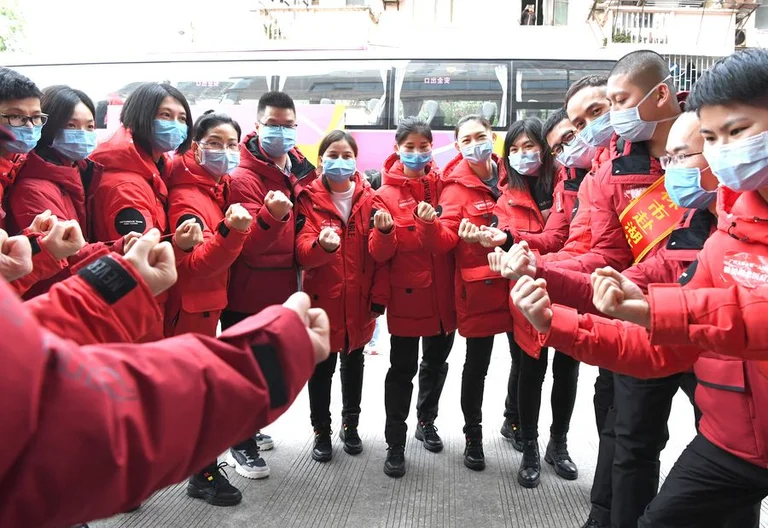
China's medical sources landed in Wuhan and other cities in Hubei following the heavy stroke of the Coronobrus. A day after Wuhan's closure, 450 military doctors assisted local doctors. About 42,000 medical staff from the rest of China were sent to Hubei. 19 provincial regions sent doctors to assist in the fight against the Coronavirus.
During the first stages of the explosion, doctors faced a severe shortage of supplies. Therefore, clothing, plastic, and other factories were converted into protective measures.
According to the Ministry of Industry and Information Technology, production in China of protective clothing rose to 500,000 pieces a day from less than 20,000 pieces at the start of the explosion. The daily production of N95's estimated medical masks increased from 200,000 to 1.6 million, while regular mask production reached 100 million. It also requires a 14 - day quarantine for anyone traveling to provinces or countries affected by the virus. The Chinese followed government rules, closed in and maintained social distances to maintain stability and public health.
Large cities like Beijing and Shanghai have strengthened the protection of people and set up emergency plans.
3. Political determination

On January 20, Xi ordered measures to prevent corruption from spreading, establishing people's security and health as top priorities. Following his order, China undertook sweeping and more rigorous measures for preventing and controlling the virus. Since January, the response to the epidemic was in order day in a series of leading meetings of China's Communist Party, led by Xi.
On January 25th, China's Prime Minister Li Badiang began running a leadership group to respond to the epidemic, and the country initiated an inter-institution mechanism. Daily reports are made about the number of patients diagnosed and suspected, for each city. While China's deputy prime minister has been overseeing field work.
Local officials who failed their responsibility to control the epidemic were fired. In February, party leaders in Hubei and Wuhan were replaced at the height of serious problems. On a visit to Wuhan on March 10th, President Xi vowed to win the war.
READ AND: Horoscope of March 14, 2020
4. Adapting to Temporary Policy

To curb the corruption of the coronobius, Chinese authorities canceled the New Year's celebration and held the schools closed. In February, China announced the postponement of annual sessions of national legislation and political consultations, one of the key events in the country's political calendar.
By January 29th, all provincial regions on Chinese territory had activated low emergency responses to the epidemic, the annulment of mass events, the suspension of public transportation, and the closure of tourist sites. When the situation began to improve, the provinces took different measures to resume economic activities.
According to a national directive, relatively low-risk regions should focus on preventing imported cases and normal beginnings of life. Middle-risk regions should promote regular work and production, while high-risk regions like Wuhan must continue to be fully committed to preventing and controlling the epidemic.
5. Economic Relief

To keep the economy on track, ministries and local governments have drafted policies to secure agricultural production in the spring season, facilitating business and employment function, with specific measures such as the landing and provision of social insurance contributions to employers. Authorities have kept consumer prices sustainable. China has about 170 million rural immigrants employed outside their homeland, and their return to work again presents an important challenge. Bus companies, high-speed trains, are planning to return them to safe jobs.
During mass quarantine, life goes on as far as it can, online. China has over 854 million people with internet access. Mobile payments and online services are wide-ranging, supporting daily needs amid the epidemic.
China also has 10 online medical platforms with over 100,000 online doctors, and some platforms offer free Q & A (Questions and Answers) to users in Hubei.
6. Transparency and Co-ordinated Action

Officials who were involved in the explosion of the Coronavirus faced a joyful checkup and pressured citizens to guarantee public security. On the international stage, Chinese authorities have pledged transparency and coordinated responses to global co-operation. On January 12th, China shared the virus genome sequences with the World Health Organisation after identifying pathogens on January 7th. So far, China has shared many files on epidemic control, as well as diagnostic plans and treatment with over 100 countries and more than 10 international and regional organisations.
It provided medical and test equipment for other countries hit by the virus, including Italy, the Republic of Korea and Japan. China also sent medical experts to Iran, Iraq and Italy to help in the battle against the virus.
7. The Power of Science and Technology

No one knew how to treat the new coronary. However, science and technology are the most powerful weapon in mankind's battle against disease. President Xi called for accelerated development of new-type testing boxes, medicines that serve as antibodies, diagnosis and treatment plans. It's even developing a vaccine.
Outside research labs and hospital departments, technology has also been very helpful. China has used robots to disinfect, fear to measure temperature and wider use of health codes.
Hangzhou was the first Chinese city to pass the QR codes for medical service. QR codes are linked to user electronic health cards and social insurance cards, facilitating everything from registration to taking drugs. Instead of filling out health report forms, residents can now show QR codes at the checkpoints. Thus, contact - free controls help reduce the spread of the coronary.