9 minutes ago
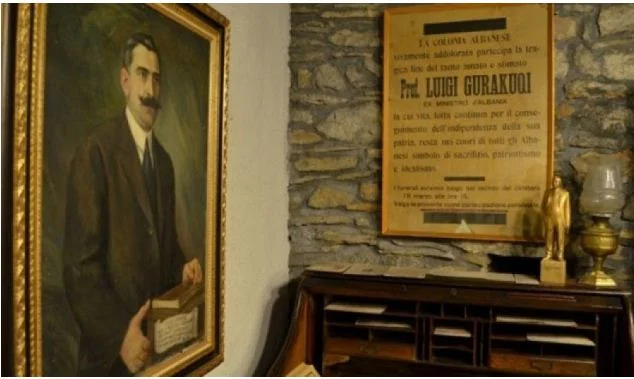
95 years from the murder of Louis Gurakuqi
Periskopi(6 years ago)
(6 years ago)Today, 95 years are filled out by the killing of Luigj Gurakuqi, national affairs activist, designer and signatory of Albania's Declaration of Independence, poet, educator, textologist, linguistic, diplomat, MP and Hero of the Albanian People. He wrote Albania's independence declaration. His hand wrote the alphabets approved by the Library Congress. It's one of the personalities [...]
Today, 95 years are filled out by the killing of Luigj Gurakuqi, national affairs activist, designer and signatory of Albania's Declaration of Independence, poet, educator, textologist, linguistic, diplomat, MP and Hero of the Albanian People.
He wrote Albania's independence declaration. His hand wrote the alphabets approved by the Library Congress.
It is one of the most remarkable personalities of our national, educational and cultural movement at the end of the National Renaissance and the beginnings of independence, experiencing the country's most peak events in the first quarter of our century in most of which, if not organising, was a direct participant. In his writings, he used the names of the Jachin Shkodra feather of Lek Gruda.
He was born in Shkodra on February 20, 1879, while a manuscript marks February 19, 1880, and grew up in the bosom of a school market family by parents Peter and Leze Gurakuqi.
His education took his father in a special way. Peter Gurakuqi was a relatively prominent merchant with a wide circle of friends and friends between the merchants and intellectuals of Shkodra, with an active life in the city market, and business dealings with Venice and Milan.
The home of this cultured and glistening merchant buzzed at the entrances of the people who came to discuss the problems of time and to learn about the world. Always located near his father, he listened attentively to conversations and discussions about events past and day, about the heroic wars of the people against Ottoman invaders and Balkan predators, and about the men who run them. Looking back these years, Gurakuqi student would write:
I'm fed up with their goods in the house and with their babe tue kallzue, as before, on the events of the Shkodre Carves, the mighty and the mighty men of Montenegro's war, the things that had been different from theirs, and that he himself had many without”
The incomplete and elementary school was attended at the Saverian College in technical and trade order, which was the most organised and completed school that Albania had at the time. Luigi was among the most diligent students of the school and very soon, when 13 years of age, Albanian-language trends and literary creations, the first mother-in-law wrote it 13 years old. From the Saudi colleague came out in 1897. It then complements secondary education at St. Minister Corona's Arber College, where there were teachers De Rada, who inspired him for the rest of his life; he was the first Albanian student there. The meeting with Gurakuqi recalls:
And he's like, "I can't stop at all with two teardrops, a warm kiss on that hand which worked for savé." ”
He picks up his maturity in Kozza for natural sciences, following and special courses in philosophy. He put in university studies in Naples (Italy) at the Faculty of Medicine in 1901-1906, where he met Jeff Schiroin, professor of Albanian Language and Literature at the Eastern Institute of Naples. The action of Skiroit Luigi would compile a preface that Konica would present to the French world with a beautiful translation into the period “Albia”. Consumed by the spirit dedicated to Albania, it is forced to leave its studies in half to devote the tide of national freedom to the name Leka Gruda.
With the work “ (Napoli, 1906) made the first successful effort to define the metrics of literal poetry. The same year, published in Bucharest the book “SAbbetar saw the mass of abschemit tʹSthamball with stories in both goats” and at Naples “French-French and French-Schip-Skip words” etc. Luigj Gurakuqi published many poetry that stands out for patriotic content, lyricality, and incarnation technique. With his articles, he also made an important contribution to aesthetic thought and literary criticism. As for his Albanian-language vocal, Father Justin Wheels «The broke-up language was well known to me as any shieldbag”.
The first concern with Turkish authorities occurred in 1904 because of a small publication on Albanian colonies in Italy “Two Coloní Albanian inItalí so far unknown” In 1905 he was forced to take the mountains to escape pursuit. All political guilt is forgiven by the proclamation of the Constitution.
In July 1908, he arrives at the popularly worshipped Shkodra, giving an Albanian speech in the presence of the Youth Tourist Committee, followed all the way home. In November, he attends the Monastery Congress, along with representatives from Shkodra: Father Fishta, Dom Mjeda, Hille Mosit and Matti Logorec; where he was elected deputy chairman and a member of the commission to unify the alphabet. Joining Fisten was the representative of “Beskim”, with Logoric they had the mandate to represent the Shkodrane intelligence, Luigji himself had the mandate to represent Italy's arabers.
Gurakuqi was credited with and directly leading the fight for the establishment of Albanian national school and our educational system. Under his direction, the first foundations of the state primary education system were laid in Albania. The first experience of the establishment of the Albanian education administration was created, the first school documents were drafted, a whole system of preparation and the qualifications of the missus s. His hand wrote the alphabets approved by the Library Congress and revealed them to delegates.
In October 1909 he was appointed director of the first normal school to open in Elbasan, where he made a valuable contribution to putting education on national grounds. Gurakuqi is credited with clearly defining, more than any predecessor, the concept of Albanian national school, its content, character and building principles. It required that the entire spirit and content of the school be in operation of national goals and ideals. Gurakuqi is the most prominent Albanian textologist of the beginning of our century. He gave the Albanian school as author and coauthor 8 textbooks with a volume of 738 pages.
He's forced to flee Elbasan, abroad with Saif and I saw Elbasan. In April 1911, she participates in the uprising of the Mazemands and, as one of her leaders, writes along with Father Mattie Pronushi Memorandum of Greca, or Red Book, as otherwise known to the rebels, whose arms fire would warn independence. In 1912, a intense event is held to organise the general uprising, present in Toskzer and later even near Kosovo leaders. He attended the Bucharest meeting, and would participate in the migration from Bucharest to Vienna. With the water given by the Austro-Hungarians accompanying Ismail Kemal down to Durres on November 24th at 4: 00 p.m., they left the next day with 25. One night they slept at Cherema at Dervis make Bicakciu, and one night in Fier at Omer Pasha Vroni. They arrived in Vlora on December 27 p.m.
In Vlora's Interim Government (December 1912), he was elected Minister of Education and established compulsory primary education for boys and girls. She attends the London Conference in 1913, with Ismai the Kemal of Isa Boletin. From the tense situation in middle Albania, as the resistance did not emerge productively withdraw to Shkodra with Saif saw the top of a Acting Rulerial Commission. With World War Shkodra occupied by the Montenegrin Army, Luigj Gurakuqi is interviewed in Podgorica from July 17th 1915 to January 1916.
During the Austro-Hungarian invasion, the presence of the Gen's XIX company. Trollmann is appointed director - general of education, opened many Albanian schools. He was one of the founders of the Literary Committee in 1916. Professor of Roman Philology at the University of Ljubljana, formerly prof. Univ. Gratz's in Austria, which participated in the works of this Komisie, Radomir Nachtingall, appreciates Gurakucin. There are outstanding merits in the development of English literary language, in the processing of literary language and in the unification of written Albanian, in the stabilisation of spelling, in the enrichment of vocabulary, in the matter of lexicology, the terminology and gramatology. Gurakuqi is the most prominent Albanian textologist of the beginning of our century.
Education continued to remain, as he himself says, the most loving branch of his heart. He outlined in the Albanian Parliament ideas and very interesting thoughts about educational policy and the way Albanian schools should follow. Gurakuqi had a clear vision of the school's role in a modern society, for freedom and fundamental rights of the Albanian school's education field, and urged development on the legal, scientific and professorial grounds. In the government issued by the Durres Congress, where the representative of Shkodra and Mirdit was appointed deputy Dr. Michael Turtwell at the Ministry of Education of Turhan's cabinet, Pasha Permet. Since the first meeting of the Durres Congress in 1918, L. Gurakuqi “) against a national meeting of the words to be made of tossk and the Christian Christian Christian” requires that such words be prohibited and adds that “...the issue of freedom and honor of religions in Albanian must be solved after formula: “FreeFe in free state”. In charge of this government as a member of its delegation to the Paris Peace Conference, where it stayed 15 months. Any letter used by the delegation was written by his own hands and by Mustafa Merlica.
The post of interior minister was also given in the cabinet several days of H. Pristina. These ideas of thought L. Gurakuqi discussed it in detail in discussions in the Albanian Parliament and, specifically, in the “Co-operation Bases between Albanians, Mimida and Christ”. It was fundamentally against those who thought that to remove religious conflicts that might arise, it should, with a mild and firm hearty manner, erase religious beliefs in Albania. In 1921-1924, he was the deputy of Shkodra at the National Council, where as one of the leaders of the democratic opposition fought for democratisation of the country's life, facilitating the farmer's plight from heavy oppression, economic and cultural development, and for the protection of independence from the slave goals of imperial powers. He remained faithful until the end of his life to see a united day around his mother's land all the brothers of the nation. He complained:
We've been taken from the cities and left the mountain, taken from the most valuable parts of the country, leaving us as a headless body”.
Sounds like fresh exposures to Gurakuqi's ethnic cleansing policy following Serbian chauvinists:
The Yugoslav government will not stop before any “vehicle,- it declared,- “to change Kosovo's face”.
For the very difficult situation of Albanians in the Yugoslav state, it blames the Great Powers, which made Albanians and their lands dry for their interests and allies. L. Gurakuqi is Partisan to help and maintain the rights of Kosovo's population. He considered it an important task of the Albanian state.
The only fault of Kosovars stood only in that they were Albanian and wanted to remain Albanian.
Among Gurakuqi's most powerful speeches in parliament are those on the protection of the Kosovo Albanian population. When the Yugoslav government in a telegram called the intervention in its internal affairs the Albanian government's interest in the very difficult situation of Kosovo Albanians, Gurakuqi, full of indignation and anger, would take word and say:
How could a government (Jugoslas) have planted our regions with the graves of our brothers, that we are involved in their internal affairs? How could a government tell me that we're getting involved in internal affairs, when we see that thousands of children and women are naked and naked here for Tirana and feed on American sevats and army surpluses. The Yugoslav government has no right to accuse us of such a thing when the Albanian Parliament only demands on behalf of humanity and humanity to stop Serb atrocities against Albanians. ”
On March 5, 1924, he became seriously ill with a severe flu that grabbed him about a month to bed. [13] The press gave him special attention, as long as Avni Rustemi told Dom Stuntojer “Oposor is resting: We've got the sick turquq”.
In the government led by Fan S. Noley was appointed Minister of Finance. It was noted for its high sense of responsibility and for the determination and efforts to create and strengthen the Albanian democratic state. He attended the Geneva Conference along with Noley in 1924. When in Parliament Ali Kelcyra notes his liberal positions, Lujigi answers,
“Z. Ali Kelcyra told me about being liberal. Thank you and can be sure that death will separate me from my liberal thinking”
Declaring democratic and liberal, Gurakuqi said that he is neither revolutionary nor socialist, concepts that were equivalent in the years of the '20s and meant violent changes, by force of arms, by uprisings. Mark Gurakuqi will write. He was brave. But he didn't like the bleeding. The turquqi was for peaceful resolution of problems through laws, resolutions “with justice and so gently”. As such, he opposed the introduction of the people into the path of armed rebellion. Having these concepts on the role of law, and the peaceful solution, rather than the uprising of violent resolution of problems, Gurakuqi was involved in the 1924 Movement, following a reluctance and strong opposition. His friend Mustafa Merlica-Kruja writes in letter with Father Paulin Marjukane:
“In the June 1924 movement has been opposed until it was not decided, has fought like Lou's to stop, tue prophets points to all the consequences that were later confirmed one after another. But, unfortunately, then when he did, he voted upstream and became minister with Fan Nolin”.
“Redwood withdrew (in revolution) following strong opposition. They can testify that they happened in Vlora”. He wrote Stavro Vinyu.
For his ministerial activity, we continue to read Vinyu:
“... as Minister of Finance of Cabinet Noley made miracles. He found 4 million unpaid gold francs; with his excellent administration, with his hesitations (designed state money more than his money) arrived that not only the new budget of the têja shuts down with a surplus of 1,000,000 gold francs, but all past-time state debts being paid; employees who for 2-3 years were used to getting paid with a three-month delay, achieved the last days of his administration paid regularly. And the budget equivalent did it without closing any useful pay in P's education. The world, without reducing the army and giving gendarmerie as much as I ask General Command. ”
After the printing of the June Movement, he went to Italy, where on March 2, 1925, he was killed in Bari from Baltjon Stamola at the door of Hotel Cavour, a cousin of Louis himself. It was the evening of March 2nd, at the hotel restaurant, Louis Gurakuqi was dining with two of his friends and one of their wives: Riza Dan with wife Makbule and his brother Dan Hasani. He asked them for permission to present his reason: I'm going to Sotiri, I promised a doll to his daughter. [20] In former finance minister's torn pockets, Italian police found only 350 lira. He started eating once a day with a refugee.
Luigj Gurakuqi's burial in downtown Hasan Pristina hailing his co-patriot
In organizing this assassination, both Ahmet Zogu, Ceno Kryeziu, and Cetin Saraci, reported by the letter initiated by the killer seeking help:
I request protection. Send cash to the Italian Government. Ask Cetin Sarachin where is...? “beta” Help! ...
His friend, Hasan Pristina, on his grave would say: the peaceful “Play Gurlade, the payback we will get with Albania's progress. ”
Italian authorities did not allow the funeral to be held in the city but only within the tomb walls. In those tragic moments of Gurakuqi's close friend Lin Kamsi preserved the garment with which he was killed <x0) white drancing” to leave as a memory to future generations. Albanian refugees from everywhere rushed to Bar. Talks were given by Sotir Gjika's husband, Mrs. Lilly Quarte, by Hasan Pristina, Lazarus Fundos, Becir Valter, etc.