11 minutes ago
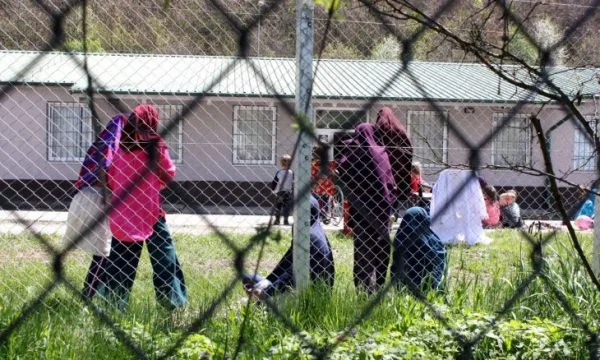
State unprepared to Treat Returns From War Zones in the Middle East
Periskopi(6 years ago)
(6 years ago)Kosovars who have returned from war zones in the Middle East have not been given adequate treatment for reintegration into society. The competent institutions are no longer dealing with these men, women, and children, since they were not prepared for their return and doordating. That is how experts are considering [...]
Kosovars who have returned from war zones in the Middle East have not been given adequate treatment for reintegration into society. The competent institutions are no longer dealing with these men, women, and children, since they were not prepared for their return and doordating. That's how they're considering safety experts and social policy experts until they put the emphasis on children.
Children returning from these countries are from Pristina, Suhareka, Lipjani, Ferizaj, Mitrovica, Kline and Gjilani.
Shukrie Gashi, executive director of the Centre for Conflict Management, Partners Kosovo, stresses that since 2016 they have been working to prevent violent extremism and reintegration into education and society.
According to her, there were not all professional capacities available for properly reintegration of these people.
“What we as an organisation during the field assessment we encountered was that among educators, social workers, psychologists and the central and municipal level, there has been a lack of proper information. Of course, as elsewhere in the world, populations have been hit by this phenomenon, as it is still difficult to build capacity and power capacity... (04:24) One category that I think remains the margin is women returning from war zones. I remember that these women need space to be given, that they can be more in touch with relief factors. And to break the partition wall between these women and the factors working in this field”, Gashi adds.
According to her, there are also very sensitive categories of children who are facing language difficulties.
Webi Mujku, from the Institute for Social Policy Development, stresses that with their return, the same had been held for only 72 hours in Vranidol. This indicates, according to him, that the institutions were not properly prepared for their return.
The children are still experiencing trauma, trauma almost constantly repeated. Because they have been part of the terrible events that they have seen there, and the social services in general in Kosovo are not prepared for their treatment and for providing psychological service and other social services they need. Meanwhile, Kosovo has enacted the Law on Child Protection. And under the Law on Child Protection, there are other definitions that affect these children directly. However, what is very important even now after a year and a half of the law's adoption in the Assembly, where the foundation of certain councils, committees, teams that need to work with these children is envisioned. And opening a house for the day stand, no one has been able to become so far. And this has greatly hindered the reintegration and rehabilitation of children”, he points out.
In the absence of such services, Mujk points out that children can be violent because they have grown up in war centers.
And security expert Kadri Kastrati says their return from war grounds has been a good initiative, but that
Says it wasn't working enough for rehabilitation of these kids.
We don't have information as citizens or as field of security and protection experts about how much they worked or what programs they had for these children, especially I'm saying for children because they grow up. They were born into a culture of another country, and we would need much more to do for these children, because they would grow up in Kosovo, and they could be potential risks to the security of our country here within Kosovo.
According to him, the Government of Kosovo would have to deal more with these people, to see they are employed, in courses and other areas.
The “these may be potential risks because they were in a war, were inspired by culture there. That war for us was not a fair fight, there were organizations or different groups. Someone calls them terrorist groups, someone calls them Wahhabi groups, somebody calls them by other names. For us it's a potential danger to society, because we don't know what their mission is, we don't know what tasks they've taken. We are witnessing that radicalism is increasing from over”, Kastrati adds.
While international expert Moshe Landsman days ago in publishing a report has stressed that the interviewing process has been difficult, and coming to sessions with mental health professionals, since many of them have poor economic status.
“10 percent, 7 or 8 of them are growing by grandparents or other relatives, and that is because both parents have died, or for some reason they are not able to care for their children. These children seem to have fewer problems than those who were raised in their original families, originally in terms of integration into society. They are less exposed to extremist propaganda. At the moment, most children are in schools, in classrooms that are lower than their age, because they never went to school in Syria. When most of them returned, they had problems learning English, and then we had problems with school curriculum. And the logical conclusion was that they should be placed in schools lower than they are of age. Some schools have not even put them in regular classrooms. They have only received private lessons or lessons between”, Landsman stressed.
Landsman has stressed the need for help in teaching all these children who are left behind in this regard. According to him, the main issue with these children is the trauma these over 70 children have experienced from war grounds.
The overwhelming majority of them have post-traumatic shock disorders where professionals should be taken. There's a question of the issue of religious indoctrination, we've interviewed two religious experts, they're both imams, even though one of them doesn't think it's a profession. They had contact with families when they first returned, but then they were rejected by families and now have fewer ties with them. But children seem to be slowly integrating into their classroom environments by teachers. Perhaps when you live in an environment, you do not understand how culturally changed he is. All schools have pictures of the prime minister and president on the wall. Some of the children have opposed this because they believe Islam prohibits photo”, he said.
Men of all women actually took place in prisons, and the latter refuse to contact even in case of need. International expert has demanded the provisional release of arrested men who pose no problem, because according to him, these should be economically empowered and work. Among other things, he has sought psycho-social treatments for all children, since the same are facing post-traumatic disorders.
However, in a written answer, Aferdita Jaha from the Ministry of Education and Science has denied that there are children who are not integrated into the education process. According to her, all Syria-turned children are integrated into schools.
All children returning from Syria are integrated into schools and pre-school institutions. Children whose age is older than their previous age with the Law on Pre-university Education is locked in intensive learning. Based on MPB data, 74 children have returned from war centres, from which 36 children are under the age of 0 to 3, while 29 children at pre-school and 24 in schools today have begun to process education and are expected to soon integrate 9 children into gardens. The teachers are trained MASH trained. But there's still training work. And psychologists are also trained. In schools where there are no psychologists, the directorate communicates with the municipality and assigns psychologists”, Jaha reports.
These communities and institutions that provide social services are required to be equipped with psychologists and professional quartet equipment in order to work with these children.
Meanwhile, in April last year, 110 Kosovars had returned to Kosovo from war grounds in the Middle East. Among them were 74 children, until some of Syria's children were without parental attention.