3 minutes ago
The EU denies being blocked dialogue, the next meeting “but as long as conditions”
Periskopi(6 years ago)
(6 years ago)Kosovo and Serbia are officially involved in the dialogue process for normalising the reports, mediated by the European Union, but that a meeting at the level of leaders, scheduled to be held in late September, has been repeatedly postponed, under the argument of “deadlocking from the pandemic”. But the coronary pandemic has not prevented the October 29th meeting. [...]
Kosovo and Serbia are officially involved in the dialogue process for normalising the reports, mediated by the European Union, but that a meeting at the level of leaders, scheduled to be held in late September, has been repeatedly postponed, under the argument of “deadlocking from the pandemic”.
But, the Corleone pandemic has not prevented the meeting of October 29th, of Kosovo and Serbia delegation chiefs Skender Hyseni and Petar Petkovic in Brussels, where they have discussed resolving financial claims and property issues between the two countries.
In Brussels, they insist the dialogue has not been blocked.
“Since the resumption in July, dialogue is continuing and advancing with expert meetings and at the political level. The next political summit will be called to Brussels, but as soon as conditions allow”, EU spokesman Peter Stano told Radio Free Europe.
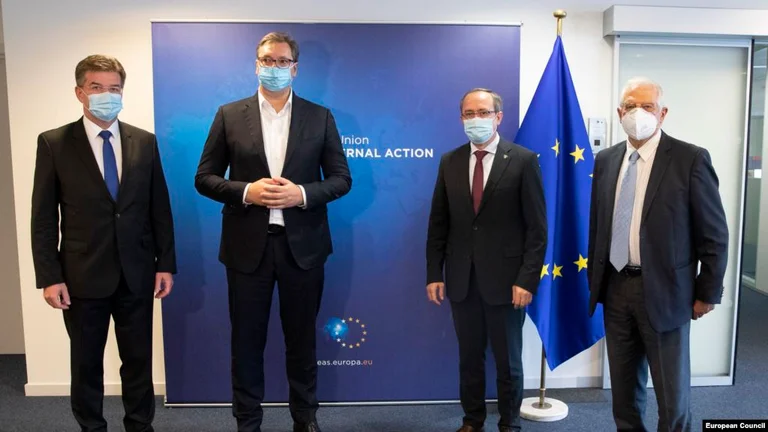
The meeting between the leaders of Kosovo and Serbia, in the EU-brokered dialogue. Brussels, September 7, 2020.
Kosovo government says sʹka blockade
In the Government of Kosovo, delays in dialogue are exclusively related to pandemic.
Because of the second wave of COVID-19, Brussels is closed for meetings. There is no other obstacle. Preparations are continuing for meetings of technical groups once the” circumstances are created, Kosovo Prime Minister Avdullah Hoti declared Radio Free Europe.
According to them, there is currently no date set for any future appointment.
Kosovo Prime Minister Avdullah Hoti and Serbia's President Aleksandar Vuciq have met for the last time in Brussels on September 7th, where the Serbian president had also raised the issue of the Association of Serb Major municipalities -- a body that Serbia seeks to have executive competencies -- that would manage a range of issues for the ten Serb majority municipalities.
After returning to Kosovo, Prime Minister Avdullah Hoti had declared that the issue of association would not return to the negotiating table “since it is the closed issue”, but Serbia calls dialogue meaningless if this issue is not discussed.
Pandemia, just as a pretext?
Political analyst Agon Maliqi estimates that the reason for the postponement of meetings in Brussels under the pretext of pandemic does not stand. According to him, the longer delay is the reflection of the lack of content in dialogue.
The first “, Serbia is making efforts as usual to delay and drag back dialogue, and at this point it is not facing any intense pressure. Second, Kosovo is in a phase of political chaos and the government does not have the weight to push this process forward. Dialogue has probably not been interrupted, but it is without dynamics and expectations of clarifying the situation with the Government of Kosovo whether we will have reconfiguration of the government, or new elections”, Maliqi told Radio Free Europe.
He thinks both sides, however, are also waiting for the start of the new US administration's work.
“I think everyone is waiting for something more container in the spring”, Maliqi stressed.
In Kosovo, the main partner of the Democratic League of Kosovo in the government, the Alliance for the Future of Kosovo, had called for the immediate interruption of dialogue, following the first arrests by Specialised Chambers in The Hague.
Also, Kosovo President Vjosa Osmani's duty to Kosovo has been requested by the government to discontinue dialogue.
But, Prime Minister Hoti in an interview for Radio Free Europe on November 10th, sharply rejected calls for the interruption of dialogue with Serbia.
There are two solutions: either we can keep the country isolated and complain in Pristina with press statements, in press conferences, or we go to Brussels and sit at the table of dialogue and defend Kosovo's state interests. I've chosen this second”, Hoti said.
Besides the ruling partner, even opposition parties -- the Vetevendosje Movement and the Democratic Party of Kosovo -- oppose continuing dialogue with Serbia.
Dialogue without epilogue?
Political analyst Agon Maliqi sees this kind of dialogue as very difficult to bring the final agreement on the normalisation of reports.
I am skeptical because they have entered a dead end, where compromises cannot be implemented by this government can't be implemented, but from what will be”, Maliqi said.
Of the need for changing the Constitution on the part of Kosovo, Kosovo had spoken at a news conference in Belgrade, the special representative for the Kosovo-Serbia dialogue, Miroslav Lajcak. He had said that in a serious negotiator process, “is logical that will have to change the Constitution”.
In this context he has added that Kosovo will implement all obligations it has taken over in Brussels, including the establishment of the Serb majority municipalities' association.
After this statement had prompted reactions in Pristina, EU Foreign Policy and Security spokesman Peter Stano had told Radio Free Europe that Lajcak's statement was misinterpreted, as constitutional changes apply to Belgrade as well.
When an international agreement is reached, then the necessary legal arrangements by the government, including the constitutional level, should be considered, in order to integrate it into the legal and constitutional order, and apply to Kosovo and to Serbia”, Stano stated.
Meanwhile, on November 23rd, Kosovo President Vjosa Osmani's taskperson, has told European Union Office in Kosovo chief Thomas Szunyog that the EU should seek amendments to the Constitution from Serbia, rather than Kosovo.
It has added that to implement the agreements reached in Brussels, co-ordination and unification of the entire political spectrum positions in Kosovo is needed.
The final agreement should be in the interest of the citizens of Kosovo and such as respect the Constitution of our country, territorial integrity and the principle of the unitary of state. No one has a mandate to renegotiate our constitution, which already in itself includes many concessions”, Osmani said, according to a communique issued by the president's office.
The Problem With the Acscoction Agreement
Otherwise, the Agreement for Association of Serb-run municipalities was reached in 2013 under the first agreement between Kosovo and Serbia, brokered by the European Union.
Under this agreement, the Association said that it should be established on status and established on the same grounds as the existing Constitution of the Association of Kosovo municipalities, such as the mayor, deputy chairman, Assembly and Council.
The association envisions full access to areas of economic development, education, health, urban and rural planning and will exercise additional responsibilities, depending on how they are delegated by the central authorities. The association of Serb majority municipalities is designed to gather around itself ten municipalities in Kosovo, where the majority of the population are Serbs, who are North Mitrovica, Klokot, Partesh, Ranilug, Gracanica, Zvecan, Zubin Potok, Novoberda, Leposaviq and Shrpca.
In 2015, Kosovo and Serbia reached the Agreement on the principles for the establishment of this association, which the official Pristina has not yet implemented, despite Belgrade's insistence.
But, in October 2015, then Kosovo President Atifete Jahjaga sent for interpretation at the Constitutional Court of Kosovo Agreement on the principles for establishing association. The court found that this agreement, at 23 points, was not in harmony with the Kosovo Constitution.
The court had ascertained that the Association of Serb majority municipalities would be established, as envisioned with the first Brussels Agreement (of 2013), ratified by the Kosovo Assembly and proclaimed by the president of the Republic of Kosovo (v.j. Atifete Jahjaga, while the Agreement on Principles (for the establishment of Association, reached in 2015), is not entirely in accordance with the spirit of the Constitution.
Official Pristina insists that association should be established in accordance with the Kosovo Constitution, meanwhile, the Serb side demands that it have executive competencies.
Dialogue between Kosovo and Serbia, with EU mediation started in 2011. This process has started as a technical dialogue where dozens of agreements have been reached, already recently evolved into the political process and aimed at “the normalisation of relations between the two countries” through a legally binding agreement.