12 minutes ago
Kosovo government criticised for shutting down a police department
Periskopi(6 years ago)
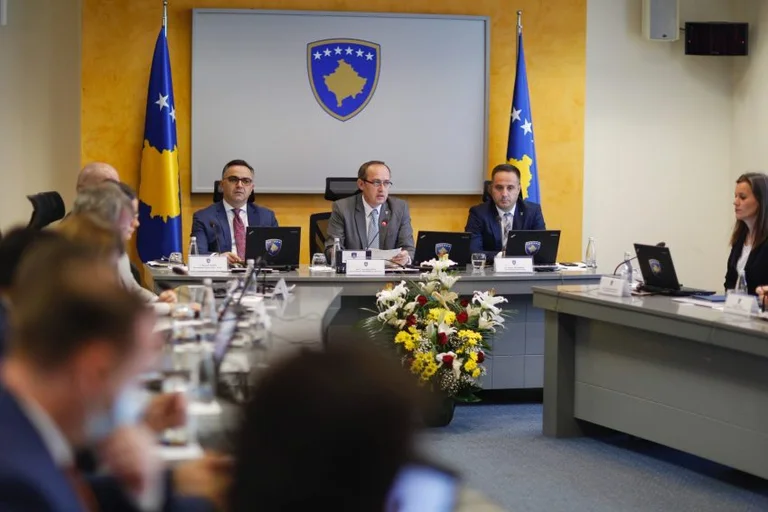
(6 years ago)The Kosovo government today will hold the next meeting, where, among the agenda points, there is the extinction of a Special Anti-Corruption Department in the Kosovo Police. This has prompted reactions at the Kosovo Institute for Justice (IKD). IKD through a media communique says this decision conflicts with [...]
The IKD through a media communiqué says this decision conflicts with the process of the Functional Review of the Law Rule Sector, rejects all investments made by international partners in the profile of investigators in the fight against corruption, and presents the worst message to independent institutions that anyone acting in opposition to policy interests will have the same destiny.
Full communication:
Kosovo's government on the agenda of the government's upcoming meeting on October 19th 2020, at 6th (6th) on the agenda has defined “Reviewing the proposal to abolish Government's No decision. 02/110 of February 26th 2010”, which the decision had established the anti-corruption force under the Kosovo Police Task Force.
On February 26th 2010, the Government of Kosovo in co-operation with EULEX had asked the Special Prosecutor of the Republic of Kosovo (PSRK) to establish a special Anti-Corruption Department in terms of investigating and combating corrupting phenomena in Kosovo.
The Kosovo government for this purpose had taken over the selection and recruiting of 30 Kosovo Police investigative officers who would be directly engaged in the investigation into cases, which would be investigated by the Special Department Anti Corruption. PSRK's.
The operation of the Special Anti-Corruption Department, which is publicly known as Task Anti-Corruption Force under the Kosovo Police, acts as a specialised unit under the investigation department and is monitored by P SRK.
This task force was established through the Government's decision, February 26, 2020, and for the way it functions, this task force is the kind or precedent of judicial police within the framework of Kosovo's justice system.
With the aim of functioning this Task Force, the United States of America and the European Union through their mechanisms, have trained and specialised almost all 30 police officials serving in this mechanism in order to be able to investigate high-level corruption cases and financial crimes, and to serve as an efficient tool of P SRK's in investigating and prosecuting high-level corruption.
Since the functioning of this Task Force, the most complex and high-level cases, which have been political figures of key parties such as PDK, LDK, AAK, other parties and top public officials have been investigated by this Task Force.
In this direction, the Government's decision to consider the possibility of abolishing this Task Force without any public consultation either on the institutional level or in the report with international partners and civil society can be seen as revenge of politics against officials of this Task Force.
Moreover, in terms of this Task Force's work every year, the European Union's Progress Report has demanded that Task Force's work be promoted, including the requirement that this Task Force be specialised further to exercise its term in the service of the SPRK.
The Kosovo Government's decision also contradicts the process of functional Reviewing the Kosovo Law Rule Sector, which has made the process detailed assessment of the work of Task Force, offering concrete recommendations to improve the integrity and performance of this Task Force, but in no circumstances its extinction and decay.
Under policy documents issued during the Kosovo Law Rule Sector Functional Review Process, the document addressing this task-force is document “Enhancing the Institution Framework for Combating Corruption”. This task force is also discussed in the “Kosovo Police Integrity” document.
The need for this task force in no case counters none of the official Review documents, but that in relation to this task-force, as specific policy documents issued under the functional Review identify the lack of procedural provisions for conducting joint investigations by P. SRK and DSAK or Task Force. Also, according to the document of the Functional Review, the specific problem is also identified if there is any co-ordinating and co-operative mechanism between the DSAK and the Offices of Basic Prosecutors.
In the face of these two specific problems, the Functional Review Document recommends improving DSAK's work or the task-force in question.
In fact, under recommendation 7.2.3. The “Enhance of the Institution Framework for Combating Corruption” is detailed the activities that should be undertaken and expected results in the event of improved DSAK or the Anti-Corruption Task Force.
In this direction, the Kosovo Government's tendency to eliminate institutions that operate for more than 10 years in the fight against corruption, without public analysis and consultation with competent actors in Kosovo, is seen as revenge of the Government for investigations conducted by this Task Force against a large number of members of political parties that have leadership positions, particularly PDK, LDK and AAK, cases which have largely failed in the bodies of prosecution and judiciary.
The decision to erase this Task Force enters the continuation of the government's ad hoc decisions and the dismissal of the Police Director, Kosovo Tax Administration Director and Kosovo Customs Director, without adequate analysis, without adequate public information about the basis on which these decisions are based, and who are perceived in public as means to apprehend the main law enforcement institutions in Kosovo that have the competence of fighting corruption and criminality.
The IKD recommends the Government of Kosovo, not to take unilateral action, directly violating its policies by making decisions that are understood in public as decisions made in order to capture independent institutions. This decision to erase Task Force, conflicts with the process of operational Review of the Law Rule Sector, rejects all investments made by international partners in the profile of investigators in the fight against corruption.