2 minutes ago
Jovanovic: The bomb in my car was the same as the one that exploded on the Serbian bus in Podujevo in 2001
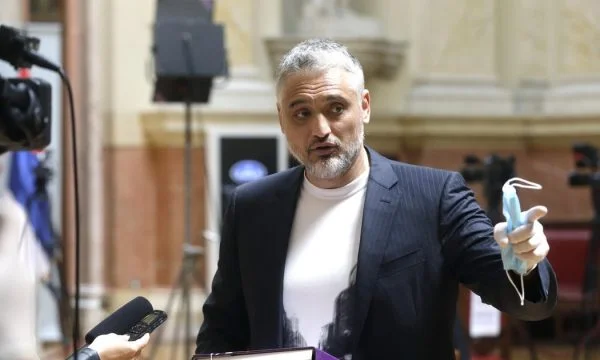
Periskopi(6 years ago)
(6 years ago)One of the opposition leaders in Serbia, Cedomir Jovanovic, has declared that the deliverive tool with which the attempt to strike him was carried out in Belgrade in 2001 is similar to the “that exploded on the bus with Serbian travellers in the vicinity of Podujevo”. The explosion in Jovanovic's car occurred on February 6th [...]
The explosion in Jovanovic's car occurred on 6 February 2001, at the time he was chairman of Serbia's Democratic Opposition of Serbia parliamentary Grub (DOS) several months after Milosevic's fall power and Serbia's leadership by democratic forces led by former Prime Minister Zoran Djindjic. Speaking on a controversial Cyrillica show in Happy- Belgrade's TV, on October 5, 2020, has not provided details other than the interconnection of the explosive vehicle his car had been destroyed with on the Nis-Express bus near Podujevo.
You know how the whole thing turned out? They wanted it all to look like Frankie did it. Because it was a meeting of the Police Minister with the deputy head of the State Security director Franco Simatovic and me. As a politician, I participated in telling him (Frenki Simatovich, C.) that he will retire and can no longer be in his position. I told him that. That meeting lasted 15 minutes. I got down, I got into the car, I led her no more than 3 minutes away, as far as I had to lead from Lajkoviceva Street to Avala Street, near the Church of St. Sava, and as soon as I got out of a car, she exploded, as soon as I entered a passage. Ten more cars were destroyed by the explosion in the retina. Asphalt melted. The same bomb exploded on that bus he carried, several days later, Serbs at the winter religious ceremony, near Podujevo. The same bomb was used. Now you conclude who did it”, Jovanovic said on the Cyrillica show.
The attempted assassination against Cedomir Jovanovic in 2001 was named by then Serbian Prime Minister Zoran Djindjic, “, an event related to government policy and its fight against corruption and organised crime”. Former Yugoslav State Secret Service head Jovica Stanisic, commenting on the case of the explosion in Jovanovic's car, has stressed that “Somebody from our agency has made it”.
Meanwhile, the explosion on the bus of Nis-Express, which carried 250 Serbs to a religious ceremony in Kosovo, occurred 10 days later, on 16 February 2001, in the vicinity of Podujevo. At least 11 Serb citizens were killed and dozens more injured after the blast. The international news agencies reported that “bomba had been placed on the bus and turned by correction”. The bus column with Serbian travellers was under the framework of NATO's peacekeeping forces in Kosovo, placed under UN administration on Security Council Resolution 1244.
The British news network BBC has reported that “a bomb controlled by correction has exploded 400m off the road, around noon, hitting the first bus of five people crossing the border in Kosovo from the direction of Nis of Serbia”. International media reported that the “restrests -- who are trying to expel Serbs from Kosovo -- are charged with attack”.
A panel of international judges in 2008 had sentenced a Kosovo Albanian to 40 years in prison for the attack on Nis Express bus, naming “the worst attack on Kosovo Serbs”.
Cedomir Jovanovic and the leader of the Social Democrats of Vojvodina, Nenad Canak, on Happy Tv's Cyrillic show have discovered that on the territory of the Republic of Serbia, since after the Kosovo war, over 16 mass graves have been discovered, which have been hidden from all regimes in Serbia since the collapse of the Milosevic regime. Finally Serbia's own foreign minister has confirmed reports of their existence in the same Happy TV show.
There are also over 1600 missing persons in Kosovo, since the end of the 1999 war, whose fate has never been revealed.