4 minutes ago
US names historical, while EU “surprised” with agreement
Periskopi(6 years ago)
(6 years ago)The European Union has not been involved in reaching the agreement in principle for opening the direct airline between Pristina and Belgrade, Radio Europe free of reliable sources within EU institutions. Numerous sources have confirmed for REL that EU officials have learned through the media that [...]
Numerous sources have confirmed for The REL that EU officials have learned through the media that Monday in Berlin the agreement was signed and that they were engaged in “befasi” with this information.
The EU has not reacted at all Monday about signing the principled agreement, such as Brussels' until-the-art practice whenever there was any positive news connecting with Pristina relations, Belgrade.
The reaction from Brussels came Tuesday to the press conference following journalists' questions on the issue. There, chief of European diplomacy spokesman Peter Stano spoke of the commercial side of the deal.
EU High Representative Joseph Borell's spokesman, Joseph Borell, has not particularly welcomed the agreement, but has said it represents the positive “syal”.
“The EU supports all ties in the region that strengthen communication between Serbia and Kosovo. This is a way to advance the normalisation of the relationship between Belgrade and Pristina”, Stano said, under which opening an airline will not influence or change the EU's position on Kosovo's status.
United States President Donald Trump has called the deal to establish direct flights between Kosovo and Serbia a victory.
The American Embassy in Pristina has written on Twitter profile that “President Trump and his team have worked hard to reach this agreement, which is just the beginning of a bright future for our friends, Kosovo and Serbia”.
Recently, the United States of America has made moves towards increasing their role in the process of dialogue between Kosovo and Serbia by appointing US Ambassador to Germany Richard Green, special envoy of President Donald Trump, for peaceful negotiations between Kosovo and Serbia.
The negotiation process, launched since 2011, was interrupted after the Kosovo government in November last year imposed a 100 per cent tax on products originating from Serbia and Bosnia and Herzegovina.
After signing the agreement for opening the line of direct flights to Pristina Belgrade and vice versa, Kosovo and Serbia expect that this agreement will soon be experienced even in practice.
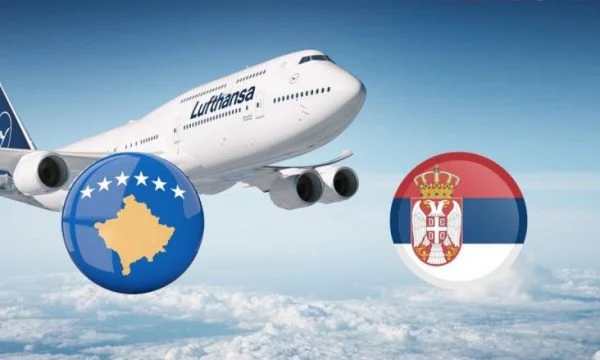
The agreement for the Pristina airline, Belgrade, is signed on 20 January in Berlin. Delegations from Pristina and Belgrade, with the mediation of American diplomats, have signed agreements with the German company, “Lufthansa”, which will operate on this line.
Belgrade Airlines Pristina aims to normalise air space and air traffic in Kosovo. The establishment of this line, according to a media communique of the Kosovo Civil Aviation Authority, could take place after arrangements between aviation authorities and NATO under the mechanism for normalising the airspace of the Western Balkans.
The director of the Agency for Air Navigation Services (ASHNA), Bahri Nuredini, free, hopes that this line will be functional very soon, though he recalls that some technical procedures have remained for her living.
He says Belgrade Airport can also be used as passenger destination to travel to different countries of Europe and the world.
The passengers also have the right to select different destinations through different airports. Of course, this too should be one of the options and opportunities that through Belgrade Airport fly to destinations as needed and required of passengers. Or even vice versa via other Belgrade lines to come to Kosovo to develop various family, business activities and whatever they are”, Nuredini says.
Air flights between Kosovo and Serbia were cut off in 1999. At the time, Serbia lost control over Kosovo after NATO bombings in 1999 aimed at protecting the civilian population and ousting Serb forces, thus ending the war in Kosovo.
Regarding the agreement reached, which aims to reopen direct flights, Nuredini says Pristina-Belgrade flights and vice versa will be realised on old air routes, those used before 1999.
Air Company “Lufthansa” will operate on this line. As a result, this corridor will cut even flight time. The road distance from Pristina to Belgrade is 350km, about four hours by car.
Citizens in Kosovo give different opinions about security and the possibility of flights from Pristina to Belgrade. Safet Beqiri, says that in case of travel to Belgrade or any other state, this line would cut travel time.
“Airlines between Pristina and Belgrade is good. If I need to go to normal Belgrade I use the airline. I prefer airlines than car trip”, he says.
Even Dejan Pavicekeviq from northern Kosovo, says that with implementation of this agreement, it is easier to travel to Belgrade
I like the decision because I can now come from Belgrade to Mitrovica. It is easier to go to Pristina (Pristina International Airport) by taxi or bus. Travel hours are cut short. I don't care about the political side, but only the most practical stuff”, Pavicevic says.
But there are also citizens, such as Zepa Elshani, who do not prefer this line to travel.
I don't like this line and I'll never use Belgrade Airport”, she points out.
And Fehmi Kursumlija, from the Bosniak community living in the northern Mitrovica municipality, considers the deal a hit.
“is not a bad idea, why not, let people be released and travel cheap”, he says.
Along with top political leaders, the agreement has welcomed economic subjects as well.
Kosovo's Economic Oda and the American Economic Oda in Kosovo said they welcome the latest initiative for the resumption of commercial flights between Kosovo and Serbia.
In a joint communiqué, it is said that these Oda consider it a step forward in improving inter-ethnic relations and freedom of movement of people and goods between the states of the Western Balkans region.
The regional economic co-operation would only improve the perception of the region in the eyes of foreign investors, so the resumption of flights would provide vital economic benefits, as well as contribute to normalisation of relations between Kosovo and Serbia, as well as the region as a whole”.
For now, all flights to Pristina are performed only through an air corridor linking the Republic of Kosovo with Northern Macedonia.
The new corridors would cut flight time by about 15-20 minutes, cut the cost of operating for airline companies, which would therefore have to be reflected in cheaper tickets to our travelers.
Kosovo still does not have Kosovo's high air space in management. In line with UN Security Council Resolution 1244 and the 1999 Military Technical Agreement, but also with current laws in Kosovo, KFOR mission commander, respectively. NATO, is responsible for the security of Kosovo's airspace.
Kosovo's low air space under the flight level of 205 to 6205 metres is managed by the Kosovo Air Navigation Services Agency, while high air space above flight level 205 to 6205m, has been reopened for civil flights on April 3rd 2014 and is under Hungary's control, respectively, of HungaroControl, which offers technical traffic control services at this height.